America’s Youth Suicide Crisis: How An Unprecedented Epidemic Spiraled Out of Control

by Vignesh Subramanian, May 15, 2024

In 2023, the Centers for Disease Control and Prevention (CDC) published up-to-date data on suicide rates among American youth that stunned public health and medical professionals nationwide. The federal report, issued in June, found that the overall suicide rate among U.S. youth ages 10 to 24 had surged 62% over the prior two decades (2001-2021), after decades of prior decline (Curtin & Garnett, 2023). On average, 11 young Americans died by suicide out of every 100,000 each year during this period; for children ages 10-14, the suicide rate had tripled from 2007-2018 (from 0.9 to 2.9 people per 100,000); for adolescents ages 15-19, it rose 57% from 2009-2017 (from 7.5 to 11.8 people per 100,000); and for young adults ages 20-24, it rose 63% over the entire period (from 11.9 people in 2001 to 19.4 in 2021 per 100,000). The findings painted a stark picture of a nation in the throes of a full-fledged crisis, with millions of its young people suffering in silence and thousands compelled by circumstance to take their own lives. 

Yet this grim milestone was seen by many as preceded by years of warning signs. Well before the COVID-19 pandemic, CDC reports noted that suicide rates among U.S. youth ages 10-24 had jumped 57.4% from 2007-2018 (rising from less than 7 deaths per 100,000 to nearly 11), with even such states as New York, New Jersey, and Massachusetts – widely viewed as having strong safety nets for at-risk youth – seeing increases in youth suicide rates ranging from 40% to 60% over that single decade (Curtin, 2020). The issue notably remained pervasive for young Americans of all ages. Between 2007 and 2019, the suicide rate among pre-teens ages 8 to 12 surged a disturbing 166% (Penfold, 2021), with 8.4% of children as young as nine and ten years old reporting suicidal thoughts and 1.3% even making attempts (Janiri et al., 2020). From 2018-2019, 18.8% of adolescents ages 12-17 seriously considered attempting suicide, with 15.7% making a suicide plan, 8.9% attempting suicide at least once, and 2.5% making an attempt that required medical treatment (Ivey-Stephenson et al., 2020), corresponding to around 1.24 million medically attended suicide attempts by American teenagers nationwide. This data came on the heels of separate studies finding that suicide rates more than doubled in the preceding decade (from approximately 2 deaths per 100,000 people in 2008 to 5 per 100,000 in 2018) for adolescents as young as thirteen and fourteen years old (Levine et al., 2023). And since 2019, emerging American adults ages 18-25 have demonstrated the highest prevalence of both serious suicidal thoughts (11.8% in 2019, rising to 13.6% by 2022) and suicide attempts made (1.8% in 2019, rising to 2.7% by 2021 before dropping to 2.1% by 2022) among adults across all age groups (National Institute of Mental Health, 2024; Richesson et al., 2022; Keating & Rudd-Arieta, 2021).

In 2023, the Centers for Disease Control and Prevention (CDC) published up-to-date data on suicide rates among American youth that stunned public health and medical professionals nationwide. The federal report, issued in June, found that the overall suicide rate among U.S. youth ages 10 to 24 had surged 62% over the prior two decades (2001-2021), after decades of prior decline (Curtin & Garnett, 2023). On average, 11 young Americans died by suicide out of every 100,000 each year during this period; for children ages 10-14, the suicide rate had tripled from 2007-2018 (from 0.9 to 2.9 people per 100,000); for adolescents ages 15-19, it rose 57% from 2009-2017 (from 7.5 to 11.8 people per 100,000); and for young adults ages 20-24, it rose 63% over the entire period (from 11.9 people in 2001 to 19.4 in 2021 per 100,000). The findings painted a stark picture of a nation in the throes of a full-fledged crisis, with millions of its young people suffering in silence and thousands compelled by circumstance to take their own lives. 

Yet this grim milestone was seen by many as preceded by years of warning signs. Well before the COVID-19 pandemic, CDC reports noted that suicide rates among U.S. youth ages 10-24 had jumped 57.4% from 2007-2018 (rising from less than 7 deaths per 100,000 to nearly 11), with even such states as New York, New Jersey, and Massachusetts – widely viewed as having strong safety nets for at-risk youth – seeing increases in youth suicide rates ranging from 40% to 60% over that single decade (Curtin, 2020). The issue notably remained pervasive for young Americans of all ages. Between 2007 and 2019, the suicide rate among pre-teens ages 8 to 12 surged a disturbing 166% (Penfold, 2021), with 8.4% of children as young as nine and ten years old reporting suicidal thoughts and 1.3% even making attempts (Janiri et al., 2020). From 2018-2019, 18.8% of adolescents ages 12-17 seriously considered attempting suicide, with 15.7% making a suicide plan, 8.9% attempting suicide at least once, and 2.5% making an attempt that required medical treatment (Ivey-Stephenson et al., 2020), corresponding to around 1.24 million medically attended suicide attempts by American teenagers nationwide. This data came on the heels of separate studies finding that suicide rates more than doubled in the preceding decade (from approximately 2 deaths per 100,000 people in 2008 to 5 per 100,000 in 2018) for adolescents as young as thirteen and fourteen years old (Levine et al., 2023). And since 2019, emerging American adults ages 18-25 have demonstrated the highest prevalence of both serious suicidal thoughts (11.8% in 2019, rising to 13.6% by 2022) and suicide attempts made (1.8% in 2019, rising to 2.7% by 2021 before dropping to 2.1% by 2022) among adults across all age groups (National Institute of Mental Health, 2024; Richesson et al., 2022; Keating & Rudd-Arieta, 2021).

Surges in suicidal ideation and attempts among young Americans subsequently contributed to sharp increases in long-running trends of associated emergency department (ED) visits and hospitalizations. From 2011-2020, pediatric ED visits by children, adolescents, and young adults ages 6-24 nearly doubled nationwide (from 4.8 million visits, or 7.7% of all pediatric ED visits, to 7.5 million, or 13.1% of all visits), even as the overall number of pediatric ED visits for all causes decreased (Bommersbach et al., 2023). This spike in visits included a five-fold increase in the number of pediatric ED visits for suicide-related symptoms (from 0.9% of all visits in 2011 to 4.2% in 2020), which now make up an average of 5% of all visits by this age group. This alarming trend has been substantiated by other large national studies examining related healthcare data. Analyses of insurance claims for 24.5 million youths ages 1-21 found that mental health-related inpatient hospital admissions surged 61% among this population between 2016-2021, alongside a 45% increase in mental health-related ED visits and a 74% increase in ED visits for suicidal ideation, attempts, and self-harm by 2022, with the increases being most pronounced for adolescents and young adults (Clarify Health Institute, 2022; Clarify Health Institute, 2023). A review of 4.8 million pediatric hospitalizations from 2009-2019 at U.S. acute care hospitals revealed that a diagnosis of suicide or self-injury made up 64% of all mental health-related hospitalizations (Arakelyan et al., 2023). Other studies have found that all mental-related pediatric ED visits among youths ages 3-17 rose 8% annually from October 2015 to February 2020 (compared to an average increase of just 1.5% for visits for other reasons) (Cushing et al., 2022), with 13% of all patients revisiting within 6 months, and that from 2019-2020 – the last full year before the pandemic – the overall number of behavioral health cases for youth under 18 increased 30%, with pediatric ED cases of suicide attempts and self-injury in particular having jumped 50% (Children’s Hospital Association, 2023). 

It was this already escalating crisis that proceeded to become severely exacerbated by the pandemic: in 2021, the first full year of the pandemic in the United States, the national suicide rate among youths 10-24 years old returned to 2018 highs after two years of moderate declines (Stone et al, 2023; Curtin et al., 2022). The stressful impacts of the period were acutely felt by young Americans of varied educational levels. The CDC found that 22% of U.S. high school students – including roughly a third (30%) of female students (Gaylor et al., 2023) – had seriously considered suicide the previous year, with 18% making a plan and 10% attempting at least once (drastically up from 16%, 13%, and 8% a decade prior, respectively) (CDC, 2023b). Separate reports also noted that three months into the pandemic, roughly a quarter (25.5%) of young people ages 18-24 – the largest age demographic on college campuses – had seriously considered suicide in the prior 30 days (Czeisler et al., 2020), and a Healthy Minds Survey found that 15% of U.S. college students surveyed during the 2021-2022 school year had seriously considered suicide, the highest rate in the survey’s 15-year history (Eisenberg et al., 2023). The CDC further found that beginning in April 2020 – shortly after the start of the pandemic in the United States – and proceeding through October of that same year, the proportion of mental health emergency-related visits among all pediatric ED visits surged 24% for children ages 5 to 11 and 31% for those ages 12 to 17 relative to 2019 levels (Leeb et al., 2020). In the second full year of the pandemic (from March 2021 to February 2022), pediatric mental health-related ED visits for youths ages 5-17 collectively jumped another 7%; the percentage of their ED visits resulting in psychiatric inpatient admission rose 8%; and the mean length of their stay increased 4%, with youth in both years of the pandemic more likely to spend two or more nights experiencing prolonged boarding (Overhage et al., 2023). 

Overall, amid the pandemic, U.S. youth and young adults ages 10-24 began to represent 15% of all suicides nationally, and demonstrated exorbitantly high rates of ED visits for mental health emergencies and self-harm in particular, with 354.4 such visits per 100,000 members of this population in 2020 (compared to 128.9 visits per 100,000 people for middle-aged adults) (CDC, 2023a). Adolescent girls were noted to be at particularly high risk, with the proportion of ED visits for suicide attempts among those ages 12-17 jumping 50.6% from February-March 2019 to February-March 2021 (compared to just a 3.7% increase for boys and young men of the same ages) (Yard et al., 2021). Girls and young women ages 10-24 overall demonstrated a 43.6% increase in visits for suicidal ideation over the past two decades (Overhage et al., 2023), as well as an associated ED visit rate in 2021 measuring roughly double that of boys and young men (though the latter themselves consistently report some of the largest increases in suicide rates, including an 8% increase among those ages 15-24 in the same year) (CDC, 2023a; Curtin et al., 2022). Even more stark disparities in suicide rates have been discovered among other marginalized groups – with over a quarter of LGBTQ+ youths reporting attempting suicide in 2021, a significantly higher rate than that of their peers (Jones et al., 2022); higher percentages of American Indian and Alaska Native (AI/AN) youths experiencing suicidality than any other race or ethnicity that same year; Latina adolescents consistently being twice as likely to attempt suicide than their peers of the same race (Ivey-Stephenson et al., 2020); Black youths experiencing the largest percentage increases in suicides among any racial group in recent years (Stone et al., 2023); and Asian American/Pacific Islander (AAPI) adolescents and young adults being the only racial group to have suicide rank as their leading cause of death (CDC, 2018) – that merit an entirely separate article beyond the limitations of this paper.

For several years, U.S. lawmakers have demonstrated a propensity to pin the blame for the country’s youth suicide crisis entirely on the pandemic – despite such claims not covering the full story (Warner & Zhang, 2022). It is clear that this crisis had already reached epidemic proportions by the time COVID-19 took hold in early 2020. Yet even if this myopic view of its origins is genuinely held by those in elected office, it has failed to translate into substantive policy reforms that might address the widespread and life-threatening struggles with mental health currently faced by millions of young Americans. Nearly two full years into the pandemic (in October 2021), the American Academy of Pediatrics (AAP), the American Academy of Child and Adolescent Psychiatry, and the Children’s Hospital Association joined together to issue the unprecedented declaration of a national state of emergency in children’s mental health (AAP et al., 2021). The declaration took into account “dramatic increases” in rates of pediatric suicidality and ED visits for mental health emergencies, and called upon “policymakers at all levels of government and advocates for children and adolescents to join us” in working to institute a series of reforms, including securing sustainable funding for mental health screenings, establishing suicide prevention programs and risk assessments in schools and primary care, and addressing acute care needs in hospital settings by expanding access to adequate numbers of beds, step-down programs from inpatient units, and short-stay stabilization units, among other measures (Hua et al., 2024). Less than two months later, the U.S. Surgeon General echoed these calls, issuing an advisory highlighting the scope of the youth mental health crisis and outlining recommendations for governments and private healthcare organizations to collaborate to support children’s emotional and social well-being (Office of the U.S. Surgeon General, 2021), and roughly a year later, the AAP and over 130 other healthcare organizations explicitly called upon the Biden administration to declare a federal national emergency in children’s mental health (AAP et al., 2022). Yet despite these high-profile calls to action, no comprehensive federal legislation has been passed to support crisis identification, prevention, and intervention services for youth in either community or hospital settings (Roubein & Beard, 2022), and President Biden has yet to declare a national emergency in youth mental health, neglecting an opportunity to mobilize the full leverage and resources of the federal government to address the crisis.

At the state and local levels, attempts to contend with the youth suicide crisis have hardly fared better. As of June 2023, while half of all U.S. states and D.C. have enacted laws over the past decade that uniformly require their K-12 schools and school districts to adopt suicide prevention and intervention policies and guidelines outlining how staff should respond to students exhibiting suicidal ideation, 25 states have still not done so, according to the American Foundation for Suicide Prevention (AFSP, 2023). Furthermore, while 13 states uniformly require K-12 school personnel to be annually trained in such prevention and intervention protocols, a plurality of states (24, plus D.C.) do not mandate such training to occur every year – raising the risk that recall of key protocols may be poor in an emergency – and another 13 states do not require training at all. 22 states also uniformly require schools to develop curricula for student education in either suicide awareness and prevention and/or mental health more generally, but a majority (28, plus D.C.) continue not to do so. Statewide policy is even less consistent at the collegiate level, with 22 states having enacted laws uniformly requiring colleges and universities to adopt various specified suicide prevention policies – ranging from printing hotline numbers on student ID cards and publicizing student mental health resource information to adopting institutional awareness programs or prevention and intervention strategies – while the majority of states (28, plus D.C.) lacked any laws establishing a uniform standard of preparedness for higher education institutions as of December 2022 (AFSP, 2022). The resulting patchwork of policies, fragmented across thousands of campuses and communities, fails to offer a comprehensive response to the nationwide youth suicide crisis that transcends their outskirts and borders. Meanwhile, conflicting guidelines on the ages at which youths are recommended to be screened early in childhood for suicide risk (the AAP recommends those ages 12 and up be universally screened annually, with those ages 8-11 screened when clinically indicated, while the U.S. Preventive Services Task Force argues there is insufficient evidence to justify screening any asymptomatic youths for suicide risk) continue to confuse localities and providers seeking to address the root causes of such ideation (Jenco, 2022). Hospitals and inpatient facilities are also becoming overwhelmed by surging numbers of suicidal young adults, adolescents, and increasingly younger-aged children who arrive in EDs already at their crisis point (Richtel & Flanagan, 2022), with no end to this epidemic in sight as of yet.

Today, suicide is the third leading cause of death among young Americans ages 15-24 and the second leading cause of death among those ages 10-14. The United States loses far more of its young people to suicide than any other developed nation each year, with the total number of lives lost representing a disproportionately large segment of its youth population (Doran & Kinchin, 2020). For every young person lost to suicide, roughly 1,000 others are estimated to be considering and struggling with the idea of attempting (National Alliance on Mental Illness, 2024) – but every one of these suicides is preventable. Despite having an abundance of options with which to act, the nation’s leaders have collectively and inexcusably allowed this crisis to spiral out of control, and in so doing, have left millions of vulnerable children, adolescents, and young adults at risk. We must act swiftly and decisively to change course, advancing reforms that will reshape national policy to confront these harsh clinical realities – and ultimately save lives. 

  1. American Academy of Pediatrics, American Academy of Child and Adolescent Psychiatry, & Children’s Hospital Association. (2021). AAP-AACAP-CHA declaration of a national emergency in child and adolescent mental health. American Academy of Pediatrics. https://www.aap.org/en/advocacy/child-and-adolescent-healthy-mental-development/aap-aacap-cha-declaration-of-a-national-emergency-in-child-and-adolescent-mental-health/ 
  2. American Academy of Pediatrics, American Academy of Child and Adolescent Psychiatry, & Children’s Hospital Association. (2022). Health organizations urge the Biden administration to declare a federal national emergency in children’s mental health. American Academy of Pediatrics. https://www.aap.org/en/news-room/news-releases/aap/2022/health-organizations-urge-the-biden-administration-to-declare-a-federal-national-emergency-in-childrens-mental-health/ 
  3. American Foundation for Suicide Prevention. (2023). Policy priority: Suicide prevention in schools (K-12). American Foundation for Suicide Prevention Public Policy Office. https://www.datocms-assets.com/12810/1686164392-afsp-k-12-schools-issue-brief.pdf
  4. American Foundation for Suicide Prevention. (2022). Policy priority: Suicide prevention on university and college campuses. American Foundation for Suicide Prevention Public Policy Office. https://www.datocms-assets.com/12810/1677181582-afsp-colleges-universities-issue-brief.pdf 
  5. Arakelyan, M., Freyleue, S., Avula, D., McLaren, J. L., O’Malley, A. J., & Leyenaar, J. K. (2023). Pediatric mental health hospitalizations at acute care hospitals in the US, 2009-2019. JAMA, 329(12), 1000-1011. DOI: 10.1001/jama.2023.1992 
  6. Bommersbach, T. J., McKean, A. J., Olfson, M., & Rhee, T. G. (2023). National trends in mental health–related emergency department visits among youth, 2011-2020. JAMA, 329(17), 1469-1477. DOI: 10.1001/jama.2023.4809
  7. Centers for Disease Control and Prevention. (2018). LCWK1 – Deaths, percent of total deaths, and death rates for the 15 leading causes of death in 5-year age groups, by race and Hispanic origin, and sex: United States, 2017. Centers for Disease Control and Prevention, National Center for Health Statistics, National Vital Statistics System, 1-195. https://www.cdc.gov/nchs/data/dvs/lcwk/lcwk1_hr_2017-a.pdf 
  8. Centers for Disease Control and Prevention. (2023a). Disparities in Suicide. Centers for Disease Control and Prevention, National Center for Injury Prevention and Control. https://www.cdc.gov/suicide/facts/disparities-in-suicide.html 
  9. Centers for Disease Control and Prevention. (2023b). Youth Risk Behavior Survey data summary & trends report: 2011-2021. Centers for Disease Control and Prevention, Division of Adolescent and School Health. https://www.cdc.gov/healthyyouth/data/yrbs/pdf/YRBS_Data-Summary-Trends_Report2023_508.pdf 
  10. Children’s Hospital Association. (2023). The latest pediatric mental health data. Children’s Hospital Association. https://www.childrenshospitals.org/news/childrens-hospitals-today/2023/04/the-latest-pediatric-mental-health-data 
  11. Clarify Health Institute. (2022). The kids are not alright – Pediatric mental health care utilization from 2016-2021. Clarify Health. clarifyhealth.com/wp-content/uploads/2022/09/The-Clarify-Health-Institute-Research-Brief_The-Kids-Are-Not-Alright.pdf 
  12. Clarify Health Institute. (2023). The kids are not alright – Mental health utilization among children and young adults: 2016-2022. Clarify Health. clarifyhealth.com/wp-content/uploads/2023/05/Clarify-Health-Institute-Research-Brief-The-Kids-Are-Not-Alright-2023.pdf 
  13. Curtin, S.C. (2020). State suicide rates among adolescents and young adults aged 10–24: United States, 2000–2018. Centers for Disease Control and Prevention, National Vital Statistics Reports, 69(11), 1-10. https://www.cdc.gov/nchs/data/nvsr/nvsr69/nvsr-69-11-508.pdf
  14. Curtin, S .C. & Garnett, M. F. (2023). Suicide and homicide death rates among youth and young adults aged 10–24: United States, 2001–2021. Centers for Disease Control and Prevention, National Center for Health Statistics (471). DOI: 10.15620/cdc:128423
  15. Curtin, S. C., Garnett, M. F., & Ahmad, F. B. (2022). Provisional Numbers and Rates of Suicide by Month and Demographic Characteristics: United States, 2021. Centers for Disease Control and Prevention, National Vital Statistics Reports, (24), 1-7. https://www.cdc.gov/nchs/data/vsrr/vsrr024.pdf 
  16. Cushing, A. M., Liberman, D. B., Pham, P. K., Michelson, K. A., Festekjian, A., Chang, T. P., & Chaudhari, P. P. (2022). Mental health revisits at US pediatric emergency departments. JAMA Pediatrics, 177(2), 168-176. DOI: 10.1001/jamapediatrics.2022.4885
  17. Czeisler, M. E., Lane, R. I., Petrosky, E., Wiley, J. F., Christensen, A., Njai, R., Weaver, M. D., Robbins, R., Facer-Childs, E. R., Barger, L. K., Czeisler, C. A., Howard, M. E., & Rajaratnam, S. M. W. (2020). Mental health, substance use, and suicidal ideation during the COVID-19 pandemic — United States, June 24–30, 2020. Centers for Disease Control and Prevention, Morbidity and Mortality Weekly Report, 69(32), 1049-1057. DOI: 10.15585/mmwr.mm6932a1 
  18. Doran, C. M. & Kinchin, I. (2020). Economic and epidemiological impact of youth suicide in countries with the highest human development index. PLOS One, 15(5). DOI: 10.1371/journal.pone.0232940
  19. Eisenberg, D., Lipson, S. K., Heinze, J., Zhou, S., Vyletel, B., Henry, H., Fucinari, J., Murphy, M., Voichoski, E., & Inscore, A. (2023). The Healthy Minds Study: 2021-2022 data report. Healthy Minds Network. https://healthymindsnetwork.org/wp-content/uploads/2023/08/HMS-National-Report-2021-22_full.pdf
  20. Gaylor, E. M., Krause, K. H., Welder, L. E., Cooper, A. C., Ashley, C., Mack, K. A., Crosby, A. E., Trinh, E., Ivey-Stephenson, A. Z., & Whittle, L. (2023). Suicidal thoughts and behaviors among high school students — Youth Risk Behavior Survey, United States, 2021. Centers for Disease Control and Prevention, Morbidity and Mortality Weekly Report, 72(1), 45-54. DOI: 10.15585/mmwr.su7201a6
  21. Hua, L. L., Lee, J., Rahmandar, M. H., Sigel, E. J., Committee on Adolescence, & Council on Injury, Violence, and Poison Prevention. (2024). Suicide and suicide risk in adolescents. Pediatrics, 153(1). DOI: 10.1542/peds.2023-064800
  22. Ivey-Stephenson, A. Z., Demissie, Z., Crosby, A. E., Stone, D. M., Gaylor, E., Wilkins, N., Lowry, R., & Brown, M. (2020). Suicidal ideation and behaviors among high school students — Youth Risk Behavior Survey, United States, 2019. Centers for Disease Control and Prevention, Morbidity and Mortality Weekly Report, 69(1), 47-55. DOI: 10.15585/mmwr.su6901a6 
  23. Janiri, D., Doucet, G., Pompili, M., Sani, G., Luna, B., Brent, D., & Frangou, S. (2020). Risk and protective factors for childhood suicidality: a US population-based study. The Lancet Psychiatry, 7(4), 317-326. DOI: 10.1016/S2215-0366(20)30049-3
  24. Jenco, M. (2022). AAP urges suicide screening despite USPSTF call for more research. American Academy of Pediatrics News. https://publications.aap.org/aapnews/news/19948/AAP-urges-suicide-screening-despite-USPSTF-call 
  25. Jones, S. E., Ethier, K. A., Hertz, M., DeGue, S., Le, V. D., Thornton, J., Lim, C., Dittus, P. J., & Geda, S. (2022). Mental health, suicidality, and connectedness among high school students during the COVID-19 pandemic — Adolescent behaviors and experiences survey, United States, January–June 2021.  Centers for Disease Control and Prevention, Morbidity and Mortality Weekly Report, 71(3), 16-21. https://www.cdc.gov/mmwr/volumes/71/su/pdfs/su7103a1-a5-H.pdf 
  26. Keating, S. R. & Rudd-Arieta, M. (2021). Emerging adults’ attitudes and beliefs about suicide and technology/social media. The Journal for Nurse Practitioners, 17(7), 833-839. DOI: 10.1016/j.nurpra.2021.04.010 
  27. Leeb, R. T., Bitsko, R. H., Radhakrishnan, L., Martinez, P., Njai, R., & Holland, K. M. (2020). Mental health–related emergency department visits among children aged <18 years during the COVID-19 pandemic — United States, January 1–October 17, 2020. Centers for Disease Control and Prevention, Morbidity and Mortality Weekly Report, 69(45), 1675-1680. DOI: 10.15585/mmwr.mm6945a3
  28. Levine, R. S., Levine, E. M., Rubenstein, A., Muppala, V., Mejia, M. C., Gonzalez, S., Zoorob, R. J., Hennekens, C. H., & Wood, S. K. (2023). Continuing alarming increases in suicide in American youths: Clinical and research challenges. Annals of Pediatrics and Child Health. https://www.jscimedcentral.com/jounal-article-pdfd/Annals-of-Pediatrics-and-Child-Health/pediatrics-11-1301.pdf 
  29. National Institute of Mental Health. (2024). Suicide. The National Institutes of Health. https://www.nimh.nih.gov/health/statistics/suicide 
  30. National Alliance on Mental Illness (2024). What you need to know about youth suicide. NAMI. https://www.nami.org/Your-Journey/Kids-Teens-and-Young-Adults/What-You-Need-to-Know-About-Youth-Suicide 
  31. Office of the U.S. Surgeon General. (2021). Protecting youth mental health: The U.S. Surgeon General’s advisory. U.S. Department of Health and Human Services, Office of the U.S. Surgeon General. https://www.hhs.gov/surgeongeneral/priorities/youth-mental-health/index.html
  32. Overhage, L., Hailu, R., Busch, A. B., Mehrotra, A., Michelson, K. A., & Huskamp, H. A. (2023). Trends in acute care use for mental health conditions among youth during the COVID-19 pandemic. JAMA Psychiatry, 80(9), 924-932. DOI: 10.1001/jamapsychiatry.2023.2195
  33. Penfold, R. (2021). Addressing the crisis of youth suicide in America. Kaiser Permanente Washington Health Research Institute. https://www.kpwashingtonresearch.org/news-and-events/blog/2021/addressing-crisis-youth-suicide-america 
  34. Richesson, D., Magas, I., Brown, S., Hoenig, J. M., Cooper, P. M., Gyawali, S., Smith, T., & Yen, J. (2022). Key Substance Use and Mental Health Indicators in the United States: Results from the 2021 National Survey on Drug Use and Health. Substance Abuse and Mental Health Services Administration. https://www.samhsa.gov/data/sites/default/files/reports/rpt39443/2021NSDUHFFRRev010323.pdf 
  35. Richtel, M. & Flanagan, A. (2022). Hundreds of suicidal teens sleep in emergency rooms. Every night. The New York Times. https://www.nytimes.com/2022/05/08/health/emergency-rooms-teen-mental-health.html 
  36. Roubein, R. & Beard, M. (2022). Congress is working on legislation to address children’s mental health crisis. The Washington Post. www.washingtonpost.com/politics/2022/06/01/congress-is-working-legislation-address-children-mental-health-crisis/ 
  37. Stone, D. M., Mack, K. A., & Qualters, J. (2023). Notes from the field: Recent changes in suicide rates, by race and ethnicity and age group — United States, 2021. Centers for Disease Control and Prevention, Morbidity and Mortality Weekly Report, 72(6), 160-162. DOI: 10.15585/mmwr.mm7206a4 
  38. Warner, J. & Zhang, J. (2022). ‘We have essentially turned a blind eye to our own children for decades’: Why we need to stop politicizing children’s mental health. The Washington Post Magazine. https://www.washingtonpost.com/magazine/2022/03/21/childrens-mental-health-crisis-politicization/ 
  39. Yard, E., Radhakrishnan, L., Ballesteros, M. F., Sheppard, M., Gates, A., Stein, Z., Hartnett, K., Kite-Powell, A., Rodgers, L., Adjemian, J., Ehlman, D. C., Holland, K., Idaikkadar, N., Ivey-Stephenson, A., Martinez, P., Law, R., & Stone, D. M. (2021). Emergency department visits for suspected suicide attempts among persons aged 12–25 years before and during the COVID-19 pandemic — United States, January 2019–May 2021. Centers for Disease Control and Prevention, Morbidity and Mortality Weekly Report, 70(24), 888-894. DOI: 10.15585/mmwr.mm7024e1 
Plato’s Unloving Lover

By Aviram Nessim, March 9, 2024

Plato’s masterpiece, Phaedrus, contains two rather intricate definitions of love. On one hand, the concept of love is tainted by the prominent Athenian orator, Lysias, during his dialogue with Phaedrus, a young, impressionable student of rhetoric. As we will see, Lysias’ declamation places the “non-lover” on a pedestal while regarding the lover as inferior, thereby jeopardizing Phaedrus’ growth by portraying love in a damaging light. On the other hand, Socrates delivers a speech disagreeing with the words of Lysias by attempting to redefine love, and, in turn, emphasize the emancipation of Phaedrus’ soul. In this essay, my objectives are threefold. First, I will explain how Lysias’ speech was inherently destructive through its attempts to denounce the very essence of love. Second, I will explore how such a speech jeopardized both Phaedrus’ philosophical and divine potential, specifically through its attempts to hinder both. Lastly, I will explain how Socrates’ amendment of the definition of love attempts to redeem Phaedrus from the ruinous nature of Lysias’ words.

Lysias turns the concept of love into a denunciation by vehemently suggesting that it is best to avoid it altogether. However, he believes that the “non-lover” can still derive pleasurable benefits, proposing that “favors should be granted to a man who is not in love rather than one who is” (Plato, 3). Favors, in this circumstance, are a euphemism for intercourse. Lysias asserts that sexual pleasures can only be reserved for those who disregard any devotion they might have for one another. Yet, such an opinion is rooted in Lysias’ belief that those in love continuously experience negative emotions such as remorse for having engaged in a relationship; according to Lysias, for this very reason, the “non-lover” must not affiliate themself with such emotions. Moreover, Lysias claims that those in love “think they have long since given return enough to the objects of their love; whereas those unloved cannot allege neglect of their own interests because of it, nor reckon up their past labours” (Plato, 7). Here, the narrative of love is perceived with a negative connotation, illustrating how lovers continuously display regret after separating from their partner (whereas their counterparts are unable to associate themselves with any sentiment). Moreover, this quote illustrates Lysias’ perception of love as an exchange of favors while denying its inherently selfless and giving nature. Thus, the theme of entering into relationships as a “non-lover” while still indulging in romantic circumstances is the overarching theme of Lysias’ argument. In his efforts to reinforce it, Lysias repeatedly condemns the longing of love, asserting that it results in intolerable emotional repercussions.

The degree to which Phaedrus embraces Lysias’ speech is, simply put, concerning. This is because, immediately following Lysias’ speech, Phaedrus eagerly reports to Socrates about how “extraordinarily well done” and well-formulated Lysias’ speech was (Plato, 11). Socrates calmly and promptly acknowledges that a vulnerability is present in Phaedrus’ novel perception of love and, as a reply, delivers his own definition of love. Socrates begins his proclamation by insisting that throughout time “there were two kinds of madness, the one caused by sickness of a human sort, and the other coming about from a divinely caused reversal of our customary ways of behaving…and belonging to Aphrodite and Love” (Plato, 49). Socrates interprets such “madness” as a phenomenon occurring on both a human and divine level. According to him, “madness” on a divine level originates from the gods and influences both the lover and the beloved with the intention of shaping their behavior and emotions in romantic relationships. Socrates’ explanation is crucial in surmounting the harmful words of Lysias to allow the growth of Phaedrus’ soul. Ultimately, it is Socrates’ portrayal of love as a purposeful, spiritual “madness” that allows Phaedrus to embrace Socrates’ concept fully while recognizing the illegitimacy of Lysias’ argument.  

Additionally, Socrates posits that a soul situated within the human body on Earth will dramatically grow its wings upon encountering beauty. Specifically, the soul will “become winged, fluttering with an eagerness to fly upwards”; it is this very occurrence that transforms one’s soul into “a lover” (Plato, 30). Socrates reiterates, explaining that the innocent soul of Phaedrus can do the same – observe beauty and soar upwards. The speech of Lysias only succumbs itself to the human benefits of what is seen to be an objectively non-loving relationship. According to Socrates’ speech, love stems from divinity, containing something far more innate and spiritually significant than casual pleasure-generating relationships. Therefore, the arguments of Lysias bitterly drag down Phaedrus, keeping his soul confined to Earth by stunting the growth of his “wings” and limiting his ability to admire the divine beauty that love can offer on both a human and divine level. Ultimately, upon Phaedrus observing this far more authentic interpretation of love, he spares his physical body of lackluster relationships, and, more importantly, his soul from withering away.

Today’s world holds many contemporary viewpoints for approaching love. One may even see a dichotomy between viewing love as merely a human emotion and having its roots in divinity and spiritual significance, which are akin to the aforementioned beliefs held by Lysias and Socrates. In this same context, however, there are many people who resemble Phaedrus: lost yet voraciously searching for a sense of direction. Hearing the wise words of astute philosophers may help them find their way.

Plato (2005). Phaedrus. Penguin Books.

Cooperation Against All Odds

by Marie Collison, December 18, 2022

Would you ever throw your best friend under the bus? Probably not. What if the reward was to have your entire education paid for? What if you were being threatened with indefinite jail time if you did not do so? These questions address a fascinating concept often reviewed in the fields of game theory and sociology: the Prisoner’s Dilemma.

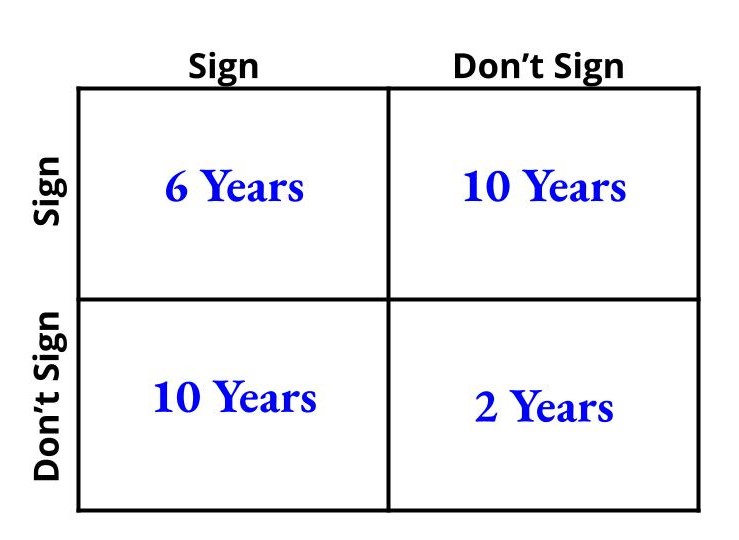
Here is an example of the Prisoner’s Dilemma: pretend you and a friend of yours just robbed a bank. Not a close friend, but someone you may have shared a class with at some point. You got caught and are now waiting in separate interrogation rooms. You are unable to communicate with one another, nor have you spoken about any sort of plan if you two were to get caught. After some time, an officer walks into the room holding a sheet of paper. The officer tells you that if you sign the paper, which blames the entire incident on your friend, you will be set free and won’t have to serve any jail time. In turn, your friend will be condemned to 10 years in prison. Alternatively, if you don’t sign the paper and your friend does, you will serve 10 years in prison and they won’t serve any time. If neither of you sign the paper, you will each serve 2 years. If you BOTH sign the paper, you each are sentenced to 6 years (see below for a diagram). What would you do?

The logical collective answer would be for neither of you to sign the paper, right? You would still serve 2 years in jail, but the total time spent in jail between the two of you is only 4 years as opposed to 10 years (if only one of you signs) or 12 years (if you both sign). However, on an individual level, the choice to sign the paper is an obvious one. If you sign the paper and your friend doesn’t, you won’t have to serve any time. The problem resides in the fact that your friend’s best move is to also sign the paper. The payoff of signing the paper (at best, 2 years and at worst 6 years) is much more appealing compared to the consequences of not signing the paper (at best 0 but at worst 10 years) on both ends. This means the most likely outcome will be the both of you signing the papers and each serving 6 years. Ideally, the two of you would each refuse to sign the papers and would each serve 2 years. This would in turn be the collectively most optimal choice. In the one-time play, each person’s interests are in complete conflict, which makes cooperation extremely difficult to achieve. 

At the heart of this problem lies the human nature towards both altruism and selfishness. If you were to play the game once, the outcome of 6 years would be unfortunate but better than 10 years. However, if you begin to play the game over and over again against the same person, the matter of history affects your future choices. Therein lies the problem: how do you optimize your strategy to “win” against any other person that you face? This is when a person’s decisions towards either altruism or selfishness matter and affects future interactions. 

In the 1980’s, Robert Axelrod, a professor of political science at the University of Michigan sent out an invitation to a special tournament. This invitation was sent out to a group of very prominent game theorists, people’s whose entire lives were dedicated to studying puzzles like the Prisoner’s Dilemma. Axelrod’s only instruction: submit a computer program that would win at the iterative Prisoner’s Dilemma game. To clarify, winning meant coming out of the game with the fewest years of prison. Each strategy would play every single other strategy and the winning strategy would be the one to result in the fewest years. 

There were numerous strategies of varying complexities. Simple strategies included always defecting (betraying your friend) or never signing (cooperating together and not giving the other up). Another strategy submitted was random (cooperating 50% of the time and defecting 50% of the time). All of the strategies were complete at the time of submission, so no changes could be made to adapt to different opponents. In the end, only one strategy reigned supreme: tit-for-tat. This strategy even won again when Axelrod repeated the tournament with newly submitted strategies.

The tit-for-tat strategy is fairly simple. It consists of two components:

  1. Begin by cooperating.
  2. Match the decision your opponent made in the previous round until the match is finished.

For example, if the match starts with your opponent cooperating, you would in turn cooperate in the next round. If your opponent then defects in round two when you cooperate, you would then defect in round three. 

Against simple strategies, it is fairly easy to analyze how the tit-for-tat strategy holds up. When against an “always cooperate” strategy, the entire match is rainbows and smiles as the two easily cooperate the whole time. Against the random strategy, both the tit-for-tat and the opponent will be 50/50 on cooperating/defecting. Against the “always defect” strategy, the tit-for-tat strategy only loses in the first round before both strategies begin to turn on one another for the rest of the match. So why does this strategy work and what does this mean in the grand scheme of the world?

The strategy works because the strategy can never be taken advantage of for multiple rounds as in the “always cooperate” version, but it will also not miss out on the benefits of cooperation. What this tournament outlines may not be the “best” strategy, as it will stoop to the level of a strategy such as “always defect;” however, it outlines possibly the most optimal strategy to come out on top. It also outlines some tips on how to promote cooperation:

  1. Teach reciprocity: when there are more tit-for-tat strategies in play, the success of other strategies diminishes.
  2. Insist on no more than equity: the tit-for-tat strategy doesn’t expect more than equal action and does not perform more than equal action.
  3. Respond quickly to provocation, but be forgiving: when the opponent defects, the tit-for-tat strategy immediately defects in the next turn. Don’t do more than match your opponent’s last action even if your opponent defects multiple times. 
  4. Don’t be envious: do not try to “beat” your opponent, simply match their previous decision. 
  5. Begin as open as possible: like in the tit-for-tat strategy, begin by opening yourself up to cooperation, making it possible to have the most ideal outcome rather than beginning on a sour note.

The Prisoner’s Dilemma goes beyond a simple mind game: it teaches us that cooperation can be difficult to achieve, even in situations where cooperation is clearly the optimal solution. It is a guide, not a perfect one, but a well tested one, on how individual rationality can lead to collective irrationality. Although this may seem like one giant philosophical problem that may not seem directly relevant, the Prisoner’s Dilemma extends well beyond theory and into the reality of human interaction. 


Works Cited

Axelrod’s Tournament. cs.stanford.edu/people/eroberts/courses/soco/projects/1998-99/game-theory/axelrod.html. Accessed 26 Oct. 2022.

Shah, Rina. “Robert Axelrod: The Prisoner’s Dilemma Simulation.” Shortform

Books, 6 Jan. 2021, http://www.shortform.com/blog/robert-axelrod/. Accessed 26 Oct. 2022.

‌Tit For Tat. 17 Sept. 2019, http://www.radiolab.org/episodes/104010-one-good-deed-deserves-another.

The Bees, the Queens, and the Wealth of Wall Street: A Sociological Analysis of WallStreetBets’ GameStop Phenomenon in January 2021

by Sophia Garbarino, August 30, 2021

Introduction

They swarmed, racing towards the deepest abyss of the hive. At the heart lay the queen, helplessly defenseless and stuck in the combs of her own making. Her workers, revolting against the monarchy with newfound passion and invigorating spirit, pushed past her and into the forbidden fortress of honey. There, they proudly paraded in hexagonal patterns, vicious and victorious, herding their hard-earned profits into the deepest chambers of their hearts: the wealth of Wall Street. A decade in the making, the reddit revolution quickly accelerated into its final stage within months. At the beginning of 2021, young and hungry reddit traders forced the queen brokers and hedge funds into submission, inflating the failing GameStop’s net worth into the double-digit billions. GameStop, a video game retailer primarily based on brick-and-mortar stores, had lost a significant number of sales due to the COVID-19 pandemic and was well on its way to bankruptcy before the rapid inflation. The long-term results remain to be seen. In this essay, I will explain this reddit-Gamestop phenomenon and analyze it using two key sociological theories by Karl Marx and Max Weber. Further, I will discuss the limitations of these theories using intersectionality theory.

The reddit GameStop phenomenon explained

According to The New York Times, GameStop stocks started rising in value after a new investment in mid-2020 (Phillips and Lorenz, 2021). For reference, a stock is an investment that represents partial ownership of a company, and its price fluctuates with that company’s overall value (U.S. S.E.C., “Stocks”). If the company is “public,” that means anyone in the general population can buy partial ownership if they have enough money (U.S. S.E.C., “Going Public”). GameStop is one such public company, and in January 2021, GameStop’s total market value went from $2 billion to over $24 billion in just a few days, meaning its stock prices also skyrocketed (Phillips and Lorenz, 2021). This sharp increase was primarily caused by amateur traders, or people who buy and sell stocks, in the subreddit social media community called WallStreetBets (hereafter referred to as “WSB”). WSB’s amateur traders, also known as retail investors, started a trading frenzy and forced seasoned professionals to participate in order to minimize financial losses. In turn, the increase in trading drove the stock price up (Phillips and Lorenz, 2021). While this obsession with GameStop seemed random and spanned only a few weeks, it was actually a profound reflection of the accumulating consequences of the COVID-19 pandemic and the 2008 Recession.

The 2008 Recession, COVID-19, and financial ruin

The majority of the WSB day traders are Millennials and Generation Z. These groups were children and teenagers during the 2008 Recession, when thousands of Americans lost millions of dollars due to the U.S. real estate catastrophe, which began a decade earlier in 2001. At that time, because banks and mortgage firms were issuing loans with low interest rates to borrowers who didn’t qualify, demand for houses rose. Years later, when interest rates started to increase again, home prices plummeted by a third (Duignan). As a result, the Recession saw the S&P 500 index1 drop by half, while the unemployment rate rose to 10 percent by the end of 2009 (Rich, 2013). This triad of financial ruin was an enormous blow to the national economy, and children watched helplessly as their parents lost their life savings to corporate greed. Many still blame Wall Street for this and saw the GameStop situation as an opportunity for revenge for the Recession, wanting to “punish” the ones responsible for their “pain” (Sarlin, 2021).

GameStop’s stock inflation may have been near instantaneous, but the animosity between the public and Wall Street’s finance magnates is nothing new. America’s wealth gap has increased every year since the Recession, leaving its people sharply divided into two distinct economic classes: the wealthy and the not-wealthy (Horowitz et al., 2020). Over a decade later, COVID-19 further increased the wealth gap as many people struggled to choose between paying their rents and feeding their families. On the other hand, the world’s wealthiest men, like Amazon founder Jeff Bezos and Tesla CEO Elon Musk, actually increased their wealth by more than five hundred billion dollars, collectively (“Wealth Increase,” 2021). In essence, wealth flowed from the poor to the rich. In recent years, however, investing has become more accessible than ever thanks to apps like Robinhood (Morrow, 2021). Now, the honey-sweet wealth of Wall Street is within reach of more people, and Millennials and Gen Z are breaking into the stock market at earlier ages (Dimock, 2019). With many WSB traders using these apps, the reddit-GameStop phenomenon is a powerful demonstration of the people’s ability to manipulate the market.

Karl Marx and Friedrich Engels: Class divides and social change

Despite the increasing accessibility of stocks, sharp social and economic divides remain in American capitalism. In The Communist Manifesto (1848), Karl Marx and Friedrich Engels categorize all of society into two economic-based groups: the bourgeoisie (rich bosses) and the proletarians (poor laborers). In other words, the bourgeoisie is the queen bee, and the proletarians are the worker bees. Unlike bees, though, human laborers are not biologically bound to their bosses; as such, according to Marx and Engels, these groups are in constant conflict with each other because the bourgeoisie use the wage-labor system to profit from and oppress the proletarians, whose values are based on how much their labor increases these capital benefits (Marx and Engels, 1848). This conflict always leads to social change as explained by Marx’s materialist theory of dialectical social change, which consists of three main parts: 1) “species being,” meaning humans are unique for their creativity and productive labor; 2) dialectical change, meaning change is caused by the synthesis/resolution of contradicting ideas, known as the theses and antitheses; and 3) historical materialism, meaning material things shape people’s ideas and cultures (Marx and Engels, 1848).

We can use Marx’s theory to explain the reddit-GameStop phenomenon. First, the non-wealthy were involved in a class struggle with the wealthy as a result of the Recession and the COVID-19 pandemic. The rich got richer and the poor got poorer. This prevented the non-wealthy from achieving their “species being” purpose, meaning they were forced into wage-labor because they could not afford to be creatively productive on their own. Historically, this conflict between the thesis—proletarians—and the antithesis—bourgeoisie—has always been ongoing, but the COVID-19 pandemic exacerbated it to the point of change. The dire need for basic resources, like food and shelter, all acquired using money, created a new environment that required elimination of the previous system, in which the wealthy had increasing control of  financial resources. The synthesis of this conflict, or the resolution, was the reddit-GameStop phenomenon: redistributing Wall Street’s wealth to the people. They had the means—apps like Robinhood—so all they needed was a personal reason.

Max Weber: instrumental rational action and value-rational action

According to German sociologist Max Weber, people’s reasons for doing things, or rationality, can be divided into two types: instrumental rational action and value-rational action. Instrumental rational action is when an individual person or a group strategizes and uses the most efficient means to achieve a goal, often of financial nature. On the other hand, value-rational action is when a person or a group prioritizes a value rather than a goal, often incurring additional costs that would not be considered most efficient by the instrumental rational action (Weber, “The Protestant Ethic,” 1905).

The motivations behind the mass, organized action of the GameStop inflation can be divided according to these two types of action. For those who were purely motivated by financial gain, the stock market was the most efficient method of achieving their goal: more wealth. For those who prioritized their anger and vengeance for the Recession, the stock market made the most sense given the prioritized values. Regardless of motivation, both behaviors necessarily involved a certain level of risk that comes with investing, but for those utilizing instrumental rational action, the benefits outweighed the costs—GameStop’s stock prices increased over 1,700 percent, enabling some traders to pay off student loan debt or become millionaires (Morrow, 2021; Sarlin, 2021). For those utilizing value-rational action, the stock market’s volatile nature and susceptibility to manipulation allowed them to beat Wall Street at its own game, regardless of risk of financial loss. For others, it was a mix of both.

Limitations of Marx and Engels’ theory and intersectional race hierarchies

As with any theory, both Marx and Weber’s ideas have limitations. The most significant fault in their theories is the lack of intersectionality. Coined in 1989 by Black law scholar Kimberlé Crenshaw, intersectionality explores how people’s experiences, including oppression and privilege, are a result of several social factors interacting with each other (Crenshaw, 1989). For example, a common intersectional analysis involving race and gender argues that Black women experience racism differently than Black men because of its connections to sexism. Intersectionality largely coincides with feminist Patricia Hill Collins’ standpoint theory, which views knowledge as subjective and socially constructed (Collins, 1990). Every person’s experiences are unique but can be similar based on belonging in certain groups. 

With this in mind, we cannot homogenize the WSB traders the way Marx and Engels would. Modern America is not composed of identical, black and yellow fuzzy bees; it is increasingly diverse. Financial consequences of the Recession varied depending on social factors such as race, gender, age, education, and geographic location, among others. The same is true of the COVID-19 pandemic over a decade later, in which BIPOC are disproportionately affected by both unemployment and COVID-related death rates (“Tracking the COVID-19 Recession’s Effects,” 2021; APM Research Lab Staff, 2021). This is largely due to systemic racism, which puts BIPOC at an economic disadvantage by default. Analyzed through a racial lens, Wall Street and WSB can be subdivided into their own bourgeois and proletariat groups: Whites and BIPOC, respectively. While many middle to upper-middle class White Americans discovered were unaffected by COVID-19 and even gained wealth, hundreds of thousands of BIPOCs lost their jobs and steady income.

Furthermore, financial education is highly determined by access to resources, which is notoriously lower in communities predominantly of color and/or lower income. Whites are overrepresented in the upper class, giving them a predetermined advantage in achieving financial success (Reeves and Joo, 2017). So when COVID-19 drove stock prices down at incredible rates and millions of new brokerage accounts were opened, race/ethnicity, class, and education were crucial factors in determining who opened those accounts and who profited from them (Fitzgerald, 2020; Zarroli, 2020). Therefore, the reddit traders were privileged themselves in that a) they had to have ready access to technology in order to place the trades; b) they had to have some sort of basic financial education, whether it was self-taught or learned from others; and c) they had money with which to trade, whether it was borrowed, essential income, saved retirement funds, or extra cash. As such, this proletariat group has an internal, sociological hierarchy within itself.

Finally, we must also consider the professional traders. The division between the WSB and Wall Street investors is not as clear as one may initially think. While WSB certainly has intersectional differences, so does Wall Street, which is what Marx would consider the privileged bourgeois group. Wall Street firms severely lack racial and ethnic diversity, with over seventy-five percent of senior managers being White in 2018 (Hoffman and Pulliam, 2020). Additionally, the ratio of male to female fund managers is nine to one despite women’s performance being equal to men’s (Sargis and Wing, 2018). So who was really making all the money during the Recession and COVID-19? White men. Even within the privileged bourgeois there’s hierarchies of privilege, just like the proletariat group. Therefore, they cannot be so easily and clearly divided the way Marx and Engels imagined.

Limitations of Weber’s theory and intersectional age privilege

Within the WSB divisions of class, gender, race/ethnicity, etc., there are also complex, intersectional components of rationality. Weber’s two types of action, instrumental rational action and value-rational action, are also oversimplified, much like Marx and Engels’ economic groups. Socioeconomic status (SES), which Weber categorized into the “property” class and “lack of property” class, contributed to how severely the Recession and the COVID-19 pandemic affected people (Weber, “The Distribution of Power” 311, 1921). Investors with less money to begin with lost more, meaning different levels of wealth privilege impacted risk tolerance, or how much money the reddit traders were willing and/or able to risk losing on the market (U.S. S.E.C., “Assessing Your Risk Tolerance”). Furthermore, younger traders may have prioritized repaying student loan debt and had more long-term risk tolerance, while older traders may have prioritized increasing their retirement funds and had less risk tolerance. Therefore, while the means to achieve the goal of financial gain were the same (stock trading), the values differed according to SES and/or age. After all, worker bees have different priorities within the hive depending on their age (Farrar, 1968).

However, age can also affect political views, particularly those regarding fiscal conservatism. According to the Pew Research Center, conservatism grows with age (Desilver, 2014). This may explain why young people, including most of WSB’s traders, have consistently been accused by older generations of having a “lax work ethic” and masquerading lazy entitlement as socialism (Shapira, 2010; Ingram and Bayly, 2021). In fact, socialism has become quite popular among young voters during the past decade (Saad, 2019). It is important to recognize, though, that supporting socialism and engaging in wage-labor are not mutually exclusive. Perhaps young people are embracing the classic “work smarter, not harder” mantra and finding non-traditional ways to make money, like starting side hustles and capitalizing on social media. Generation Z faces record-high student debt, rising tuition costs, and an increasingly difficult job market, particularly during COVID-19. Therefore, age is an important intersectional factor in rational action which Weber’s original theory failed to account for, and traders’ differing levels of GameStop profits are indicative of age and wealth privilege.

Conclusion

The GameStop situation occurring during the pandemic is no coincidence. The COVID-19 climate created stay-at-home free time, an investment goldmine, an outlet for post-Recession anger, and increased support for socialist policies. The reddit retail investors were simply exploiting pandemic conditions for revolutionary purposes, similar to a Marxist proletariat group revolting against the bourgeoisie. However, the diversity within the proletarians is critical, too, since they were not all trading for the same reason, nor were they all affected the same way. As such, instrumental rational and value-rational action are also necessary to explore. Though the stock market seemed to be the most efficient and effective method for everyone, the motivations differed. Some wanted revenge for the Recession while others wanted quick and easy money. For many, it was a mix of both; therefore, we must consider both Marx and Engels’ and Weber’s theories to achieve a full, robust understanding of the GameStop sociological phenomenon. The honey-sweet wealth of Wall Street was now in the hands of the worker bees, who had previously served the queen hedge funds while receiving minimal benefits. The WSB traders shamelessly demonstrated the power of the people en masse. Ultimately, though, their billion-dollar victory was short-lived. After a few days of halted trades, GameStop shares returned to the market as its price dropped back into the low triple-digits (Reuters Staff, 2021). As Marx and Engels’ wrote, “Now and then the workers are victorious, but only for a time” (Marx and Engels 162, 1848).

1 The S&P 500 measures the stock performance of the 500 largest publicly-traded companies in the United States (Kenton, 2020).


Works Cited

APM Research Lab Staff. “The Color of Coronavirus: COVID-19 Deaths by Race and Ethnicity in the U.S.” APM Research Lab, 5 Mar. 2021, www.apmresearchlab.org/covid/deaths-by-race. Accessed 16 Apr. 2021.

Crenshaw, Kimberlé. “Demarginalizing the Intersection of Race and Sex: A Black Feminist Critique of Antidiscrimination Doctrine, Feminist theory and Antiracist Politics.” University of Chicago Legal Forum, vol. 1989, no. 1, 1989, pp. 139–167.

Desilver, Drew. “The politics of American generations: How age affects attitudes and voting behavior.” Pew Research Center, 9 July 2014, www.pewresearch.org/fact-tank/2014/07/09/the-politics-of-american-generations-how-age-affects-attitudes-and-voting-behavior/.

Dimock, Michael. “Defining generations: Where Millennials end and Generation Z begins.” Pew Research Center, 12 Jan. 2019, http://www.pewresearch.org/fact-tank/2019/01/17/where-millennials-end-and-generation-z-begins/.&nbsp;

Farrar, Clayton Leon. The Life of the Honey Bee: Its Biology and Behavior with an Introduction to Managing the Honey-Bee Colony. University of Wisconsin-Extension, 1968.

Fitzgerald, Maggie. “Young investors pile into stocks, seeing ‘generational-buying moment’ instead of risk.” CNBC, 12 May 2020, http://www.cnbc.com/2020/05/12/young-investors-pile-into-stocks-seeing-generational-buying-moment-instead-of-risk.html.

Hoffman, Liz, and Susan Pulliam. “Wall Street Knows It’s Too White. Fixing It Will Be Hard.” The Wall Street Journal, 2 July 2020, http://www.wsj.com/articles/wall-street-knows-its-too-white-fixing-it-will-be-hard-11593687600.

Horowitz, Juliana Menasce, et al. “Trends in income and health inequality.” Pew Research Center, 9 Jan. 2020, http://www.pewresearch.org/social-trends/2020/01/09/trends-in-income-and-wealth-inequality/. Accessed 16 Apr. 2021.

Ingram, David, and Lucy Bayly. “GameStop? Reddit? Explaining what’s happening in the stock market.” NBC News, 27 Jan. 2021, http://www.nbcnews.com/business/business-news/gamestop-reddit-explainer-what-s-happening-stock-market-n1255922.

Kenton, Will. “S&P 500 Index – Standard & Poor’s 500 Index.” Investopedia, 22 Dec. 2020, http://www.investopedia.com/terms/s/sp500.asp.

Marx, Karl, and Friedrich Engels. “Manifesto of the Communist Party,” 1848. Classical Sociological Theory, edited by Craig Calhoun et al., John Wiley & Sons, Ltd., 2012, pp. 156–171.

Morrow, Allison. “Everything you need to know about how a Reddit group blew up GameStop’s stock.” CNN, 28 Jan. 2021, http://www.cnn.com/2021/01/27/investing/gamestop-reddit-stock/index.html.

Phillips, Matt, and Taylor Lorenz. “‘Dumb Money’ Is on GameStop, and It’s Beating Wall Street at Its Own Game.” The New York Times, 27 Jan. 2021, http://www.nytimes.com/2021/01/27/business/gamestop-wall-street-bets.html.

Reeves, Richard V., and Nathan Joo. “White, still: The American upper middle class.” Brookings, 4 Oct. 2017, http://www.brookings.edu/blog/social-mobility-memos/2017/10/04/white-still-the-american-upper-middle-class/. Accessed 16 Apr. 2021.

Reuters Staff. “GameStop trading resumes after brief halt as shares tumble.” Reuters, 29 Jan. 2021, http://www.reuters.com/article/us-retail-trading-gamestop/gamestop-trading-resumes-after-brief-halt-as-shares-tumble-idUSKBN2A21YD. Accessed 16 Apr. 2021.

Rich, Robert. “The Great Recession.” Federal Reserve History, 22 Nov. 2013, http://www.federalreservehistory.org/essays/great-recession-of-200709.

Saad, Lydia. “Socialism as Popular as Capitalism Among Young Adults in U.S.” Gallup, 25 Nov. 2019, news.gallup.com/poll/268766/socialism-popular-capitalism-among-young-adults.aspx.

Sargis, Madison, and Kathryn Wing. “Fund Managers by Gender: Through the Performance Lens.” Morningstar, 8 Mar. 2018, http://www.morningstar.com/content/dam/marketing/shared/pdfs/Research/FundManagerByGenderPerformanceLens.pdf.

Sarlin, Jon. “Inside the Reddit army that’s crushing Wall Street.” CNN, 30 Jan. 2021, http://www.cnn.com/2021/01/29/investing/wallstreetbets-reddit-culture/index.html.

Shapira, Ian. “Millennials accused of lax work ethic say it’s not all about 9-to-5.” Washington Post, 3 Apr. 2010, https://www.washingtonpost.com/wp-dyn/content/article/2010/04/02/AR2010040201452.html?hpid=topnews.

“Tracking the COVID-19 Recession’s Effects on Food, Housing, and Employment Hardships.” Center on Budget and Policy Priorities, 22 Apr. 2021, http://www.cbpp.org/research/poverty-and-inequality/tracking-the-covid-19-recessions-effects-on-food-housing-and.

U.S S.E.C. “Assessing Your Risk Tolerance.” Investor.gov, https://www.investor.gov/introduction-investing/getting-started/assessing-your-risk-tolerance. Accessed 9 Apr. 2021.wilkinson

U.S. S.E.C. “Going Public.” SEC.gov, https://www.sec.gov/smallbusiness/goingpublic. Accessed 16 Apr. 2021.

U.S. S.E.C. “Stocks.” Investor.gov, https://www.investor.gov/introduction-investing/investing-basics/investment-products/stocks. Accessed 16 Apr. 2021.

“Wealth increase of 10 men during pandemic could buy vaccines for all.” BBC News, 21 Jan. 2021, http://www.bbc.com/news/world-55793575#:~:text=As%20of%20June%20last%20year,his%20%243.9bn%20net%20worth..

Weber, Max. “The Distribution of Power within the Political Community: Class, Status, Party,” 1921. Classical Sociological Theory, 3rd ed., edited by Craig Calhoun et al., John Wiley & Sons, 2012, 291–309.

Weber, Max. “The Protestant Ethic and the Spirit of Capitalism,” 1905. Classical Sociological Theory, 3rd ed., edited by Craig Calhoun et al., John Wiley & Sons, 2012, 291–309.

Zarroli, Jim. “Millions Turn To Stock Trading During Pandemic, But Some See Trouble For The Young.” NPR, 11 Aug. 2020, http://www.npr.org/2020/08/11/895054084/millions-turn-to-stock-trading-during-pandemic-but-some-see-trouble-for-the-youn.

Following Our Digital Footsteps

by Ean Tam, May 19, 2021

On January 21st, 2020, the United States reported its first case of COVID-19 in Washington state. Over the course of a year, offices emptied, schools closed, and normal life disappeared. By April 2021, over 553,000 Americans had passed away due to the pandemic. Now, as vaccine shots continue to make their way into people’s arms, the hope of defeating the pandemic appears more attainable. The vaccine is our shot back to the workplace, the classroom, and, some would say, back to normal life.

While suppressing this respiratory disease itself may be possible, many people struggle to take a deep breath and relax. For more than a year, across the country Americans have been sheltering in their homes, taking in the world through screens and behind masks. They have been waiting to return to work, hoping to regain jobs they lost at no fault of their own. It will take time for people to regain a sense of control over their lives and examine the mental health effects of the pandemic.

Perhaps we can comprehend how the pandemic played into the worst sides of ourselves. How did transitioning to a life online affect us? What will be our ‘new normal’ post-pandemic? How do we want to discuss mental health? To answer these questions, we should examine the research into our social and online behavior, including new techniques in studying social media activity.

A Life Online

When isolation orders began, we observed the panic: not as frenzy crowds going berserk in the streets, but in the simplest of manners: lining up at the supermarket. Under the threat of prolonged lockdown, citizens translated their insecurities through their wallet. In the United States, where consumerism is a part of our culture, our spending behavior can exemplify our human instincts: “Cash, and the fantastic appeal of what money can buy… provide a way for humans to distance themselves from the disturbing realization that they are animals destined to die” (Arndt et al., 2004). Certainly, not everyone assumed COVID-19 was going to be the ultimate scourge of the human race, but the mindset was there. As a reflection of that mindset—that we as humans can have some control over our lives—we decided to wipe out the supermarket shelves before COVID could wipe us out.

Of course, the online world to which we were regulated put us face-to-face with another nuisance we had already been trying to grapple with: misinformation. Unfortunately for us, online misinformation has only become worse. In beginning of the pandemic, so little was known about SARS-CoV-2, the virus that causes COVID-19. Once a rumor, half-truth, or plain lie made its way online, there was no way of knowing how far it could travel. But it is clear that unreliable sources induce panic and anxiety, stoking our fears of the current situation, encouraging us to prepare more (Usher et al., 2020; Johal, 2009).

When ventures outside of our homes are limited to stocking up on groceries, the possibilities for personal connections are lost. Small talk is hard to come by, especially when you are six feet apart, wearing a mask, and staring through the glare of plexiglass. Physical interaction has become impersonal. Even the relationships established before the pandemic have been hurt. The online connection has been unable to keep up with the loneliness. While we can turn on our cameras to see each other’s faces on screen, the interaction is not a proper substitute for in-person contact (Lippke et al., 2021). In a study of 212 Swiss undergraduate students, researchers found that the students, because of the pandemic, were increasingly working alone and not engaging in networking with their peers. Students’ depressive and anxiety symptoms also increased. The concerns about the students’ minds ranged from the “fears of missing out on social life to worries about health, family, friends, and their future” (Elmer et al., 2020). For mourners who require “restorative activities (e.g., travel, spending social time with friends),” those options vanished (Lee and Neimeyer, 2020). The emotional connections that would have helped no longer do, and the strength of the friendship has diminished. This faltering sense of belonging and attachments to others can manifest itself in our physical and mental health (Baumeister and Leary, 1995).

It is no secret that internet use and mental health are intertwined. More time spent on the internet affects our social interactions and increases the chances of cyberbullying. It appears the relationship between internet use and social interactions can go either way: problematic internet use (PIU) can be both the cause and the result of diminished social interactions. When internet use is the cause, social interactions suffer because of depression, neglect of offline obligations, and obsessive behaviors, all of which are linked to PIU. When PIU is the result of diminished social interactions, the internet is seen as a coping mechanism—a world to which people can escape (El Asam et al., 2019).

However, the world people enter is not always so agreeable. Excessive internet use has a profound impact on adolescents because they are not only victims of cyberbully, but also encouraged to take part in it. Online communities offer opportunities for validation. At times, participating in cyberbullying is a way for some adolescents to ‘fit in’ with their online counterparts. Moreover, an adolescent who engages in such internet behavior can be expected to develop PIU (Chao et al., 2020). It appears that most of the time, victims of cyberbully do not allow the abuse to end with them. They will have “a desire to respond, which may encourage others to join the fray leading to a potentially long and drawn-out series of increasingly abusive and antagonistic communications” (Chao et al., 2020).

Before lockdown, excessive users of the internet had the ability to separate themselves from their devices. However, once life went online, that opportunity disappeared. We all, in a way, became problematic internet users. A life online, while necessary for the past year, has shown to be harmful to our mental well-being.

Back to Normal?

When we eventually emerge from this pandemic, the cloud of lockdown will still hang over us. One of the lingering concerns will be the home as the petri dish. Throughout this pandemic, citizens have created their own fortresses, hoping to keep the COVID invader at bay. Every trip outside of the home was a potential for letting an intruder in. That is why we wiped down all our groceries and bathed ourselves in hand sanitizer after every door handle. The pressure to keep the home decontaminated has been especially hard on those living with vulnerable groups like the elderly.

Retreating to our homes for the past year has proven to us that some things are simply no longer worth going out: movies, restaurants, shopping. However, “even people who do not become housebound may become fastidious germaphobes, striving to avoid touching ‘contaminated’ surfaces or hugging people or shaking hands” (Taylor and Asmundson, 2020). Pandemic sanitation standards will persist, similar to how some American families maintained their parsimonious, self-sufficient lifestyles after the Great Depression (Taylor and Asmundson, 2020).

The stress of yourself being a carrier and potential hazard to those around you can be exacerbated when living conditions are tight. When living conditions are limited, tensions can flare. Unfortunately, some people find themselves trapped at home with COVID outside and an abuser inside, making their situation a possible source of post-traumatic stress disorder (PTSD) (Taylor and Asmundson, 2020).

For those who have contracted COVID-19, some have had to deal with guilt for possibly infecting others, embarrassment for having contracted the disease while others did not, and shame for not protecting oneself enough. Not even our healthcare workers have been exempted. In Italy, Daniela Trezzi, a 34-year-old nurse, took her own life in March of 2020 after she had tested positive for COVID-19. Trezzi’s colleagues reported that her suicide may have been the result of her concerns of having infected other people (Giuffrida and Tondo, 2020). As COVID-19 surged in New York City last April, Dr. Lorna Breen, an ER doctor at New York-Presbyterian Allen Hospital, committed suicide. The virus had taken the lives of many of Dr. Breen’s patients. Despite the overachieving and dedicated passion to her job, Dr. Breen’s family believed she “was devastated by the notion that her professional history was permanently marred and mortified to have cried for help” (Knoll et al., 2020).

Plenty of people will be able to return to normal life post-pandemic, to go back on the street as if nothing has changed. But for many members of the Asian-American and Pacific Islander (AAPI) community, this is an impossibility. A wildfire of misinformation spreads (and continues to spread) across the internet, pinning a substantial number of American citizens as walking embodiments of SARS-CoV-2. Therefore, for AAPIs, returning to a normal life post-pandemic does not mean traveling down the street as if nothing has changed. As the United States begins to open, we are already seeing increases in racist attacks against AAPIs. We have seen this before. In 2014, Ebola was blamed on Africans because it was deemed an “African problem” (Usher et al., 2020). The ease of scapegoating specific demographics is an example of maladaptive coping “where coping is emotion-focused rather than problem-focused” (Cho et al., 2021).

We would like to think there is a chance for a return to normal. However, for many people, this is an unlikely future. Quarantine and the pandemic experience have affected the mental health of citizens across the globe. The pandemic has left us lonely, guilty, and fearful. It has forced some people to channel their insecurities into counterproductive behaviors. Behaviors that prevent us from regaining a sense of camaraderie and interconnectedness—some things we all lost this past year in quarantine.

Putting Our Online Activity to Good Use

Although living our lives on the internet has strained everyone, there may be something to gain from our past year online. In recent years, mental health researchers have turned their eyes to social media. With every post, like, or share, there may be a hidden meaning waiting to be deciphered. A variety of social media websites have been utilized for possible insights into specific mental health issues. Twitter is a popular site for study. It has been used for learning about detecting signs of depression and suicide (De Choudhury et al., 2013; Tsugawa et al., 2015; Coppersmith et al., 2016). Instagram, Reddit, and Tumblr have been used to study depression, suicide, and anorexia, respectfully (Reece and Danforth, 2017; Shing et al., 2018; Chancellor et al., 2016).

Taking advantage of machine-learning to comb over patients’ extensive social media activity, researchers have found indicators of mental health illnesses. For example, researchers classified tweets of suicidal individuals by their expressed emotions, emoji usage, and frequency of tweets. They found that tweets usually expressed sadness then anger after a suicide attempt, and that frequency of emotional tweets increases while emoji prevalence decreases (Coppersmith et al., 2016). The machine-learning systems allow for detecting these indicators with accuracy as high as 80 to 90 percent. This technique of combining computing power with psychiatric evaluation has led to the term “digital psychiatry” (Chancellor and De Choudhury, 2020). The focus on social media is particularly helpful in studying younger generations. Regardless of race or medical history, a younger age has been “the only significant predictor of blogging and social networking site participation” (Chou et al., 2009).

Northwell Health, New York state’s largest healthcare provider, has realized the importance of using social media for the purpose of engaging with patients as soon as possible. Since 2013, Northwell’s Early Treatment Program (ETP) has specialized in treating adolescents and young adults suffering from psychotic symptoms. Dr. Michael Birnbaum, Director and founding member of the ETP, studies the application of social media as an indicator for psychosis. I spoke with Dr. Birnbaum to learn more about his research with social media and its implications.

“This line of research was happening in the world of computer science, but not so much in psychiatry,” Dr. Birnbaum explained. “The idea sort of organically arose through reading the exciting literature on machine-learning and social media. Thinking about some of the major challenges and obstacles to delivering effective care, we came up with this solution.”

To perform his studies, Dr. Birnbaum and his colleagues retrieved social media archives donated by participants. These databases were downloaded straight from social media websites and then inputted into machine-learning systems provided by computer scientists from institutions like IBM, Cornell Tech, and Georgia Tech. The magnitude of data for these studies were immense. For instance, in one study, from just 223 research participants, Dr. Birnbaum and his team had collected 3,404,959 Facebook messages and 142,390 images. With this Facebook data alone, they found that the machine-learning system could identify research participants who had schizophrenia spectrum disorders (SSD) and mood disorders (MD). In terms of posts and messages, those with SSD were more likely to use words of sensory perception, those with MD were more likely to make references to the body, and SSD and MD groups were both more likely to use curse words. When it came to Facebook photos—a more abstract source of analysis—Dr. Birnbaum and his research team found that those with SSD and MD were more likely to post smaller photos by dimension, and the hues of photos from MD participants were more blue and less yellow (Birnbaum et al., 2020).

Now, while the volume of information is essential to the experiment, the social media archives are not limited to just the research participants. Within these archives, you can find private messages sent by the research participant and messages sent from second parties whom the participant was communicating with.

“One of the other ethical issues is the fact that there are a ton of secondary subjects: all of the friends and connections to other users who don’t necessarily agree to have their data donated and analyzed, and so that’s something that, as a team, will need to sort of grapple with,” Dr. Birnbaum explained. To handle this ethical issue, Dr. Birnbaum’s studies had to eliminate the data from these secondary parties. So, while these secondary subjects may not have their private messages inputted into a machine-learning system, there is no denying that those messages are being stored somewhere at some point. It will be up to the patient to inform his or her friends that their conversations may eventually find their way into a stored database. Consent, conservation, and confidentiality of social media information are only some of the big hurdles of digital psychiatry (Wongkoblap et al., 2017). However, Dr. Birnbaum believes that with the correct system in place and an understanding from the public, the application of machine-learning can find success in psychiatry.

“This shouldn’t be about surveillance or taking the power away from the patient. It’s just the opposite. In my mind it’s creating a way for the patient to be able to learn more about themselves and also share it with their clinician. Just like when you go to see your doctor who orders a blood test or an X-ray, you donate your blood to inform because it’s going to improve your care. Though most people don’t like taking their blood, similarly, I imagine a situation where the benefits would be clear and patients would be willing and interested in donating their digital data to inform their care in a meaningful way.”

Furthermore, Dr. Birnbaum highlighted a key issue in psychiatry: the reliance on self-reported information. It has been shown that self-reported data can be unreliable and underestimate health issues (Wallihan et al., 1999; Newell et al., 1999). Dr. Birnbaum elaborated, “We just are notoriously bad at this—all of us—at describing our own behaviors. Most of us can’t remember what we ate for dinner a few days ago, and so I think that these things can be immortalized in digital data, and so we can accept it more readily and use it.”

And in terms of the depth and perception from which we can learn, social media information may be the closest thing psychiatrists can have to 24/7 observation of their patients. Retrospective analysis of a patient after they have been admitted into the hospital is not the best solution. Social media information may hold the key.

“A patient sees the doctor periodically, and they meet for a certain amount of time and then that’s it,” Dr. Birnbaum said. “You don’t really know what’s happening in between meetings beyond patient self-report. The [social media information] provides information about what was going on between sessions. So, you can learn a lot more about, or rather from a different source and a more objective source, about what people are doing, thinking, and feeling.”
Of course, social media information is no substitute for in-person meetings. For Dr. Birnbaum, “I imagine a situation where someone donates their digital data a day or two before they come to meet me in my office, and then we can discuss the findings and determine whether or not we need to change the treatment plan.”

Although Dr. Birnbaum explained earlier that routine treatment involves monthly meetings with patients, the timing of when a patient should donate their social media archives is not exactly clear: “That is something that has yet to be empirically explored. Maybe it’s once a month when they come see me, maybe not. I could imagine a situation where it is done at the beginning of care and maybe perhaps periodically after that. I think it depends on what information we’re after, what we’re looking for, and how each individual uses social media.”

In the end, social media activity would just be one component of digital psychiatry. The way Dr. Birnbaum sees it, “Social media is a piece of the puzzle. They’re also people looking at speech, facial movements, wearables, cell phone data. All of this stuff paints a picture. A more comprehensive picture.”

What’s the Point?

On April 9th, The Wall Street Journal published an article titled, “Loneliness, Anxiety and Loss: the Covid Pandemic’s Terrible Toll on Kids.” In it, the author, Andrea Peterson, details the faltering grades, confidence, and motivation of young students. One 13-year-old stated, “[I]t’s been a lot harder to make friends and talk to new people… I feel like a lot of us drifted apart… It has set in that I’m alone” (Peterson, 2021).

With vaccines getting administered around the world, our public health appears to be on the right track. For many of the students who spoke with Peterson, transitioning back to in-person social activities will be difficult, but nonetheless, they will finally be in-person. Hopefully, for all of us, returning to in-person work or school will be the remedy we need. But the final obstacle we will face is the way we confront mental health as a society.

When The Wall Street Journal shared Peterson’s article on its Twitter profile, many of the comments were supportive—a lot of teachers and students voicing their approval with the awareness raised by the article. Then, of course, there were comments like these:

https://twitter.com/HRHSherlock/status/1380646040714375170

https://twitter.com/eagles2sixers/status/1380923582268764164

It would be quick and easy to say kids these days are just soft. It would be quick and easy to say there are more pressing matters than this. But the people who choose these quick and easy solutions seem to forget that we are all wired differently. We process things differently. Just as physical abilities differ from person to person, our ways of handling strains of our mental health differs. And to those who say the deaths from COVID-19 are more important: yes, preventing deaths is the number one priority, but the pandemic will be over. Can we talk about mental health effects then? Or would we have forgotten about it already?

It is unfortunate to think that these attitudes can exist within families, preventing people from getting the help they need. Whether it be depression or psychotic disorders, stigma exists everywhere. The family unit is not always equipped to understand the needs of someone suffering from a mental illness.

“For the most part, it’s impossible to tease apart providing good care to a patient without involving their family,” Dr. Birnbaum told me while explaining the role of family at the ETP. “So, it’s critical that the family understands what’s happening and has a connection to the treatment team, is involved in the treatment decisions in some capacity, and knows how to be most helpful and supportive for their child.”

It is no secret that there is a clash of how we discuss mental illness. Some people, due to culture or age, like to keep it under the rug, while younger generations tend to be more open about mental health. Those who like to keep a tight lip about it find themselves being blamed for being a part of the problem. Well, to put it simply, they are. I would hope people do not see that as a political opinion. It is informed medical advice.

When asked about breaking the stigma surrounding mental health and culture, Dr. Birnbaum explained, “I think that’s part of the work and that’s part of the advocacy. And part of the excitement of early intervention is sort of getting the message out that there are resources and tools and help available. The more we talk about it, the better.” He added, “Hopefully that’s something that we can do by changing society.”

Changing society will be no easy task. It will take time, just like waiting for this pandemic to be finally over. The ‘new normal’ waiting for us will ultimately be defined by us. If we decide to keep things the status quo, then that is what we should expect. As difficult as the past year has been, we ought to make the most of it. With the new advancements in machine-learning, we can learn from the online activity we amassed in quarantine. Work like Dr. Birnbaum’s shows that studying our online presence can improve the way we comprehend mental health. We can learn more about ourselves, mental health, and possibilities for early treatment for young people. When it comes to pandemic, the light at the end of the tunnel seems to be getting brighter. While we cannot say the same for mental health, our digital footprints can help lead the way.


Work Cited

@CortezGeovanny. “Kids are getting softer and softer with each generation.” Twitter, 9 Apr 2021, 9:20 p.m., twitter.com/CortezGeovanny/status/1380692134659940352.

@eagles2sixer. “I’m sorry the kids had to stay home on their phones for a year but please. Did the kids that worked in dangerous factories or lived during the blitzkrieg or black in the south in the early 1900s or during the depression or a million others not have it 1000X worse?” Twitter, 10 Apr 2021, 12:40 p.m., twitter.com/eagles2sixers/status/1380923582268764164.

@HRHSherlock. “Yes, this is all very sad, but over 560,000 Americans are dead.” Twitter, 9 April 2021, 6:17 p.m., twitter.com/HRHSherlock/status/1380646040714375170.

Ardnt, Jamie, Sheldon Solomon, Tim Kasser, and Kennon M. Sheldon. “The Urge to Splurge: A Terror Management Account of Materialism and Consumer Behavior.” Journal of Consumer Psychology, vol. 14, no. 3, 2008, pp. 198-212. Wiley Online Library, doi.org/10.1207/s15327663jcp1403_2.

Baumeister, Roy F., and Mark R. Leary. “The Need to Belong: Desire for Interpersonal Attachments as a Fundamental Human Motivation.” Psychological Bulletin, vol. 117, no. 3, 1995, pp. 497-529. APA PsycNet, doi.org/10.1037/0033-2909.117.3.497.

Birnbaum, Michael L., Raquel Norel, Anna Van Meter, Asra F. Ali, Elizabeth Arenare, Elif Eyigoz, Carla Agurto, Nicole Germano, John M. Kane, and Guillermo A. Cecchi. “Identifying Signals Associated with Psychiatric Illness Utilizing Language and Images Posted to Facebook.” npj Schizophrenia, vol. 6, no. 38, 2020, pp. 1-10. PubMed, doi.org/10.1038/s41537-020-00125-0.

Chancellor, Stevie, and Munmun De Choudhury. “Methods in Predictive Techniques for Mental Health Status on Social Media: A Critical Review.” npj Digital Medicine, vol. 3, no. 43, 2020, pp. 1-11. Google Scholar, doi.org/10.1038/s41746-020-0233-7.

Chancellor, Stevie, Tanushree Mitra, and Munmun De Choudhury. “Recovery Amid Pro-Anorexia: Analysis of Recovery in Social Media.” Proceedings of The Sigchi Conference on Human Factors in Computing Systems, 2016, pp. 2111-2123. ACL Digital Library, doi.org/10.1145/2858036.2858246.

Chao, Cheng-Min, Kai-Yun Kao, and Tai-Kuei Yu. “Reactions to Problematic Internet Use Among Adolescents: Inappropriate Physical and Mental Health Perspectives.” Frontiers in Psychology, vol. 11, art. 1782, 2020, pp. 1-12. PubMed, doi.org/10.3389/fpsyg.2020.01782.

Cho, Hyunyi, Wenbo Li, Julie Cannon, Rachel Lopez, and Chi Song. “Testing Three Explanations for Stigmatization of People of Asian Descent During Covid-19: Maladaptive Coping, Biased Media Use, or Racial Prejudice?” Ethnicity & Health, vol. 26, no. 1, 2021, pp. 94-109. Taylor & Francis Online, doi.org/10.1080/13557858.2020.1830035.

Chou, Wen-Ying S., Yvonne M. Hunt, Ellen B. Beckjord, Richard P. Moser, and Bradford W. Hesse. “Social Media Use in the United States: Implications for Health Communication.” Journal of Medical Internet Research, vol. 11, no. 4, 2009, pp. 1-12. Google Scholar, doi.org/10.2196/jmir.1249.

Coppersmith, Glen, Kim Ngo, Ryan Leary, and Anthony Wood. “Exploratory Analysis of Social Media Prior to a Suicide Attempt.” Proceedings of the 3rd Workshop on Computational Linguistics and Clinical Psychology: From Linguistic Signal to Clinical Reality, 2016, pp. 106-117. ACL Anthology, doi.org/10.18653/v1/W16-0311.

De Choudhury, Munmun, Michael Gamon, Scott Counts, and Eric Horvitz. “Predicting Depression via Social Media.” Proceedings of the International AAAI Conference on Web and Social Media, vol. 1, no. 1, 2013, pp. 1-10. Microsoft Academic, http://www.microsoft.com/en-us/research/publication/predicting-depression-via-social-media/.

El Asam, Aiman, Muthanna Samara, and Philip Terry. “Problematic Internet Use and Mental Health Among British Children and Adolescents.” Addictive Behaviors, vol. 90, 2019, pp. 428-436. ScienceDirect, doi.org/10.1016/j.addbeh.2018.09.007.

Elmer, Timon, Kieran Mepham, and Christoph Staftfeld. “Students Under Lockdown: Comparisons of Students’ Social Networks and Mental Health Before and During The Covid-19 Crisis in Switzerland.” PLoS ONE, vol. 15, no. 7, 2020, pp. 1-22. Google Scholar, doi.org/10.1371/journal.pone.0236337.

Giuffrida, Angela, and Lorenzo Tondo. “‘As if a storm hit’: More Than 40 Italian Health Workers Have Died Since Crisis Began.” The Guardian, 26 Mar. 2020, http://www.theguardian.com/world/2020/mar/26/as-if-a-storm-hit-33-italian-health-workers-have-died-since-crisis-began. Accessed 18 April 2021.

Johal, Sarbjit S. “Psychosocial Impacts of Quarantine During Disease Outbreaks and Interventions That May Help to Relieve Strain.” The New Zealand Medical Journal, vol. 122, no. 1296, 2009, pp. 47-52. PubMed, pubmed.ncbi.nlm.nih.gov/19652680/.

Knoll, Corina, Ali Watkins, and Michael Rothfeld. “‘I Couldn’t Do Anything’: The Virus and an E.R. Doctor’s Suicide.” The New York Times, 11 July 2020, http://www.nytimes.com/2020/07/11/nyregion/lorna-breen-suicide-coronavirus.html.

Lee, Sherman A., and Robert A. Neimeyer. “Pandemic Grief Scale: A Screening Tool for Dysfunctional Grief Due to a Covid-19 Loss.” Death Studies, 2020. Taylor & Francis Online, doi.org/10.1080/07481187.2020.1853885.

Lippke, Sonia, Marie Annika Fischer, and Tiara Ratz. “Physical Activity, Loneliness, and Meaning of Friendship in Young Individuals – A Mixed-Methods Investigation Prior to and During the COVID-19 Pandemic With Three Cross-Sectional Studies.” Frontiers in Psychology, vol. 12, art. 617267, 2021, pp. 1-13. PubMed, doi.org/10.3389/fpsyg.2021.617267.

Newell, Sallie A., Afaf Girgis, Rob W. Sanson-Fisher, and Nina J. Savolainen. “The Accuracy of Self-Reported Health Behaviors and Risk Factors Relating to Cancer and Cardiovascular Disease in the General Population: A Critical Review.” American Journal of Preventive Medicine, vol. 17, no. 3, 1999, pp. 211-229. ScienceDirect, doi.org/10.1016/S0749-3797(99)00069-0.

Peterson, Andrea. “Loneliness, Anxiety and Loss: the Covid Pandemic’s Terrible Toll on Kids.” The Wall Street Journal, 9 Apr 2021, http://www.wsj.com/articles/pandemic-toll-children-mental-health-covid-school-11617969003?reflink=desktopwebshare_permalink.

Reece, Andrew G., and Christopher M. Danforth. “Instagram Photos Reveal Predictive Markers of Depression.” EPJ Data Science, vol. 6, no. 15, 2017, pp. 1-12. SpringerOpen, doi.org/10.1140/epjds/s13688-017-0110-z.

Shing, Han-Chin, Suraj Nair, Ayah Zirikly, Meir Friedenberg, Hal Daumé III, and Philip Resnik. “Expert, Crowdsourced, and Machine Assessment of Suicide Risk via Online Postings.” Proceedings of the Fifth Workshop on Computational Linguistics and Clinical Psychology: From Keyboard to Clinic, 2018, pp. 25-36. ACL Anthology, doi.org/10.18653/v1/W18-0603.

Taylor, Steven, and Gordon JG. Asmundson. “Life in a Post-Pandemic World: What to Expect of Anxiety-Related Conditions and Their Treatment.” Journal of Anxiety of Disorders, vol. 72, art. 102231, 2020, pp. 1-2. ScienceDirect, doi.org/10.1016/j.janxdis.2020.102231.

Tsugawa, Sho, Yusuke Kikuchi, Fumio Kishino, Kosuke Nakajima, Yuichi Itoh, and Hiroyuki Ohsaki. “Recognizing Depression from Twitter Activity.” CHI ’15: Proceedings of the 33rd Annual ACM Conference on Human Factors in Computing Systems, 2015, pp. 3187-3196. ACM Digital Library, doi.org/10.1145/2702123.2702280.

Usher, Kim, Joanne Durkin, and Navjot Bhullar. “The COVID‐19 Pandemic and Mental Health Impacts.” International Journal of Mental Health Nursing, vol. 29, no. 3, 2020, pp. 315-318. Wiley Online Library, doi.org/10.1111/inm.12726.

Wallihan, Daniel B., Timothy E. Stump, and Christopher M. Callahan. “Accuracy of Self-Reported Health Services Use and Patterns of Care among Urban Older Adults.” Medical Care, vol. 37, no. 7, 1999, pp. 662-670. JSTOR, http://www.jstor.org/stable/3767088.

Wongkoblap, Akkapon, Miguel A. Vadillo, and Vasa Curcin. “Researching Mental Health Disorders in the Era of Social Media: Systematic Review.” Journal of Medical Internet Research, vol. 19, no. 6, 2017. Google Scholar, doi.org/10.2196/jmir.7215.

You Can Sit With Us, But You Shouldn’t Have To: The Hidden Benefits of Social Cliques

by Vineeta Abraham, May 9, 2021

Many adults with yearbooks filled with high school “horror stories” will claim they  originated from the rigid, harsh social structure they had to adhere to, complete with bullies,  queen bees, and their select array of victims. This myth is the reason behind many administrative efforts to integrate students in middle schools and high schools across the country as an attempt to attack the issue of social circles or “cliques” from multiple angles. When doing this, they often think that tackling the main problem involves eliminating the social hierarchies that exist in the halls of almost every high school. While this seems to be in the students’ best interests, it may be doing more harm than help. What teachers and administrators often fail to recognize is that when students are socially structured, they are able to create identities for themselves and thrive in the niches that the school environment creates for them. While most people assume this means that a sense of privilege will linger among several of these social standings, it should be noted that allowing students to stay comfortably within their social groups might be a better alternative than forcing them to intermingle. Although people have misconceptions about the nature of so-called “cliques,” and are therefore enforcing programs to dismember them, allowing these social circles to thrive, while taking care to encourage healthy cooperation between them, can help students develop psychologically in group settings and avoid the negative effects of not having a social group to call their own.

Much of the skepticism surrounding the existence of social circles in schools comes from  stereotypical assumptions about them. These are often fueled and exaggerated by the media,  through means such as books, television series, and teen-drama movies. The entirety of the  infamous 2004 comedy Mean Girls revolves around a typical new girl trying to outmaneuver the  social ladder that exists at her new school, including the “A-list girl clique” described in the  summary provided on the internet movie database, IMDb. In this movie, many types of cliques  and social circles are represented, as well as a clearly defined ladder that is topped by the so called “mean girls.” The movie highlights the entitled, harmful personalities of those who top these social hierarchies and proposes that cliques tend to remain vicious towards each other and cannot coexist peacefully (IMDb). Media such as this promote a general sense of wariness in the minds of their audiences, which include families, educators, and administrators, through their use of pure exaggeration. One may argue that some schools do in fact have a strong presence of social hierarchies and social ladders, but it must also be noted that this is not very different from how society is structured in a world outside of the school building. Status is not a foreign concept for our communities, and treating it as such in school doesn’t prepare students for what they will face long after graduating from their microcosms of the real world. However, it is possible to attract attention towards eliminating the toxic potentials of social hierarchies while still encouraging the social groups. 

Social circles have existed in schools for generations, and although the way they’re structured has varied through generations, their general formulas remain fairly consistent. Cliques are nothing new, as shown by Jerry Adler, a former senior editor of Newsweek who has written for magazines such as The New Yorker, The Smithsonian, and Scientific American. In a 1999 Newsweek article, he explains that these groups include “athletes and preppies and wanna-be gangsters; pot-smoking skaters and sullen punks; gays and nerds and, yes, morbid, chalk-faced Goths,” and remain “surprisingly similar from coast to coast” (Adler). This consistency further supports the idea that these social structures are not only normal, but even instinctive, especially for adolescents. Shayla Ahamed, a blogger from Penn State University, writes that most people are simply “inclined to become friends with people that are similar to them and share their interests,” claiming that while negative side effects seem to be the focus in the media, forming groups are for the students’ own benefit (Ahamed). Additionally, Daniel A. McFarland, a sociology professor at Stanford University, uses his 2014 study for the American Sociological Review to discuss details of social structures, calling them “supportive and protective” and claiming that this is what leads students to tend to create them more often than not (McFarland). Perhaps the universality in these adolescents’ instincts to self-segregate is an important reason why we should nurture, rather than destroy, this phenomenon that we term “cliques.”  

Although Adler describes that in some places, these hierarchies demand a certain  evaluation of “status” be added to the existing situations, this is not always the case (Adler).  McFarland discusses how “adolescent societies” form when students begin to create groups “with individuals who share similar attributes, behaviors, or attitudes,” continuously  emphasizing the term “homophily” to describe how students constantly look for a sense of  “familiarity” (McFarland). As students begin the extremely trying time in their lives  corresponding to their high school years, their need for connecting to others like them increases immensely, highlighting the importance of having a strong social system to guide them  (McFarland). Although one may believe that social divisions can lead to insensitivity or other  undesirable side effects like bullying, the truth is that proper lessons in respect can, together with  these groups, be advantageous to the student body.  

These avoidable consequences of cliques encourage educators and administrators to overcompensate and actually cause more harm. This anti-clique mentality is inspiration for programs such as “Mix It Up at Lunch,” a social campaign started by the Southern Poverty Law Center’s Learning for Justice project. The “Mix It Up” program aims to encourage students to spend time at lunch with people who are not in their primary friend groups by eating with people outside of those social circles. Learning for Justice has also created multiple other activities to promote integration, including “Mix it Up Dialogue Groups” (“Mix it Up”). Another such example of programs created in an attempt to dismantle these social structures is Abigail N. Kirk’s teacher inquiry for Penn State University called “Kick the Cliques,” in which she promotes classroom activities to encourage girls to cooperate with each other while avoiding the creation of self-made groups (Kirk). These and other similar programs aim to teach students to adapt to other personalities and promote large group settings by straying away from creating smaller groups or self-segregating. While their intentions are pure, programs like these are usually a mix of ineffective and awkward for the students being forced into them, typically without having the choice to opt out. While one may argue that current discomfort will pay off later on, the chances of making most long-lasting friendships from continuously forced collaborations are slim. Furthermore, continuous efforts by the administration to intervene in students’ social decisions can be more harmful than beneficial. 

Rather than trying to eliminate these cliques, schools should embrace the idea of  encouraging kids to thrive within their own social circles. Physician Susan Biali Haas, M.D. argues in her 2013 Psychology Today article, “Stop Trying to Fit In, Aim to Belong Instead,” that people should stop “trying to be something [they’re] not in order to gain acceptance,” which is what integration promotes (Haas). This viewpoint emphasizes the idea that people should embrace their own characteristics and look for those with similarities in order to find their social circles rather than drastically changing their personalities to match those of a preexisting group. The alternative to having to change oneself for the benefit of fitting in would be to allow students to create groups that are naturally suited for their personality types and interests — in other words, allowing them to focus on belonging (Haas). The concept of belonging encourages self-acceptance and self-esteem, thereby providing students with more helpful guidelines for life and helping redirect the goals of administrators. For example, rather than focusing on rearranging students’ social groups, administrative intervention can include teaching students to avoid mean or hateful actions towards those who don’t necessarily fit into their own cliques. Furthermore, author Mark Rowh writes in an article for Current Health 2 that many students claim cliques can be “useful anchors in their social lives,” showing the true benefits they can have on the socioemotional health of students (Rowh). 

Being in small group settings can be psychologically beneficial, and studies of “social  psychology, for example, examine how emotion, cognition, and action are shaped by the social  environment” (McFarland). In an interview with psychologist Dr. Stacey Scott from Stony Brook  University, whose research specializes in emotions and stress in development throughout the lifespan, she described the importance of having “social support” throughout one’s life and  claims that adolescents require that strong support just like adults do (Scott). She explains further by saying that the social segregation that occurs during high school or one’s adolescence is representative of how “adults function in society,” even claiming that “adults aren’t necessarily  friends with everyone, so adolescents shouldn’t be expected to be either” (Scott). She also  suggested that other research has been conducted in the past to explain the normalcy of students  to “view their peers as being nominated under certain groups” and that this is not something we necessarily need to eliminate (Scott). It also encourages students to join small yet fundamental clubs and sports. These clubs and sports follow the same general guidelines that most cliques do — the only difference between most of these clubs and allowing students to create their own social circles is the absence of administrative involvement.  Furthermore, cliques and social groups help students develop and thrive within a self-made “niche in some section of [their] society,” as examined by psychologist Jeffrey Jensen Arnett from the University of Maryland College Park in a 2000 article for the American Psychologist (Arnett). 

The fate is much worse for students who don’t belong to a clique at all. While students  may think that most of the so-called “shunning” comes from social classes of higher status  towards those of lower status, the ones who don’t belong to a specific group often get the worst  of the blow. Chris MacLeod, a registered social worker who founded the website Succeed Socially, claims that failing to socially integrate can lead to “slip[ping] through the cracks” of the community (MacLeod). This feeling of not being “right” for a certain group can lead to feelings of loneliness and exclusion. Although it’s true that those who don’t necessarily conform to a certain group may choose to be that way, either because they  “don’t have enough” of whatever that particular group demands of them or simply because they believe those groups are either “on a pedestal” or “below them,” MacLeod suggests that eliminating these mindsets and embracing the idea of joining a group would prove to be beneficial to one’s social state (MacLeod). MacLeod supports the idea that joining such groups even when apprehensive could help improve one’s social skills such as “making conversation, feeling more comfortable around others, [and] being able to open up to people” (MacLeod). Daniel A. McFarland further discusses the importance of this “peer network” in his research by stating that “cliquing increases” during adolescence because of the “attachment shift from parents and family to peers” (McFarland). Allowing these close-knit relationships to form between students would be a better alternative for educators instead of trying to break these social structures down. This, in turn, will eliminate many of the problems associated with adolescent loneliness, as described by researcher Ahmet Gurses in his 2011 article for Procedia Social and Behavioral Sciences as he attempts to connect the problems of loneliness in high school to “academic  unsuccessfulness” (Gurses). Students without groups at all can find themselves falling into a spiral of adolescent loneliness and social awkwardness, as described by MacLeod. The simple alternative is to embrace the benefits cliques can have on the student population (MacLeod).  

Although the use of the words “clique” and “social circle” have negative connotations, it  should be noted that the majority of these assumptions about the implications of creating social  structures come from personal experience. Most phenomena in society have the potential for negative side effects, but it is wiser to eliminate the side effects rather than their causes. Allowing social structures to flourish in a high school setting can actually be beneficial to the students both socially and psychologically. Rather than implementing programs to negate and eliminate the instinct of high schoolers to self-segregate, schools and educators should work to promote healthy segregation. This would encourage students to embrace their differences and connect with others by developing their similarities. Therefore, programs originally intended to eliminate the prospect of social groups should be redirected in order to fuel the creation of healthy divisions among students while promoting sympathy and amiability between these divided groups. The main focus of administrators and  educators should be shifted from reworking preexisting divisions that students make instinctively to teaching students how these divisions can help them flourish as they enter adulthood and the outside society.


Works Cited

Adler, Jerry. “The Truth about High School.” Newsweek, 10 May 1999, www.newsweek.com/truth-about-high-school-166686. 

Ahamed, Shayla. “The Science of Cliques.” SiOWfa15: Science in Our World: Certainty and  Controversy, Penn State University , 8 Sept. 2015, sites.psu.edu/siowfa15/2015/09/08/the-science-of-cliques/. 

Arnett, Jeffrey Jensen. “Emerging Adulthood: a Theory of Development from the Late Teens  through the Twenties.” American Psychologist, vol. 55, no. 5, 2000, pp. 469–480. 

Gurses, Ahmet. “Psychology of Loneliness of High School Students.” Procedia Social and  Behavioral Sciences, vol. 15, 2011, pp. 2578–2581. 

Haas, Susan Biali. “Stop Trying to Fit In, Aim to Belong Instead.” Psychology Today, 17 Oct. 2013, http://www.psychologytoday.com/us/blog/prescriptions-life/201310/stop-trying-fit in-aim-belong-instead.

Kirk, Abigail N. “Kick the Cliques: Activities to Promote Positive Relationships among Girls in the Classroom.” Penn State U, 26 Apr. 2006. Penn State University, www.yumpu.com/en/document/read/51491966/kick-the-cliques-activities-to-promote-positive-relationships-among-. Manuscript. 

MacLeod, Chris. “When You Feel like You Don’t Fully Fit into Any Social Group.” Succeed  Socially, http://www.succeedsocially.com/dontfitintoanygroup. Accessed 20 November 2019.

McFarland, Daniel A. “Network Ecology and Adolescent Social Structure.” American  Sociological Review, vol. 79, no. 6, 2014, pp. 1088–1121. 

“Mean Girls.” IMDb, http://www.imdb.com/title/tt0377092/. Accessed 20 November 2019. 

“Mix it Up.” Learning for Justice, http://www.learningforjustice.org/mix-it-up. Accessed 5 May 2021. 

Rowh, Mark. “The In-Crowd: the Not so Shocking Truth about Cliques.” Current Health 2, a Weekly Reader Publication, vol. 34, no. 2, pp. 11+.

Scott, Stacey B. Personal interview. Oct. 2019. 

The Insidious Rise of Automation

By Ali Ahmad, April 23, 2021

Next time you go to your favorite coffee shop or go the checkout aisle at Walmart, you won’t be met with the warm welcome of a person behind the counter. Instead, a computer will simply prompt you for payment. Automation is replacing jobs that were once held by people with cold efficient machines. This raises ethical issues of unemployment, wealth inequality, and how we interact with machines. Automation holds the potential to drastically upend the precious balance of labor that we have today.

Automation is the result of advancement made in artificial intelligence, robotics, and advanced computing systems. Customer service is especially vulnerable to automation takeover. Instead of a cashier behind a counter, customer check out is now equipped with automated touchscreen kiosks.  Businesses looking to improve customer satisfaction and reduce wait time in lines are resorting to these kiosks. Leading technology and business executives concluded during a Gartner Customer Service Summit that “nearly 85% of all customer transactions will be done with humans” by 2030 (Schneider, 2017).  Furthermore, people are turning to robots for brand information and outreach. Facebook, along with airline and tourism businesses, are employing thousands of chatbots to connect consumers with ads—in fact, messaging apps overtook social media since “individuals are increasingly using messaging apps to interact with brands” (Schneider, 2017).

Automation is also becoming increasingly involved in the kitchen.  In 2015, four MIT graduates founded Spyce, a fully robotic kitchen that “cooks food constantly by tumbling your food, thus providing a nice sear” (Andrews, 2019). These robotic culinary contraptions cook food in less time and reduce wait time. Businesses are eagerly turning to automation technology as operating costs and competition increase, but right now automation remains more of a “ helping hand” (Andrews, 2019).

Having automated machines in the workplace has generated heated ethical dilemmas in the workplace. With an increase in automation, there is a good chance that some jobs will be considered obsolete in a few years. Humans will no longer be “central and critical” to the workplace environment and productivity (Mayor, 2019). Advances in automation also highlight the growing wealth inequality in America and impact corporate greed has had on technological development. From 1987 to 2016, displacement due to automation was 16 percent but reinstatement was only 10 percent in factory positions (Dizikes, 2020). In other words, more people from lower paying jobs are being displaced than are being hired. Furthermore, by pushing low income groups out of the labor force and replacing them with automated machines, the need for skilled labor increases. This demand for scarce labor may push highly skilled income further above low skilled income, widening the already massive income gap (Dizikes, 2020).

Introducing automated machines into the workplace could also lead to heightened workplace anxiety. By having machines that do some of the tasks originally done by humans, workers might begin to fear losing their job. Since automated machines are quickly becoming more and more advanced, it is not unmanageable to foresee a future where machines perform work in an office environment, thus “causing panic and reducing morreale” (Gaskell, 2018). If automation is to have a much larger place within our society these pressing ethical dilemmas need to be addressed immediately.

Automation is here to stay, and we need to adapt to the ever-changing technological challenges that automation brings. As algorithms replace human workers, there is a chance of increased unemployment. In an automated society, many people will face the dilemma of “broken career ladders,” in which entry-level workers no longer have any opportunity to enter the workforce (Wong, 2015). Entry-level jobs in finance, banking, construction, and even waiting tables could become automated in the future. These jobs will greatly reduce career options for many young workers. The future of automation appears quite alarming.  Once a reservoir of creativity and hope, modern technological advancement is quickly becoming a nightmare with extensive ramifications for blue collar workers.


References

Andrews, R. (2019, August 28). How automation is changing the way restaurants do business. Eat. https://restaurant.eatapp.co/blog/automation-in-restaurant-industry

Dizikes, P. (2020, May 5). Study finds stronger links between automation and inequality. MIT News. https://news.mit.edu/2020/study-inks-automation-inequality-0506

Gaskell, A. (2018, April 18). Automation, ethics and accountability of AI systems. Forbes. https://www.forbes.com/sites/adigaskell/2018/04/18/automation-ethics-and-accountability-of-ai-systems

Mayor, T. (2019, July 8). Ethics and automation: What to do when workers are displaced. MIT Sloan School of Management. https://mitsloan.mit.edu/ideas-made-to-matter/ethics-and-automation-what-to-do-when-workers-are-displaced

McNeal, M. (2015, August 7). Rise of the machines: The future has lots of robots, few jobs for humans. Wired. https://www.wired.com/brandlab/2015/04/rise-machines-future-lots-robots-jobs-humans/

Schneider, C. (2019, October 28). 10 reasons why AI-powered, automated customer service is the future. Watson Blog. https://www.ibm.com/blogs/watson/2017/10/10-reasons-ai-powered-automated-customer-service-future/

Wong, J.C. (2015, January 18). How will automation affect society? World Economic Forum. https://www.weforum.org/agenda/2015/01/how-will-automation-affect-society/

Fast Cars, Fast Women: A Societal Analysis

by Josh Gershenson, April 18, 2021

(BMW Hellas)

The advertisement above showcases a young, attractive woman with the caption, “You know you’re not the first,” comparing a used car to the woman. After receiving criticism and backlash, the ad was pulled and never ran (Green). Immediately, the blatant objectification perpetrated by BMW Hellas (Greece) is identifiable, but there is much more at hand regarding the interpretation of the deeper, more complex meaning and long-term societal effects this form of rhetoric can impose.

To start, beauty is equated to promiscuity. Promoting this, especially in the sphere of consumerism and public availability, leads to an altered perception of women as enjoyment objects. Portraying a beautiful woman as always ready and willing completely neglects her choices in sexuality and tears down the fabric of consent in our society. The person depicted in this advertisement could be a virgin or completely celibate; just because she is considered pretty does not warrant judgment about what choices she makes with her sex life. This ad only reinforces the mentality that sexually violating women, both verbally and physically, is socially acceptable and encourages this same mentality in the younger generations.

The objectification and mentality of using women like a car exposes the consumerism in this country and how its grasps have fallen over even the usage and discarding of women. As a society, our perception of fast purchases has become synonymous with our sexism. This unveils the detrimental effects our economic system has on other issues – a comorbidity which can be seen in multiple other social problems we face in the Western world, such as relentless classism and its strong ties to racism.

The majority of women viewing this ad, however, would most likely be repulsed by its imagery and would not be enticed to buy a BMW. So, how could this ad have gotten past BMW’s review board if it polarized half of the audience from buying their products? This would be a counterintuitive move for a company that appeals both men and women— and that’s the catch: I don’t think it does. It seems that BMW made this decision based on the notion that only men would buy their cars, and the opinions of women was irrelevant in terms of sales. Pushing this concept even deeper, it may be that BMW doesn’t even consider the majority of women as potential buyers. Even now, in 21st century America and Europe, the effects of a male dominant society can be seen in ads like this. The mentality that women would never buy a car without their husbands’ permission still taints even the largest, most successful manufacturers to the core.


Works Cited

BMW Hellas. You know you’re not the first. BMW, 2008, retrieved 7 April 2021 from i.insider.com/51545499ecad04b50f00000f.

Green, Dominic. “The 10 Sleaziest Ads of The Century.” Business Insider, 30 Mar. 2013, www.businessinsider.com/sleaziest-car-ads-of-the-21st-century-2013-3.

Gentrification: A Call For Reform or a Negative Acceptance?

by Iqra Ishrat, April 9, 2021

According to experts from Brookings Institute, gentrification is “the process of neighborhood change that results in the replacement of lower income residents with higher income ones” (Kennedy & Leonard, 2001), and has existed in United States urban centers since the 1970s (Fox, 2013). Since then, it has been changing communities, populations, developments, and professional opportunities in cities. According to statistics presented by population researcher Mark R. Montgomery, “During the period 2000-2024, the world’s total population is projected to grow by 1.76 billion persons, with some 86% of this growth expected to take place in the cities and towns…” (Montgomery, 2008). With populations increasing and more people moving into cities, some claim that gentrification can lead to health improvements, better education, lower crime rates, and more refined neighborhoods. However, it also leads to displacement of people, higher rent-prices, and animosity between inhabitants. These consequences and setbacks raise a question: do the benefits of gentrification outweigh the toll put onto original residents in the United States? Considering economic and political lenses along with perspectives of old residents, new wealthier inhabitants, researchers, and other community members in cities, gentrification is necessary for cities to develop and improve.

A major economic problem of gentrification is the cost of rent, which is increasing for former residents. Data from the US Census shows that in 1990, the median value of owner-occupied housing in central cities was 127,589 dollars and later in 2010 jumped to 184,839 dollars (Ellen, Horn, & Reed, 2017). That is a major price change of 57,250 dollars; many old residents are unable to pay for new, expensive housing, forcing them to leave. Along with increasing prices for housing in gentrifying cities, rent has also increased throughout the United States from 2000 to 2016. US Census data gathered by the Institute for Policy & Social Research shows that in states with many gentrifying cities like New York or Connecticut, the rent prices nearly doubled to over a thousand dollars per month (Institute for Policy & Social Research, 2018). Clearly, with such high changes in rent price, old residents do not have the wealth to afford increasing rent or house costs, forcing tenants to leave their cities.

Many old residents are angered with the inflating prices of housing. Since the prices keep increasing, people are being displaced from their communities. In other words, people are forced to move out to different neighborhoods since they cannot afford the current costs of living. Viewing the perspective of these old residents, they complain of the rent price rise due to gentrification. In an online newspaper entitled The Guardian, author Franseca Perry mentioned the opinion of a homeowner in Silicon Valley, “My entire family has left over the years to more affordable places for the working class… People are casually displaced every day and $1,000 a month rent hikes are not uncommon” (Perry, 2016). This view indicates that not all individuals can cope with economic changes occurring in gentrifying cities.

As the cost of living in cities is increasing, so are the cities’ tax revenues since homes have more value and wealthier inhabitants are moving in. Although this may promote displacement of the poor, it has many benefits that are necessary for cities. According to experts Maureen Kennedy and Paul Leonard (2001) from Brookings Institute, with the tax revenue increasing and more affluent individuals present, a city can spend more money to make itself vibrant, poverty rates can be decentralized, and commercial activity can be promoted. Thus, with more money, services can be added to revitalize the dull cities, and the old streets and broken-down residence cities can be cleaned and replaced with much needed improved housing. At the same time, new residents moving in can bring new customers to old businesses using their purchasing power and can also promote the development of new businesses, benefiting the economy. Overall, the better economy and increased number of wealthy occupants leads to decentralized poverty rates. According to the perspective of a community director in Cleveland, “I know it’s not politically correct, but with an average poverty rate of 42 percent, what my target neighborhoods need is a little gentrification” (Kennedy & Leonard, 2001). Although many old inhabitants in cities are displaced through gentrification, it will lead to much needed prosperity in neighborhoods and contribute to a more stabilized economy.

Additionally, while many residents have been displaced through the process of gentrification, studies found that the displacement may have been beneficial, to promote economics as mentioned previously, but also helpful to those that were forced to leave. In a large survey of five cities addressed by Professor of Economics Stephen Sheppard at Williams College, “displaced residents did not live in worse conditions following their moves. The majority of the displaced reported increased levels of satisfaction with their home and neighborhood and commute times were more likely to decrease after the move” (Sheppard, 2012). In other words, even though people couldn’t afford to live in their old neighborhoods, they are being moved to cities with better conditions where they can live their lives. Because of wealthier inhabitants, cities will have the benefit of a stronger economy; at the same time, old residents who cannot continue to afford the lifestyle get to live more comfortably when they move out to a new neighborhood.

Nevertheless, with changes occurring in cities through gentrification, animosity between residents is bound to occur. Specifically, the old residents are unhappy with the new wealthier individuals moving in. According to Elizabeth M. Kirkland who has a Juris Doctor degree and has focused on systemic racism at the Race Relations Institute of Fisk University, “the pre-gentrified neighborhood is inhabited mostly by African Americans or other people of color, and the in-movers are typically white” (Kirkland, 2008). Often, old residents of a certain ethnicity are unhappy with new groups moving in since they feel that their hometowns are being breached by people that will steal their city. Social Researchers Victoria F. Burns, Jean-Pierre Lavoie, and Damaris Rose interviewed elderly people in gentrifying cities on their thoughts of new individuals moving in. One interviewee, an 85-year-old woman, stated, “We ask ourselves where we are. I don’t like it. They are invading us…they are going to take everything from us… all the businesses; it’s them who are running them” (Burns, Lavoie, & Rose, 2012). Hence, it is important to note that community changes are not compensated within enlivening cities.

View of American poet Richard Blanco is similar to those unhappy with changes in the community due to gentrification. In his poem, “Looking for The Gulf Motel”, Blanco describes the changes that took place to his old neighborhood in Marco Island, Florida, and he wishes it was still the same as then:

“I am thirty-eight, driving up Collier Boulevard, looking for The Gulf Motel, for everything that should still be, but isn’t. I want to blame the condos, their shadows for ruining the beach and my past, I want to chase the snowbirds away with their tacky mansions and yachts, I want to turn the golf courses back into mangroves, I want to find The Gulf Motel exactly as it was and pretend for a moment, nothing lost is lost.” (Blanco, 2012)

In his poem, Blanco does not appreciate how everything that once was is gone. All the old buildings, scenes, and history important to him in Marco Island are gone; resembling the theme of change that is present in gentrification. This shows that not all will appreciate the changes done through revitalization of a city, comparable to the woman quoted earlier believing her community was invaded.

However, gentrification can decrease integration, or, race-based segregation in schools. Overall, with different-raced inhabitants moving in, gentrification leads to more diverse populations in schools. Professor of Law and co-founder of Perception Institute which focuses on researching social problems and creating solutions based on the research, Rachel D. Godsil wrote a paper on segregation in schools and how gentrification can help. In her paper, she states, “Diversity has been shown to play a critical role in spurring innovation and rigorous thinking” (Godsil, 2019). Simply, gentrification leads to interaction between diverse peoples, which ultimately encourages stronger thoughts and better relationships in schools. Also, schools can provide better education since they will have better funding due to increased tax revenue from wealthier inhabitants. With this money, supplies such as student recourses and/or technology can be added to a school district. So, with gentrification of cities comes the benefit of a better education due to greater diversity and increased funding. While this may not solve the problem of preserving communities and their history, it can ease tensions and lead to a brighter and more cooperative neighborhood.

When cities are re-developed through gentrification, health norms can be increased. Health conditions are typically bad in pre-gentrified cities due to low city budgets not being able to afford adequate standards. As stated by researchers Joseph Gibbons, Michael Barton, and Elizabeth Brault from the Department of Sociology in San Diego State University (2018), low income communities lack healthy food options, quality healthcare, and park space. Additionally, due to poverty in the cities, there are environmental factors that weaken residents’ health; physical examples such as living in broken and cramped homes, and social examples being the witnessing of depressed, drunk individuals on the streets (Gibbons, Barton, & Brault, 2018). Therefore, when communities described as such go through gentrification, improved healthcare is available, along with the availability of leisurely activities like community parks, overall helping to improve the health standards.

Along with better health for a community, crime rate can also decrease. Specifically, personal and violent crime rates tend to decrease in gentrifying cities. The United States Bureau of Justice Statistics defines personal crimes as “Rape, sexual assault, personal robbery, assault, purse snatching, and pocket picking” (Bureau of Justice Statistics, n.d.). Basically, it is any crime that may harm an individual. In a large study done that analyzed fourteen gentrifying neighborhoods by researcher Scott C. McDonald, it was found that as new wealthier inhabitants were moving in while cities were being changed, personal crimes overall decreased (McDonald, 1986). Recent statistics provided by the US Census also highlight the same results as McDonalds’ research. According to the data, in 1988 there were 13.5 violent crimes occurring per 1,000 population; but later in 2008, dropped down to a mean of only 8.9 violent crimes in the same population (Ellen, Horn, & Reed, 2017). This indicates that crime is reduced overall through gentrification and cities in the United States become safer.

Unfortunately, the uncontrolled gentrification process may not be able to maintain cities the way older residents prefer, but many positive and necessary changes in health, economics, safety, education, and revitalization occur to improve cities. However, improvements can be made to the gentrification process so that it doesn’t harm old residents of the cities as much. Currently, methods are used to ease gentrification and to keep the number of people being displaced low. Some methods mentioned by Kennedy and Leonard are, “tax abatements, housing trust funds, job linkage efforts, linkage fee programs, rent control, and so on” (Kennedy & Leonard, 2001). These methods allow more individuals to cope with economic changes occurring and they increase the number of old residents able to remain in cities. The goal is to achieve “equitable development”, described by the United States Environmental Protection Agency as “an approach for meeting the needs of underserved communities… It is increasingly considered an effective place-based action for creating strong and livable communities” (United States Environmental Protection Agency, n.d.). In other words, it was an attempt to make things fairer to old residents in gentrifying cities and to mitigate the detriments in the gentrification process overall.

First, it would be necessary to strengthen the relationships of community members so that they can devise a plan together. Cooperation would be important between different groups and communities within a city. “Strategies can and should be supported, implemented and funded by regional, city, private sector, non-profit sector and philanthropic interests” (Kennedy & Leonard, 2001). All these different groups coming together would be important to a city because they can help directly influence the outcome of the gentrification process. Through the various studies Godsil analyzed in her paper, she claims, “Studies have found a link between the quality of the informal interactions with diverse peers and analytical problem-solving and complex thinking skills (Godsil, 2019). If there is unity, diversity, and problem solving, different groups sharing their ideas would be highly effective.

Second, it would be required that all groups taking part have a common goal and view in mind. All people would need to know exactly what the purpose is for the city and how it is planned to achieve that goal. According to Kennedy and Leonard, working towards a common goal is not only beneficial since it creates a sense of trust, but it also allows for securing of land and homes for people through the communication of public and private sector leaders (Kennedy & Leonard, 2001).

Finally, once there is a common goal, work needs to be done to implement the desirable changes. This means policies may need to adjust, home development plans must go into effect, negotiations between leaders should occur, and overall taxes must be used effectively. If the entire process of gentrification occurs in this way, there will be far less drawbacks to it. Through this entire process, the necessity of gentrification will be revealed since it may bring positive changes to neighborhoods, bringing far more benefits than drawbacks through a much-needed stronger economy, better health conditions, lower crime rates, improved education, and most importantly, a united community.


References

Blanco, R. (2012). Looking for the gulf motel. In R. Blanco (Author), Pitt Poetry Series: Looking for the Gulf Motel (pp. 1-3). Pittsburgh, PA: University of Pittsburgh Press. (Original work published 2012)

Burns, V. F., Lavoie, J. P., & Rose, D. (2011). Revisiting the role of neighbourhood change in social exclusion and inclusion of older people. Journal of aging research, 2012, https://doi.org/10.1155/2012/148287

Bureau of Justice Statistics. (n.d.). Terms & definitions: Crime type. Retrieved March 25, 2019, from Bureau of Justice Statistics website: https://www.bjs.gov/index.cfm?ty=tdtp&tid=3

Ellen, I. G., Horn, K. M., & Reed, D. (2017, March 1). Has falling crime invited gentrification? Retrieved from Social Science Research Network database. (Accession No. http://dx.doi.org/10.2139/ssrn.2930242)

Fox, J. C. (2013). Urban Renewal. In K. L. Lerner, B. W. Lerner, & S. Benson (Eds.), Human Geography: People and the Environment (Vol. 2, pp. 653-656). Detroit, MI: Gale. Retrieved from http://link.galegroup.com/apps/doc/CX2062300256/SUIC?u=nysl_li_valleysc&sid=SUIC&xid=a418b775

Gibbons, J., Barton, M., & Brault, E. (2018). Evaluating gentrification’s relation to neighborhood and city health. PLoS ONE, 13(11), 1–18. https://doi.org/10.1371/journal.pone.0207432

Godsil, R. D. (2019). Rigor and Relationships: The Positive Case for Integration in Schools and Neighborhoods. Cardozo Law Review, 40(3), 1287–1326. Retrieved from http://search.ebscohost.com/login.aspx?direct=true&db=a9h&AN=135181365&site=ehost-live

Institute for Policy & Social Research. (2018). Kansas statistical abstract 2017 (52nd ed.). Retrieved from http://hdl.handle.net/1808/27662

Kennedy, M., & Leonard, P. (2001). Dealing with neighborhood change: A primer on gentrification and policy choices. Brookings Institution, 5. Retrieved from https://www.brookings.edu/research/dealing-with-neighborhood-change-a-primer-on-gentrification-and-policy-choices/

Kirkland, E. (2008). What’s race got to do with it? Looking for the racial dimensions of gentrification. The Western Journal of Black Studies, 32(2), 18+. Retrieved from http://link.galegroup.com/apps/doc/A196534328/SUIC?u=nysl_li_valleysc&sid=SUIC&xid=0fa6f5b6

McDonald, S. (1986). Does Gentrification Affect Crime Rates? Crime and Justice, 8, 163-201. Retrieved from http://www.jstor.org/stable/1147427

Montgomery, M. R. (2008). The urban transformation of the developing world. Science, 319(5864), 761-764. https://doi.org/10.1126/science.1153012

Perry, F. (2016, October 5). ‘We are building our way to hell’: Tales of gentrification around the world. The Guardian. Retrieved from https://www.theguardian.com/cities/2016/oct/05/building-way-to-hell-readers-tales-gentrification-around-world

Sheppard, S. (2012). Why is gentrification a problem? [PDF]. Center for Creative Community Development. Retrieved from http://web.williams.edu/Economics/ArtsEcon/library/pdfs/WhyIsGentrificationAProbREFORM.pdf

United States Environmental Protection Agency. (n.d.). Equitable development and environmental justice. Retrieved March 26, 2019, from United States Environmental Protection Agency website: https://www.epa.gov/environmentaljustice/equitable-development-and-environmental-justice

Zoom Is Not A Dating App

by Zarya Shaikh, March 31, 2021

I turn on my camera and answer questions in the chat during office hours and lectures. I welcome private messages (PMs) when someone misses a key point our professor made. After all, as a pre-med student, it is my job to have color-coded notes on everything. I sometimes joke and socialize in breakout rooms to get to know who I am working with. Unfortunately, it is not uncommon for someone to perceive my well-intentioned, friendly but professional, actions as flirty or feisty. In Spring 2020, one professor compared me to his ex-girlfriend when I asked about the status of a pending grade. I laughed it off as a joke and rephrased my original question. 

On the last day of classes in the Fall 2020 semester, I was attending classes via Zoom while grocery shopping. A classmate I had not spoken with before PM’d me during our final lecture, wishing me luck on my finals. I wished him well, too. He sent another PM, but I lost wi-fi. I finished grocery shopping and re-joined the lecture once my internet connection returned. I continued the conversation: 

I had received a wink from three other individuals without any prompting by that point in the semester, and I was not sure what to make of it. It reminded me of my classmate *Peter who would PM me at the start of the semester. He would comment on the content we were currently reviewing in the ongoing lecture and then ask for my social media in the same conversation. After answering his lecture-based questions, I would politely try ending the conversation by noting I do not use social media, and it was time for me to focus on the lecture (see screenshot below). He persisted in the following three Zoom lectures, and I was exhausted. I caved and gave him my Snapchat username. I never added Peter back, and he stopped asking. 

I was stunned by how committed Peter was considering I had expressed I was not interested in different ways on several occasions. He could see from my video feed how uncomfortable I was whenever he messaged me. It felt like Peter was in my room with me. He would know I chose not to respond to his message the next time I sent a general chat during lecture. So, I responded out of obligation and did not know if I was overreacting. I was used to second-guessing myself and questioned why I did not simply turn off my camera. 

In person during Fall 2019, I had developed a habit equivalent to turning off my camera. My two male classmates, *Imran and *Rahul, heckled me from the back of our Frey lecture hall. “Zarya beti!” (daughter in Urdu). I could hear it from the front of the large classroom. My professor heard it. My classmates heard it. I would turn around and tell them to stop distracting me and others around me. They persisted, and I could not focus. We had several conversations in which they agreed to stop. They did not.

Imran had the audacity to not only mock me during class but also ask, “Can you ask your friend to go out with me?” at the end of every lecture. In one case early on, I asked my friend (who I sat with every lecture) if she wanted to go out with him. She declined. Imran looked at me as though I had told him he missed an exam. He had been referring not to my friend but to another female classmate *Asma I randomly sat next to once. Following our conversation, Imran figured out where *Asma sat in our lecture hall and insisted that I ask her to go out with him – even though I had never spoken with her. Imran made it his life’s mission to make Asma and her friends uncomfortable by frequently turning around in class to look at them. In the meantime, Imran and Rahul built the courage to start sitting next to me in class. I used to arrive 10 minutes early to Frey, so I could get the seat I wanted. I eventually developed a habit of coming in after the class started, so they couldn’t easily change seats to where I was sitting.

To make the situation more complex, Imran and Rahul were both in my workshop section. I asked my graduate teaching assistant to change my group since Imran was in mine, too. Little did I know that Imran and Rahul would both appear at my desk at random times of the workshop and ask to go out with my group member. I became uncomfortable to the point where midway through the semester, I started watching lectures from my dorm room and finishing workshop exercises in 15 minutes just so I could leave before they arrived. 

Zoom classes are simply another space where I have felt the need to hide. 

A 2015 study found that among 385 female college students, 90.4% experienced verbal harassment and 80.0% experienced nonverbal sexual harassment.1 Individuals who were nonverbally harassed were “12 times more likely to experience psychological distress.”1 It is alarming that my experience of nonverbal sexual harassment is not a unique one; we are looking at a common issue that does not stop at the collegiate level. These statistics are only one preview of the sexual harassment that “38% of women and 13% of men across the US” endure in the workplace.2 “About 72% of sexual harassment charges” are met with retaliation from employers.3 It is disheartening that I was hesitant to reach out to my professor or the Title IX office. My fear stemmed from the notion that there would be retaliation if I reported Imran, Rahul, or Peter as there was in the cases of those surveyed. I look forward to replacing that fear with a network of support on campus for those who experience sexual misconduct.

*Names have been changed to protect students’ identities. 


References

[1] Mamaru, A., Getachew, K., & Mohammed, Y. (2015, January). Prevalence of physical, verbal and nonverbal sexual harassments and their association with psychological distress among Jimma University female students: a cross-sectional study. Ethiopian journal of health sciences, 25(1), 29–38. https://doi.org/10.4314/ejhs.v25i1.5

[2] Chatterjee, R. (2018, February 22). A new survey finds 81 percent of women have experienced sexual harassment. Retrieved from https://www.npr.org/sections/thetwo-way/2018/02/21/587671849/a-new-survey-finds-eighty-percent-of-women-have-experienced-sexual-harassment

[3] Frye, J. (2017, November 20). Not just the rich and famous. Retrieved from https://www.americanprogress.org/issues/women/news/2017/11/20/443139/not-just-rich-famous/