Scattered Reflections: Haikus by Eli Olevsky


I. Melancholy & Memory

Someday, I would like
To run in a flower field.
Then, I’d be happy.

Every note, a tear.
Crying seas of melodies,
Pianos don’t float.

Sunsets mark the end.
A seasonal depression—
Then the cold sets in.

Cold, dead, leafless trees.
Spines of their beautiful selves,
Reborn in the spring.

Down by the river,
Reflections looking at you—
What have you become?


II. Darkness & Disillusionment

Afraid of the dark.
Afraid of what’s in the dark.
The dark is lonely.

Screams overwhelm me,
But silence unsettles me.
My ears deceive me.

The stars in the night
Are just satellites up high:
Techno-pollution.

Truth is fallacy.
Lies, just hiding behind cloaks—
Soon to be revealed.

A childhood ruined,
Fond memories corrupted.
Cocoa made by slaves.


III. Wander & Wonder

Staring at my screen,
Light pierces my retina.
I lay motionless.

If you jump up high,
Maybe you can touch the sky.
They’ll call you spaceman.

Do not fight the waves,
For they will carry you home—
Just go with the flow.

Alone in my mind,
I travel through time and space.
I find memories.

When you’re having fun,
Time sure likes to go by fast.
Isn’t that kind of cruel?


Threads of Being: Short Poems by Eli Olevsky

————————————————————————————————————–

Seasons

A Summer ending with a fallen leaf,

A tree standing bare, lonely in a daze.

Whispers of Autumn, the song of a thief,

Blankets of warmth and light, gone in a haze.

Beasts retreat amidst Winter descending,

A father’s call, “Где ты, моя солнушка?”

A sun hides, tired, in its gaze, relenting.

“I’m sorry, I have to sleep now, Papa.”

And yet, a lowly flower lies unharmed,

The aftermath of war, a survivor.

A tear of pollen, a bloom of hope sired

From the heavens, melodies of a lyre.

Visions of light, once made a pariah,

A sign of Spring, hymns of the Messiah.

—————————————————————————————————————

Deception

(Inspired by survivor accounts of the Nazi Death Marches)

I can’t stop running, 

You’re so tired 

My body is shaking, 

Take a break 

I can feel my heart beating, 

Go to sleep 

I look up, it’s snowing 

It’s so cold 

The silence is captivating, 

Say something 

I’m not breathing, 

What is that smell? 

I think I’m bleeding, 

You’re too weak 

The light is fleeting, 

It’s getting dark 

I can feel myself collapsing, 

This is the end 

I wake up, 

You weren’t dreaming. 

————————————————————————————————————–

Manifesting Divinity

Who is God without Adam? 

Who is Adam without God? 

The touch of life and its duality 

The connection between two worlds 

One cannot live without the other 

Connected like the atoms in our body 

The movement of electricity 

Gives meaning to our world 

Supposed greatness perceived 

By what is tangible and what is not 

Who is God without Adam? 

Who is Adam without God?


Sunburned

So, how’s your day?

Sun-sick skin

Scorching sand sizzling

Soaking, salt stinging

Aquatic arms aching

Ashy aromas abound

Albatross alarms air

And still, it’s a blissful day

————————————————————————————————————–

Scintillating Sky

The scintillating sky soars above, scattered so high. 

A creature overlooking, an all-seeing eye. 

It watches from afar, 

Like an empire and its Czar. 

It’s light will soon fade away, 

To be seen again the next day. 

The scintillating sky soars above, scattered so high. 


We carry

(Inspired by “Things We Carry on the Sea by Wang Ping” )

We carry memories of happiness 

We carry memories of sadness 

We carry the hugs of our mothers 

We carry the lessons of our fathers 

We carry the heat of hot summers 

We carry the cold of icy winters 

We carry the leaves that fall from trees 

We carry the ocean’s gentle breeze 

We carry our sins and our greeds 

We carry our virtues and good deeds 

We carry our hopes and dreams 

We carry our egos and high self esteems 

We carry the first breath out of our lungs 

We carry the death of our loved ones 

We carry memories of happiness 

We carry memories of sadness 

Cooperation Against All Odds

by Marie Collison, December 18, 2022

Would you ever throw your best friend under the bus? Probably not. What if the reward was to have your entire education paid for? What if you were being threatened with indefinite jail time if you did not do so? These questions address a fascinating concept often reviewed in the fields of game theory and sociology: the Prisoner’s Dilemma.

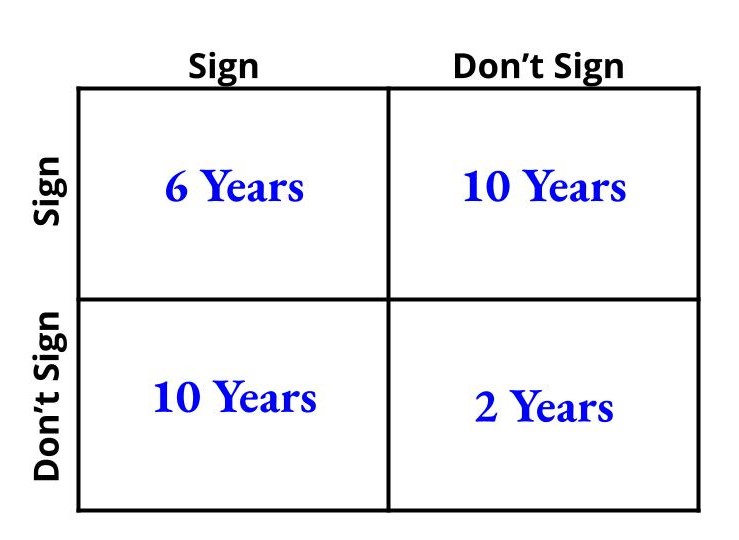
Here is an example of the Prisoner’s Dilemma: pretend you and a friend of yours just robbed a bank. Not a close friend, but someone you may have shared a class with at some point. You got caught and are now waiting in separate interrogation rooms. You are unable to communicate with one another, nor have you spoken about any sort of plan if you two were to get caught. After some time, an officer walks into the room holding a sheet of paper. The officer tells you that if you sign the paper, which blames the entire incident on your friend, you will be set free and won’t have to serve any jail time. In turn, your friend will be condemned to 10 years in prison. Alternatively, if you don’t sign the paper and your friend does, you will serve 10 years in prison and they won’t serve any time. If neither of you sign the paper, you will each serve 2 years. If you BOTH sign the paper, you each are sentenced to 6 years (see below for a diagram). What would you do?

The logical collective answer would be for neither of you to sign the paper, right? You would still serve 2 years in jail, but the total time spent in jail between the two of you is only 4 years as opposed to 10 years (if only one of you signs) or 12 years (if you both sign). However, on an individual level, the choice to sign the paper is an obvious one. If you sign the paper and your friend doesn’t, you won’t have to serve any time. The problem resides in the fact that your friend’s best move is to also sign the paper. The payoff of signing the paper (at best, 2 years and at worst 6 years) is much more appealing compared to the consequences of not signing the paper (at best 0 but at worst 10 years) on both ends. This means the most likely outcome will be the both of you signing the papers and each serving 6 years. Ideally, the two of you would each refuse to sign the papers and would each serve 2 years. This would in turn be the collectively most optimal choice. In the one-time play, each person’s interests are in complete conflict, which makes cooperation extremely difficult to achieve. 

At the heart of this problem lies the human nature towards both altruism and selfishness. If you were to play the game once, the outcome of 6 years would be unfortunate but better than 10 years. However, if you begin to play the game over and over again against the same person, the matter of history affects your future choices. Therein lies the problem: how do you optimize your strategy to “win” against any other person that you face? This is when a person’s decisions towards either altruism or selfishness matter and affects future interactions. 

In the 1980’s, Robert Axelrod, a professor of political science at the University of Michigan sent out an invitation to a special tournament. This invitation was sent out to a group of very prominent game theorists, people’s whose entire lives were dedicated to studying puzzles like the Prisoner’s Dilemma. Axelrod’s only instruction: submit a computer program that would win at the iterative Prisoner’s Dilemma game. To clarify, winning meant coming out of the game with the fewest years of prison. Each strategy would play every single other strategy and the winning strategy would be the one to result in the fewest years. 

There were numerous strategies of varying complexities. Simple strategies included always defecting (betraying your friend) or never signing (cooperating together and not giving the other up). Another strategy submitted was random (cooperating 50% of the time and defecting 50% of the time). All of the strategies were complete at the time of submission, so no changes could be made to adapt to different opponents. In the end, only one strategy reigned supreme: tit-for-tat. This strategy even won again when Axelrod repeated the tournament with newly submitted strategies.

The tit-for-tat strategy is fairly simple. It consists of two components:

  1. Begin by cooperating.
  2. Match the decision your opponent made in the previous round until the match is finished.

For example, if the match starts with your opponent cooperating, you would in turn cooperate in the next round. If your opponent then defects in round two when you cooperate, you would then defect in round three. 

Against simple strategies, it is fairly easy to analyze how the tit-for-tat strategy holds up. When against an “always cooperate” strategy, the entire match is rainbows and smiles as the two easily cooperate the whole time. Against the random strategy, both the tit-for-tat and the opponent will be 50/50 on cooperating/defecting. Against the “always defect” strategy, the tit-for-tat strategy only loses in the first round before both strategies begin to turn on one another for the rest of the match. So why does this strategy work and what does this mean in the grand scheme of the world?

The strategy works because the strategy can never be taken advantage of for multiple rounds as in the “always cooperate” version, but it will also not miss out on the benefits of cooperation. What this tournament outlines may not be the “best” strategy, as it will stoop to the level of a strategy such as “always defect;” however, it outlines possibly the most optimal strategy to come out on top. It also outlines some tips on how to promote cooperation:

  1. Teach reciprocity: when there are more tit-for-tat strategies in play, the success of other strategies diminishes.
  2. Insist on no more than equity: the tit-for-tat strategy doesn’t expect more than equal action and does not perform more than equal action.
  3. Respond quickly to provocation, but be forgiving: when the opponent defects, the tit-for-tat strategy immediately defects in the next turn. Don’t do more than match your opponent’s last action even if your opponent defects multiple times. 
  4. Don’t be envious: do not try to “beat” your opponent, simply match their previous decision. 
  5. Begin as open as possible: like in the tit-for-tat strategy, begin by opening yourself up to cooperation, making it possible to have the most ideal outcome rather than beginning on a sour note.

The Prisoner’s Dilemma goes beyond a simple mind game: it teaches us that cooperation can be difficult to achieve, even in situations where cooperation is clearly the optimal solution. It is a guide, not a perfect one, but a well tested one, on how individual rationality can lead to collective irrationality. Although this may seem like one giant philosophical problem that may not seem directly relevant, the Prisoner’s Dilemma extends well beyond theory and into the reality of human interaction. 


Works Cited

Axelrod’s Tournament. cs.stanford.edu/people/eroberts/courses/soco/projects/1998-99/game-theory/axelrod.html. Accessed 26 Oct. 2022.

Shah, Rina. “Robert Axelrod: The Prisoner’s Dilemma Simulation.” Shortform

Books, 6 Jan. 2021, http://www.shortform.com/blog/robert-axelrod/. Accessed 26 Oct. 2022.

‌Tit For Tat. 17 Sept. 2019, http://www.radiolab.org/episodes/104010-one-good-deed-deserves-another.