The Perpetuation of Child Labor in the Cocoa Industry: A Critical Examination of Neglect and Corporate Accountability

by Eli Olevsky, May 3, 2024

Consider the chocolate bars you grew up eating. Many of us have fond memories associated with our favorite brands. An exposé by The Washington Post written by Peter Whoriskey and Rachel Siegel revealed that much of the cocoa we buy from major chocolate companies such as Mars, Nestlé, and Hershey begins with child labor. Additionally, the article points out the lack of reduction in child labor, despite pledges from the companies themselves to end child slavery in cocoa plantations such as those in the Ivory Coast in West Africa (Whoriskey and Siegel). This essay will seek to shed light on the inhumane child slavery practices within the cocoa industry, its connections to the chocolate company giants, as well as their subsequent failures to reduce and end those affiliations. Since companies cannot be relied on to change tactics out of the goodness of their hearts, it will ultimately be upon the shoulders of the masses to effect change as they are the primary consumers of these tainted products and can bring about true change by targeting their bottom lines. Once a strategy is no longer profitable, exploitative corporations are forced to change or amend their approaches as proven by numerous successful boycotts and awareness campaigns I will mention in this essay. 

Unfortunately, the presence of child slavery in the cocoa industry is not a recent revelation. It is estimated that 25-50% of children within Ghana and Côte d’Ivoire worked in Cocoa as the results of 2007 and 2008/9 surveys. Despite this, only 5% of children in Côte d’Ivoire and 10% in Ghana worked for pay (Payson Final Report 2011). Comparatively, The Department of Labor reports that currently, “there are 1.56 million children in child labor with 43 percent engaged in hazardous work in Côte d’Ivoire and Ghana”. Additionally, the site lists several dangers of working in these fields, such as chemical exposure, burning fields, sharp tools, and lifting heavy loads (Child Labor in Cocoa). The initial article by The Washington Post described the kind of work children were put to, stating, “There is land to be cleared, typically with machetes; sprayings of pesticide; and more machete work to gather and split open the cocoa pods. Finally, the work involves carrying sacks of cocoa that may weigh 100 pounds or more” (Whorisky and Siegal). A follow-up survey from Tulane University presenting the statistics as of 2013-14 mentioned that these children experienced many types of injuries. The injuries included wounds and cuts, broken bones, burns, snake bites, back pain, muscle pain, and several more (Payson Final Report 2015). Moreover, a 2020 report by NORC found the percentage of children working in cocoa exposed to agrochemicals increased from 15% to 50% in both regions (Sadhu et al.).

In a 2001 congressional record, an article was included in which a reporter details the conditions of working on the Ivory Coast as a child laborer, detailing, “Most of them are 12 to 16 years old. Some are as young as 9. The slaves live on corn paste and bananas. Some are whipped, beaten, and broken like horses to harvest the almond size beans”. The article goes on to a particular account from a consul general in an Ivorian Coast town, reading: 

They called Abdoulaye Macko, who was then the Malian consul general… he found the 19 boys and young men there. Aly, the youngest, was 13. The oldest was 21. “They were tired, slim, they were not smiling.” Macko said. “Except one child was not there. This one, his face showed what was happening. He was sick; he had (excrement) in his pants. He was lying on the ground, covered with cacao leaves because they were sure he was dying. He was almost dead. . . . He had been severely beaten.’ According to medical records, other boys had healed scars as well as open, infected wounds all over their bodies (107th CONGRESS, FIRST SESSION).

The important question to ask after these realizations of child slavery within regions that supply 60% of the world’s cocoa is “What is being done to prevent this?” (Child Labor in Cocoa). In 2001, the Harkin-Engel protocol was established to remove the worst forms of child labor in the growing and processing of cocoa beans. This protocol was signed by several major chocolate companies such as Hershey Food Corporation, Nestlé Chocolate and Confections USA, M&M/Mars Inc., and several more (Harkin Engel Protocol). Despite the protocol, according to The Washington Post Article mentioned before, “The world’s chocolate companies have missed deadlines to uproot child labor from their cocoa supply chains in 2005, 2008 and 2010” (Whoriskey and Siegel).  The 2015 report by Tulane University presenting data between their 2008/09 and 2013/14 surveys noted that children working in cocoa production increased from 1,817,278 to 2,260,407 between the two survey dates (Payson Final Report 2015). The 2020 NORC report also cited, “In Côte d’Ivoire the prevalence rate of hazardous child labor in cocoa production… increased from 23 percent in 2008/09 to 37 percent in 2018/19, while in Ghana….increased from 43 percent in 2008/09 to 51 percent in 2018/19” (Sadhu et al.).

Two decades after the Harkin-Engel Protocol, these chocolate corporations have implemented initiatives to identify child labor within the supply chain and eliminate it. According to Mars’ Cocoa For Generations sustainability plan, they commit to “prevent and mitigate human rights issues…Ensure 100% of our cocoa is responsibly sourced globally and is traceable (from the farmer to the first point of purchase) by 2025” (Cocoa for Generations). Hershey’s Cocoa For Good plan indicates, “we are expanding the coverage of our Child Labor Monitoring and Remediation Systems (CLMRS)…as we aim for 100% coverage of our Cocoa For Good farms by 2025” (Tejada Chavez). Nestlé’s Cocoa Plan echoed a similar tone: “We sourced, in 2022, 68.3% of our cocoa volumes from the Nestlé Cocoa Plan with the aim of reaching 100% by 2025” (Nestle Cocoa Plan). 

To understand the degree to which these companies can be trusted to create any real impact and change, the Washington Post article previously mentioned compiled the relationships between the percent of cocoa that is currently certified by these corporate chocolate giants and the traceable amount. For Mars, “around 50 percent of its cocoa is certified by Fairtrade and Rainforest Alliance”, but only “24 percent is traceable to the farmer level”. Hershey’s claims to have had “80 percent certified at the end of 2018”, while “less than half” is traceable to its source. For Nestlé, however, it has been shown that in the Ivory Coast, 80% of their cocoa that is certified is also traceable to the source (Whoriskey and Siegel). 

Striving for 100% traceable cocoa, while a step in the right direction, does not guarantee any meaningful results as the sourcing of chocolate is done through faulty fair trade certification companies. What good is being able to trace cocoa beans to their source, if the supposedly “certified” source still has instances of child labor harvesting those beans? A 2019 report done by the Corporate Accountability Lab noted, “a BBC investigation found children, including trafficked children, working on Fairtrade certified plantations in Ghana and Cote d’Ivoire. The Kuapo Kokoo cooperative…an Ivorian coop supplying to Nestlé, were both certified Fairtrade” (Empty Promises). A more recent investigation done by the Corporate Accountability Lab in 2021 found that, 

in December 2020, investigators saw a little girl working on a certified farm near Aboisso, carrying cocoa pods on her head. The investigators learned that this farm sold their cocoa beans to the CNEK cooperative, which is certified by both Rainforest Alliance and Fairtrade International…That same December, the investigators spoke with a small boy who was carrying a large bag of cocoa pods to an assembly point on a farm near Abengourou. This farm, they learned, sold its cocoa to the FAHO cooperative that was certified by UTZ through August 2021 and is certified by Fairtrade International (Brudney).

Not only do these certifications fail to adequately reduce the amount of child labor in the cocoa industry, but certified farms in the Ivory Coast were found to be even more likely to have child laborers than other plantations (Whoriskey). The reliance on these certification companies by major global chocolate corporations despite these third-party inspectors only being “required to visit fewer than 10% of cocoa farms”, according to The Washington Post, demonstrates a lack of trustworthiness in these chocolate companies efforts’ to address the still pervasive child slavery in the cocoa industry (Whoriskey and Siegel). It is only symptomatic of the increase in child labor in the cocoa industry over the years.

Despite the prevalence of information highlighting the cruel environments for many children in West Africa, progress has been bafflingly slow to remedy it. Their inability to meet deadlines over the last two decades, coupled with their use of completely unreliable certifications is beyond problematic. Due to this, it seems hard to believe that chocolate companies such as Hershey, Mars, and Nestlé have every intention of demonstrating a major change in their supply chain habits to create 100% ethical chocolate production by 2025. Fueled by the increasing numbers of children put in danger to create the products they sell, they need to be held accountable for their inaction.

Several campaigns have been previously successful at changing corrupt industries for the better. An example of this includes the campaign against Nike in the 90s to end the use of child labor and sweatshops in its overseas factories which resulted in reforms and improvements in working conditions within the supply chain (Klein). Another notable example is the Accord on Fire and Building Safety established in Bangladesh, which was established after the Rana Plaza collapse in 2013. The tragedy resulted in the death of 1000 garment factory workers as a result of poor working conditions. Due to increased pressure as a result of public outcry and divestment, the regulation led to major brands, trade unions, and NGOs coming together to implement safety inspections, training programs, and remediation efforts in garment factories (The Bangladesh Accord). We as consumers must speak out against this, for these companies rely on our money to make their chocolates. With our voices and without our funding, they will have no choice but to listen. 

Brudney, Allie. “CAL Finds Evidence of Child Labor on Rainforest Alliance Certified Farms.” Corporate Accountability Lab, 25 Oct. 2021, corpaccountabilitylab.org/calblog/2021/10/25/cal-finds-evidence-of-child-labor-on-rainforest-alliance-certified-farms. Accessed 5 Mar. 2024.

Bureau of International Labor Affairs. “Child Labor in the Production of Cocoa.” DOL, 2024, www.dol.gov/agencies/ilab/our-work/child-forced-labor-trafficking/child-labor-cocoa. Accessed 5 Mar. 2024.

“Cocoa for Generations | Mars, Incorporated.” MARS, 2024, www.mars.com/sustainability-plan/cocoa-for-generations. Accessed 5 Mar. 2024.

Corporate Accountability Lab. “Empty Promises: The Failure of Voluntary Corporate Social Responsibility Initiatives to Improve Farmer Incomes in the Ivorian Cocoa Sector.” Square Space, July 2019, static1.squarespace.com/static/5810dda3e3df28ce37b58357/t/5d321076f1125e0001ac51ab/1563562117949/Empty_Promises_2019.pdf. Accessed 5 Mar. 2024.

“Harkin Engel Protocol.” ICI Cocoa Initiative, Sept. 2001, www.cocoainitiative.org/knowledge-hub/resources/harkin-engel-protocol. Accessed 5 Mar. 2024.

Klein, Naomi. No Logo. BUR, 2018. 

“Nestle Cocoa Plan.” Nestlé Cocoa Plan, 2024, www.nestlecocoaplan.com/. Accessed 5 Mar. 2024.

Payson Center for International Development and Technology Transfer. “Final Report – Oversight of Cocoa Industry in Ghana and Ivory Coast.” Issuu, 11 Apr. 2011, issuu.com/stevebutton/docs/tulane_final_report.  Accessed 5 Mar. 2024.

Payson Center for International Development and Technology Transfer. “Final Report: Survey Research on Child Labor in West African Cocoa Growing Areas.” DOL, 30 July 2015, www.dol.gov/agencies/ilab/final-report-survey-research-child-labor-west-african-cocoa-growing-areas. Accessed 5 Mar. 2024.

“PROCEEDINGS AND DEBATES OF THE 107th CONGRESS, FIRST SESSION.” Congress.Gov, 28 June 2001, www.congress.gov/crec/2001/06/28/CREC-2001-06-28.pdf Accessed 5 Mar. 2024.

Sadhu, Santadarshan, et al. “NORC Final Report: Assessing Progress in Reducing Child Labor in Cocoa Production in Cocoa Growing Areas of Côte d’Ivoire and Ghana.” NORC, Oct. 2020, https://www.norc.org/content/dam/norc-org/documents/standard-projects-pdf/NORC%202020%20Cocoa%20Report_English.pdf Accessed 5 Mar. 2024.

Tejada Chavez, Angela. “Visible Progress: Hershey’s Cocoa for Good Strategy.” The Hershey Company, 2024, www.thehersheycompany.com/en_us/home/newsroom/blog/going-beyond-fair-trade-with-hersheys-sustainable-cocoa-strategy.html Accessed 5 Mar. 2024.

“The Bangladesh Accord on Fire and Building Safety.” The Bangladesh Accord, bangladeshaccord.org/. Accessed 29 Apr. 2024.

Whoriskey, Peter, and Rachel Siegel. “Hershey, Nestle and Mars Broke Their Pledges to End Child Labor …” The Washington Post, 5 June 2019, www.washingtonpost.com/graphics/2019/business/hershey-nestle-mars-chocolate-child-labor-west-africa/. Accessed 5 Mar. 2024.

Whoriskey, Peter. “Utz Finds Alarming Problems at Four Cocoa-Certifying Firms – The …” The Washington Post, 23 Oct. 2019, www.washingtonpost.com/business/2019/10/23/chocolate-companies-say-their-cocoa-is-certified-some-farms-use-child-labor-thousands-are-protected-forests/. Accessed 5 Mar. 2024.

The Possible Anti-depressant Effects of Magic Mushrooms

By Maisha Pathan, March 9, 2024

Depression is a debilitating condition that affects up to 17.8% of American adults as of
2023 (Witters). Although there are countless treatment options in the form of antidepressants,
and therapy, sometimes, these treatments may still not be enough to provide relief for those
suffering from depression. Shrooms, also known as magic mushrooms may be an emerging
answer to those seeking an alternative. This unorthodox form of treatment called
psilocybin-assisted therapy (PAT) is gaining popularity, and the results are significant enough to
be brought to the public’s attention. In PAT, the patient is given a dose of the psychedelic
psilocybin, also known as magic mushrooms, in a controlled setting while their assigned
therapist stands by to monitor the experience. Despite its low toxicity and even being safer than
nicotine and aspirin, the stigma surrounding psychedelics causes people to hesitate even
considering this as an option, on top of which it’s still a controlled substance by the government
(Lowe et al. 20). However, research obtained from clinical trials shows that in a controlled
environment and administered by a trusted professional psilocybin has a powerful impact on
depressive symptoms, and many participants report improvement in their condition after their
sessions. For the people struggling with treatment-resistant depression, severe depression, or
anyone who finds that medication and therapy aren’t helping them: psilocybin-assisted therapy
could be a viable option for treating depression and should be offered alongside therapy and
medication.


Historically, psilocybin mushrooms have been in use for centuries, prominently in the
Aztec empire around the 15th century. The substance was referred to as “god’s flesh” in Nahuatl
and used in religious and healing rituals (Nichols 679). However, it wasn’t until 1957, when
Albert Hoffman a chemist who (also created LSD) isolated psilocybin from a Mesoamerican
psilocybin mushroom, and published its effects, that magic mushrooms entered modern
American society (Nichols 680) . Although the substance was then used in psychedelic therapy,
it became popularized for its recreational use during the 60’s aided by the hippie movement,
until the USA passed the Comprehensive Drug Abuse Prevention and Control Act of 1970,
which marked it as an illicit drug along with LSD and other psychedelics. Despite these
restrictions, psilocybin continued to be used recreationally by citizens and has been gaining
more traction in media.


Major depressive disorder is a serious depressive disorder that can have a lasting impact
on the brain. This damage essentially rewires the brain which can keep the person in their
depressive state for a prolonged amount of time. The compounds that makeup psilocybin can
sometimes reverse, or rewire, the damage depression does to the brain. According to an article
published by Healthline, a medical information website, depression can shrink regions of the
brain governing memory (hippocampus), emotion (amygdala), and cognitive functions
(prefrontal cortices). As a result of shrinking, function in these brain regions such as emotional
regulation and interest, memory, and concentration are also diminished (“5 Ways Depression
Can Physically Affect the Brain”). Psilocybin, specifically psilocin comes into play here due to
its role as a subtype of serotonin receptor. It activates a serotonin receptor called the 5-HT2A
which increases serotonin levels similar to SSRIs (2-Minute Neuroscience: Psilocybin, 0:16). In
a study conducted by researchers at Weill Cornell Medicine, an fMRI was used to show how the
activation of the 5-HT2A serotonin receptor by psilocin affected the brain landscape. The results showed that on psilocin, the brain lowered energy barriers between different regional
connections in the brain which allowed regions of the brain that were typically not stimulated to
be activated. Due to the flattening of the brain’s energy landscape, new connections could be
made between different brain regions, enabling neuroplasticity and promoting neurogenesis,
which is generation of new neurons. This opens up space that allows the brain to rewire itself,
and if the psilocybin is taken in a clinical setting such as in a PAT session, old patterns of
thinking can be replaced with new, expansive thought patterns which can reverse the effects of
depression on the brain by fostering new connections (Kuceyeski).


The structure of PAT is what makes it so successful and extremely safe in treating
depression. It’s is controlled by doctors and therapists in a clinical setting and is spread
throughout three stages: a preparatory stage, an administration stage, and an integration stage
(Schuitmaker 2). Each stage of PAT plays a significant role in how effective the treatment will
be for the patient while maintaining the environment in a controlled setting.


In the preparatory stage, participants attend several psychotherapy sessions to set their
goals and intentions for their experience. This creates the set and setting. Although individuals’
experiences on psilocybin vary from person to person an important factor to the experience is set
and setting. An article analyzing PAT in medicine by Cureus, a peer-reviewed medical journal,
explains that set refers to a patient’s goals and intentions for their psilocybin experience and is
discussed with their therapist so that it could be used to guide the individual and keep them on
track. The setting refers to the patient’s mental, physical, and emotional state prior to and during
the treatment. Attending these preparatory therapy sessions helps the therapist assess when and
where treatment should take place (Ziff et al. 7).


Once the patient is prepared, the next stage is “administration” which the Yale Manual for
Psilocybin-Assisted Therapy of Depression details. Typically, on the day of administration, the
patient is taken to a homey, welcoming room, where they lie down on the couch, put on
headphones, run a musical playlist, and wear a blindfold. The dose of psilocybin provided can
vary but typically is less than 1 gram and based on what the participant can handle. The music,
lying down, and blindfold work together to create a relaxing environment where the patient can
feel safe. They know that if they need any support they have their therapist right there next to
them. These measures create a controlled environment for the patient, minimizing possible
adverse reactions like anxiety or paranoia which can lead to nausea or vomiting. Once the patient
is settled and has consumed their psilocybin dose, the drug slowly takes effect, guiding them on a
journey into the depths of their mind. The therapist only guides the patient when needed based on
the goals and intentions set in the preparatory sessions, and otherwise does not interfere with the
psilocybin trip (Guss et al. 45-50).


The day after administration takes us to the third stage, “integration.” Integration
consists of several sessions through the following weeks during which the therapist asks the
patient about their experience, what they saw, felt, learned, what they’d like to take away from
their experience, and how to integrate that into their lives (Guss et al. 51-60). Although all three
stages of psilocybin-assisted therapy are equally as important, integration ensures that the
positive experiences are incorporated into the patient’s life and have a lasting effect while the
negative experiences if any are worked through. This structuring makes the therapeutic
administration of psilocybin safe and maximizes the benefits the substance can provide a
patient.

The effectiveness of psilocybin-assisted therapy as a treatment is evident in a number of studies.
In an article published by Johns Hopkins Medicine, the efficiency of using psilocybin to treat
major depression is explored through two studies conducted under their Psychiatry and
Behavioral Sciences department. The results found from both studies showed that using
psychedelic therapy by giving each participant a dose of psilocybin followed by psychotherapy
significantly reduced the symptoms of depression in both studies. Half of the participants in the
first study entered remission from depression at the end of the four-week follow-up. In the
second study, participants with a long history of depression on antidepressants were provided two
doses of psilocybin in a few weeks. They took a GRID-Hamilton Depression Rating Scale before
and after. The results showed that 67% of the participants showed a reduction in their symptoms
after a week, and four weeks after treatment, 54% of participants in the study were in remission
(“Psychedelic Treatment with Psilocybin Relieves Major Depression, Study Shows”). In another
study conducted by the Psychiatric University Hospital of Zurich, 52 participants suffering from
major depressive disorder were treated with psilocybin-assisted therapy. Half of them were given
psilocybin while the other half, 26 individuals were given a placebo. The results showed that
psilocybin significantly decreased depressive symptoms in those who had it, more than those
who received a placebo along with their therapy sessions. By the end of the study 14 out of 26,
met the criteria for remission from depression on the Montgomery–Åsberg Depression Rating
scale. In comparison to the placebo group in which the treatment was technically seven required
therapy sessions, 4 out of 26 met the criteria for remission demonstrating that psilocybin was the
driving force for the symptom reductions (Rotz 7-10).


In one clinical PAT trial conducted by NYU School of Medicine, the participants were four
cancer patients struggling with depression and anxiety. At the end of their participation which
spanned 26 weeks, each patient demonstrated a significant reduction in their depressive
symptoms which resulted from the experiences they had during their trips.
Many people suffering from depression who participated in psilocybin-assisted therapy
clinical studies report having positive experiences that aided in reducing their depressive
symptoms. Chrissy, a 50-year-old female with stage 4 breast cancer stated “[The psilocybin
experience] brought my beliefs to life, made them real, something tangible and true – it made my
beliefs more than something to think about, really something to lean on and look forward to,”
(Malone et a. 4). Although Chrissy knew that she was still going to pass, she was able to accept
and even look forward to the time she had left. In a separate trial by the Faculty of Medicine at
Al-Hikma University, ten participants struggling with depression were treated their with
psilocybin-assisted therapy. During an integration session with their therapist, a young adult
known as Participant 1 stated, “My whole thought pattern changed. I was so relieved. My head
had never been clearer. I was so happy the day after cried to my trip buddy about how I could see
again…. I was on three different anti-depressants, valium, and sleeping pills. This stopped within
2 weeks of my first dose,” (Hisham et al. 3). Many other participants from the same study
reported the experience was mind-expanding, and gave them a more positive outlook in life. The
experiences of the participants in this particular study are consistent with the neuroplasticity
effect psilocybin can have on the brain which allows it to create new connections and eradicate
old, negative thought patterns.


Psilocybin-assisted therapy has proven to be a worthwhile treatment venture for many of the
patients who participated in treatment for their depressive disorders. It’s important to note that psilocybin in this case is being used for treatment, not for recreation or self-exploration and
because it is being used for treatment by entrusted clinics it poses a relatively low risk, if at all to
those who receive it. However, that is not to say that this should be an option for everyone.
Studies have shown that people who are genetically predisposed to psychotic disorders such as
Schizophrenia can be triggered if exposed to any psychedelic substances such as psilocybin, in
the case where if they hadn’t been exposed to the substance they would not have developed any
form of psychosis (Ziff et al. 8). This is however, managed under psilocybin-assisted therapy as
before being able to receive it, all patients must undergo medical health screening to ensure it
will be an appropriate option for them. Many of the clinical studies on PAT usually begin with a
large pool of participants, which is slowly trickled down to a very small number via medical
health screening. The doses of psilocybin provided by these clinics are also quite moderate, and
typically less than even 1 gram which is the starting dose for recreational users. Years of research
and studies have gone on to show that psilocybin-assisted therapy can bring profound
improvement to depressive symptoms, especially for those who have exhausted all other options
such as medications and therapy. Age, health, and environment are all factors to consider when it
comes to PAT and it should be offered based on a mutual decision between the patient and their
mental healthcare provider. Although psilocybin-assisted therapy is not currently offered as an
official treatment and can only be accessed by participating in clinical trials, this may change
soon. In 2018, the FDA granted psilocybin-assisted therapy “break-through therapy” status
which means they will prioritize reviewing it soon for approval meaning it could soon be widely
offered for treatment (Coleman). For those struggling with depression who haven’t found relief
from any of the current treatment options, or are interested in trying psilocybin-assisted therapy,
this may be good news. Still, as in all cases, it’s important to do your own research to determine
whether this is the right option for you.

  1. Alshaikhli, Hisham, et al. “Effectiveness of Psilocybin on Depression: A Qualitative Study.”
    Electronic Journal of General Medicine, vol. 18, no. 3, Apr. 2021, p. em296,
    https://doi.org/10.29333/ejgm/10862.
  2. Coleman, Theara, and The Week US last updated. “The Legal State of Psychedelic Therapy in
    the US.” The week, 25 June 2023,
    theweek.com/drugs/1024449/the-state-of-psychedelic-therapy-in-the-us. Accessed 26
    Oct. 2023.
  3. Guss, Jeffrey, et al. “The Yale Manual for Psilocybin-Assisted Therapy of Depression (Using
    Acceptance and Commitment Therapy as a Therapeutic Frame).” Yale Manual for
    Psilocybin-Assisted Therapy of Depression , Aug. 2020,
    https://doi.org/10.31234/osf.io/u6v9y. Accessed 4 Nov. 2021.
  4. Kuceyeski, Dr. Amy. “Psychedelic Drugs Flatten the Brain’s Dynamic Landscape.” WCM
    Newsroom, Weill Cornell Medicine, 2022,
    news.weill.cornell.edu/news/2022/10/psychedelic-drugs-flatten-the-brain%E2%80%99s
    dynamic-landscape
    .
  5. Lowe, Henry, et al. “The Therapeutic Potential of Psilocybin.” Molecules, vol. 26, no. 10, Jan. 2021, p. 2948, https://doi.org/10.3390/molecules26102948.
  6. Malone, Tara C., et al. “Individual Experiences in Four Cancer Patients Following Psilocybin-Assisted Psychotherapy.” Frontiers in Pharmacology, vol. 9, 2018, p. 335252, https://doi.org/10.3389/fphar.2018.00256. Accessed 26 Oct. 2023.
  7. Nichols, David E. “Psilocybin: From Ancient Magic to Modern Medicine.” The Journal of Antibiotics, vol. 73, no. 10, May 2020, pp. 679–86, https://doi.org/10.1038/s41429-020-0311-8.
  8. Neuroscientifically Challenged. “2-Minute Neuroscience: Psilocybin.” YouTube, YouTube Video, 5 May 2020, www.youtube.com/watch?v=XBEas8MGzd0.
  9. Rotz, Robin, et al. “Single-Dose Psilocybin-Assisted Therapy in Major Depressive Disorder: A Placebo-Controlled, Double-Blind, Randomised Clinical Trial.” EClinicalMedicine, vol. 56, Feb. 2023, p. 101809, https://doi.org/10.1016/j.eclinm.2022.101809.
  10. Schuitmaker, Nicole. “Psilocybin-Assisted Therapy: A Scoping Review of Participants’ and Facilitators’ Experiences in Qualitative Studies.” Research, Society and Development, vol. 12, no. 9, Sept. 2023, p. e12312943308–e12312943308, https://doi.org/10.33448/rsd-v12i9.43308. Accessed 26 Oct. 2023.
  11. Witters, Dan. “U.S. Depression Rates Reach New Highs.” Gallup.com, 17 May 2023, news.gallup.com/poll/505745/depression-rates-reach-new-highs.aspx#:~:text=In%202023%2C%2029.0%25%20of%20Americans. Accessed 19 Aug. 2023.
  12. Ziff, Shawn, et al. “Analysis of Psilocybin-Assisted Therapy in Medicine: A Narrative Review.” Cureus, vol. 14, no. 2, Feb. 2022, https://doi.org/10.7759/cureus.21944.
  13. “Psychedelic Treatment with Psilocybin Relieves Major Depression, Study Shows.” Www.hopkinsmedicine.org, 4 Nov. 2020, www.hopkinsmedicine.org/news/newsroom/news-releases/2020/11/psychedelic-treatment-with-psilocybin-relieves-major-depression-study-shows#:~:text=In%20a%20small%20study%20of. Accessed 26 Oct. 2023.
  14. “5 Ways Depression Can Physically Affect the Brain.” Healthline, 24 Oct. 2018, www.healthline.com/health/depression-physical-effects-on-the-brain#reversing-the-effects. Accessed 26 Oct. 2023.

Exploring the Roots of the Controversies Arising from the Fukushima Incident – Particularly from the Perspective of Pluralistic Public Attitudes Toward Government Decision-making

   by Zijun Zhou, February 20, 2024

With the rapid development of technology, mankind has been able to obtain energy in many ways. From the early days of relying on coal to drive thermal power plants, to the gradual recognition of the importance of clean energy, people began to use wind turbines to generate electricity and to obtain tidal energy from the rising and falling of the tides. The emergence of nuclear power plants has made it seem as if we have an endless supply of energy, and technological advances have brought many conveniences to our lives.

In 1986, when the Chernobyl accident occurred, people were reveling in the convenience of nuclear power plants and the great success of clean energy. Twenty-five years later, the Fukushima Daiichi earthquake and tsunami in Tohoku, Japan, and the nuclear leak at the Fukushima Daiichi nuclear power plant have again raised the alarm and prompted a re-examination of the use of nuclear power plants.

Moreover, accidents at nuclear power plants are not the only issues that have caused widespread concern. After the Fukushima accident, Tokyo Electric Power Company was faced with the challenge of dealing with large amounts of contaminated water. This water, which contained radioactive substances, posed a potential threat to the environment and ecosystem. Tokyo Electric Power Company decided to discharge the treated contaminated water into the Pacific Ocean, a practice that immediately drew widespread international attention and controversy. The practice has also caused much controversy.

This article will examine the controversy over the disposal of contaminated water from the Fukushima nuclear power plant and possible solutions.

On March 11, 2011, the most serious nuclear accident since the Chernobyl disaster occurred at the Fukushima Daiichi nuclear power plant. The accident was initially rated as a Level 5 by the International Nuclear Event Scale (INES) and was later upgraded to a Level 7, ranking it as the most serious nuclear accident alongside Chernobyl. The Fukushima nuclear accident was primarily caused by the Tohoku earthquake and subsequent tsunami.

At the time of the earthquake, the active reactors at the plant automatically shut down their normal fission power generation reactions. Its emergency diesel generators were automatically started to remove residual decay heat. The seismic design basis for the six units at Fukushima ranges from 0.42 g to 0.46 g. The plant experienced no damage to critical parts of the reactors when ground acceleration reached 0.125 g for 30 seconds after the 1978 Miyagi earthquake, which is an indication that the plant is sufficiently earthquake-resistant (Brady 1980). However, the ensuing tsunami flooded the lower portion of the reactor building for Units 1-4, resulting in the loss of power to the emergency generators and circulation pumps and disrupting all AC power to Units 1-4 (Fackler 2011). Due to the lack of cooling water, reactors 1, 2, and 3 suffered meltdowns. Reactors 5 and 6 were offline at the time of the earthquake.

Approximately 110,000 residents were evacuated in the days following the accident. The accident released a large amount of radioactive material into the atmosphere, 80% of which was deposited in the ocean. In addition, a portion of the radioactive material was released directly into the ocean. About 18,000 TBq of radioactive cesium-137 was released into the Pacific Ocean during the accident, and as of 2013, about 30 GBq of cesium-137 was still flowing into the ocean every day (Fackler and Hiroko 2013).

Although some nuclear radiation experts say cancer-related deaths may not increase, a monitoring system operated by the Preparatory Commission for the Comprehensive Nuclear-Test-Ban Treaty Organization tracks radioactive dispersion globally. Within just one month, by day 15, traces of radioactivity could be detected throughout the northern hemisphere (CTPTO 2011). This rapid rate of spread has raised concerns about TEPCO’s decision to discharge nuclear wastewater.

To prevent groundwater from flowing into the buildings of the three damaged reactors at the Fukushima Daiichi nuclear power plant, the Japanese government invested 3.4 billion yen to build a frozen underground barrier (Fackler 2016). Although the barrier succeeded in reducing the flow of groundwater from about 260 tons per day to about 500 tons per day, at Fukushima Daiichi, cooled molten nuclear fuel mixed with groundwater flowing into the reactor buildings, producing contaminated water. In particular, the wastewater from Unit 2 has a high level of radioactivity.

To securely store this wastewater, TEPCO decided to transfer it to a centralized radiation waste treatment facility. Currently, nuclear wastewater is increasing at a rate of about 1 ton per day. TEPCO treats this wastewater using equipment such as the multinucleated removal system (ALPS) and storing it in tanks. By 2020, this wastewater has accumulated to about 1.2 million tons. According to TEPCO’s projections, the tanks will be filled by the summer of 2022 under the current tank expansion plan.

Construction of the equipment needed for treatment and review by the Nuclear Regulatory Commission is expected to take two years, so it is thought that this summer will be the deadline for a decision. Previously, about 10,000 tons of low-level radioactive wastewater and groundwater have been stored in the drainage pits of Units 5 and 6 and are scheduled to be discharged into the sea. The total discharge of radioactive substances is about 1.5×10¹¹ becquerels.

According to TEPCO’s assessment, even if an adult person consumes fish and seaweed from the adjacent sea every day, the effective radioactive dose absorbed is only 0.6 mSv per year, a figure that is only a quarter of the annual radioactive dose (2.4 mSv) received by the public from the natural environment. Complementing this assessment, Ken Buesseler, a marine chemist at the Woods Hole Oceanographic Institution in Massachusetts, successfully persuaded an organization to collect water samples for testing up and down the west coast of North America. The test results showed that the samples contained a maximum of only 8 becquerels of radiation per cubic meter, with less than 2 becquerels originating from Fukushima’s cesium-134 and the rest coming primarily from strontium-90 and cesium-137. This is consistent with the U.S. Environmental Protection Agency’s guidelines for drinking water, which allow for a maximum of 7,400 becquerels of radioactivity per cubic meter of water (Sherwood 2014). These provide support for TEPCO’s view.

In February 2023, a committee of experts from the Ministry of Economy, Trade and Industry (METI) submitted a proposal stating that discharging wastewater into the ocean or atmosphere is a “realistic option” and that ocean discharge is a method that can be “reliably implemented. Since April, the Japanese government has held numerous consultations with local governments, the agriculture, forestry, and fishery sectors, economic organizations, and other stakeholders, and cooperated with the International Atomic Energy Agency (IAEA), eventually gaining the support of the IAEA.

On April 13, 2021, the Japanese Cabinet meeting officially decided that the nuclear wastewater (NW) stored in TEPCO’s FDNPP, or treated water as it is called in Japan, will be discharged into the ocean through the construction of port tunnels. Some experts point to the World Health Organization’s drinking water standard for tritium of 10,000 becquerels (Bq) per liter. This is several times higher than the planned concentration of water discharged from Fukushima.

The Asahi Shimbun, Yomiuri Shimbun, and other mainstream Japanese media provided in-depth coverage and analysis immediately after the Cabinet meeting announced the decision to discharge Fukushima nuclear wastewater into the sea. The decision sparked widespread discussion and enthusiastic reactions in Japanese society. According to a nationwide public opinion poll conducted by the Asahi Shimbun, public support and opposition to the discharge of nuclear wastewater were almost evenly divided, which fully reflects the complexity and dilemma of the issue (Ishimoto 2023).

Following the announcement of the government resolution, a large number of protesters gathered outside TEPCO headquarters, where they demanded that the company take responsibility for the 2011 core meltdown at the Fukushima Daiichi nuclear power plant and provide adequate compensation to the victims. Meanwhile, the protesters strongly demanded the cancellation of plans to send nuclear wastewater into the sea. Activists warned that tritium, a radioactive substance that is readily soluble in water, could enter the human body through the food chain once it is discharged into the ocean, potentially causing long-term contamination of marine life, especially fish and seaweed, and possibly serious public health effects. These concerns have sparked serious public concern about marine pollution in Japan and around the world.

Although TEPCO insists that treated and diluted nuclear wastewater is safe, this claim has been widely questioned and challenged. After the government lifted the evacuation order for all areas of Fukushima Prefecture in August 2021, only a small number of residents chose to return to their hometowns, no doubt reflecting the deep public concern about the safety of the Fukushima area.

In addition, the fishermen’s groups most affected by the decision have launched large-scale protests (Rikimaru 2023). Since the Fukushima nuclear accident, seafood from Fukushima and the nearby Chiba region has been widely rejected by consumers, which has led to serious damage to the reputation of seafood from these areas (Takagi 2021). To preserve their livelihoods and the economic interests of the region, fishermen have launched fierce protests.

As mentioned earlier, the decision to discharge nuclear wastewater from Fukushima sparked widespread controversy in Japanese society. Although two years have passed, a large number of Japanese people still question and disagree with the government’s decision, and they are disappointed with the government’s failure to adequately explain and convince the public to accept the decision (Motoyama 2023). In response, large numbers of people protested outside the Japanese Diet and TEPCO headquarters to express their discontent and concern. They criticized the government’s lack of transparency in the decision-making process and the public’s failure to fully participate in and understand the process. They believe that the government needs to pay more attention to environmental protection and public participation to ensure the fairness of decision-making and the rights of the public.

The Japanese cabinet government’s decision on the discharge of nuclear waste water from Fukushima has also provoked strong reactions internationally. Environmental groups, neighboring countries, and Pacific Island countries, among others, have expressed strong dissatisfaction.

Greenpeace International released a report called Stemming the Tide 2020: The Reality of the Fukushima Radioactive Water Crisis, which refutes the claims of the Japanese government and TEPCO in detail (Burnie 2020). The report states that the three reactors at the Fukushima Daiichi nuclear power plant contained 520 petabytes of strontium-90 in their radioactive cores before the meltdown, of which about 1 to 3 percent has been released into the Pacific Ocean, causing massive water contamination. The report warns that this huge amount of strontium must be stopped from entering the environment.

The Japanese government and TEPCO have adopted the ALPS system designed by Purolite USA and Hitachi General Electric Nuclear Energy Ltd (HGNE) to reduce the concentration of radioactive materials. However, in the process of building and operating the ALPS based on Purolite’s ion exchange technology, the contract was transferred to Toshiba and then to HGNE, and Purolite was excluded. This is particularly significant because Purolite has decades of experience in water treatment ion exchange, while Toshiba and HGNE have little experience in this area. TEPCO’s plans to stop such practices in the next few years are not credible under the current circumstances.

The report further notes that the half-lives of tritium and strontium-90 are 12.3 and 28.8 years, respectively, and that even considering only these radionuclides, the radiation risk would last 125 to 290 years (the risk period is usually considered to be 10 half-lives). Because strontium-90 is similarly absorbed by the body to calcium, it poses a significant health risk and may increase the risk of leukemia. In addition, while TEPCO claims to have addressed the risk of tritium, they may be ignoring the effects of organically bound tritium (OBT) on the human body and the possible conversion of tritium water (HTO) to organically bound tritium in the event of a steam release.

The report also emphasizes that, Unlike the oceanic behavior of tritium, large amounts of radioisotopes are more likely to be absorbed into marine communities or deposited on the seafloor. For example, the bioconcentration factor of carbon-14 in fish is 50,000 times higher than that of tritium. In addition, isotopes such as cobalt-60 may be associated with seafloor sediments by as much as 300,000 times. As these radioactive materials are released from nuclear power plants into the marine environment, the exposure of marine organisms to radioactivity will inevitably increase. The specific exposure levels are influenced by many factors, and the concentrations in these biomes are directly related to humans because people may consume these contaminated marine organisms.

TEPCO made a bad decision by focusing on tritium monitoring and ignoring other radioactive materials that could have an impact on humans. Jennifer Morgan, executive director of Greenpeace International, strongly criticized this approach. She said, “It is unacceptable that in the 21st century when our planet and especially the global oceans face so many challenges and threats, the Japanese government and TEPCO should justify the deliberate dumping of nuclear waste into the Pacific Ocean. This decision is a violation of Japan’s legal obligations under the United Nations Convention on the Law of the Sea (UNCLOS) and will be strongly opposed in the months ahead.”

The decision by the Japanese government and TEPCO to begin discharging treated water from the Fukushima Daiichi nuclear power plant into the ocean in the summer has caused widespread concern in its neighboring countries. Sun Xiaobo, director general of the Chinese Foreign Ministry’s Arms Control Department, publicly criticized the decision and said at a press conference in Beijing that “Japan’s unilateral decision to discharge treated water into the ocean is an extremely irresponsible act.” Sun stressed that he would work with neighboring countries to oppose the decision (Paid Article 2023). The Chinese government has long expressed strong concern about such actions and opposes any discharge of treated water into the ocean. Sun also said that if Japan decides to force the discharge of wastewater into the ocean, he will join with neighboring countries such as Russia and South Pacific countries in protest (Hayashi 2023).

On March 24, 2023, China and Russia issued a joint statement expressing once again their serious concern over the Japanese government’s decision to discharge nuclear wastewater into the ocean (Tomina 2023). Meanwhile, South Korean President Moon Jae-in’s office announced that South Korea would file a lawsuit with the International Tribunal for the Law of the Sea over Japan’s resolution to dispose of the water discharge and that interim measures might be taken (Toyoura 2021). Although South Korea’s foreign minister later said that his government would not object to Japan’s decision if it met International Atomic Energy Agency (IAEA) standards (Tateishi 2021), a survey by the University of Tokyo showed that about 90 percent of South Koreans and Chinese believe that food produced in Fukushima Prefecture could be affected by the planned spring and summer discharges of nuclear wastewater into the ocean from TEPCO’s Fukushima Daiichi nuclear power plant, and would therefore be potentially risk. The findings further underscore the serious concerns of Japan’s neighbors about the country’s discharge of nuclear wastewater (Fukuchi 2023).

In exploring the opposition of Japan’s neighbors to Japan’s nuclear wastewater discharge decisions, we must consider a variety of possible influences. First, the historical context and the long-standing relationship between Japan and its neighbors may be a source of these opposing voices. International political issues in recent years may also have had an impact on the relationship between Japan and its neighbors, which in turn may have generated opposition to this decision.

Environmental groups’ opposition to Japan’s decision is likely based on deep environmental concerns. They are concerned that the discharge of treated nuclear wastewater into the ocean could have serious negative effects on the ecosystem, which in turn could threaten human health and life.

The public’s opposition attitude has also drawn our attention. We need to recognize the complexity of forming people’s attitudes toward government decisions, where people’s approval or disapproval of government decisions is not always based on rational judgments based on in-depth knowledge and comparison of various expert opinions. In this regard, Robert C. Solomon has argued that in many (if not most) trust relationships, trust itself is invisible or transparent.

The environment in which we are raised, both culturally and socially, has a profound effect on our attitudes toward government decisions. Even when we are not aware of it, these environmental factors are shaping our views. For example, we may have a natural affinity for a certain viewpoint, perhaps because of our nationality, our beliefs, or the environment in which we were raised.

Jennifer A. Reich makes a similar point in her work, Calling A Shot: Why Parents Reject Vaccines. She points out that people may trust or reject a certain point of view due to a variety of factors such as religious beliefs, educational background, and nationality (Reich 2016). This phenomenon is evidence that our opinions and attitudes are not always based on rational analysis and judgment, but are influenced by our beliefs and environment.

In addition, our interests can also influence our attitudes toward government decisions. When a decision may harm our interests or position, we may choose to oppose the decision. This is why in some cases, even if expert opinions support government decisions, people may still be opposed to them because their interests may be harmed as a result.

Therefore, we must note that people’s attitudes toward government decisions are not based on rational analysis and judgment of experts’ views alone, but may also be influenced by their beliefs, circumstances, and personal interests.

On the other hand, the public is informed by a variety of sources, including government announcements, news media, environmental organizations, scientific experts, and social media. These sources may provide different or even conflicting information, leading to differences in the public’s understanding and perception of a particular decision.

In addition, the public’s level of trust in other countries and organizations may also influence their attitudes toward Japan’s nuclear wastewater discharge decisions. For example, if the International Atomic Energy Agency supports Japan’s decision, then some members of the public may take this to mean that the discharge of wastewater was fully evaluated and deemed safe. However, if other countries and organizations like neighboring governments or international environmental organizations express opposition, the public may be skeptical and concerned about the Japanese government’s decision as a result.

In the decision-making process of discharging nuclear wastewater from the Fukushima nuclear power plant, we see the involvement of a large number of experts from the IAEA and the Japanese government to representatives of neighboring countries, international organizations, and environmental groups who have a significant impact on the decision-making process. These experts play different roles in Pielke’s “honest broker” theory, including pure scientist, science arbiter, issue advocate, and honest broker (Pielke 2007).

The role of the pure scientist is primarily to provide scientific information, and they are not concerned with how that information is used to make decisions. Similarly, science arbiters answer questions about science but do not try to influence the outcome of decisions. However, in the case of the Fukushima nuclear wastewater discharge, we find that many experts are closer to the role of issue advocate. They not only provide information but also try to persuade people to accept their views by limiting the scope of the information.

Although the role of an honest broker is to provide people with all the information and help them make decisions based on their preferences, it may be difficult to find a truly honest broker on this issue. because all parties have their interests and positions, which makes it possible for them to provide information while trying to influence people’s decisions.

However, it is important to recognize that people’s trust in a particular idea is not constant and that every trust relationship undergoes a dynamic process of change. No matter how much people trust a certain idea in the initial stage, this trust relationship will always change with time and the emergence of new information.

The decision-making process for the treatment and discharge of nuclear wastewater from Fukushima demonstrates how a policy issue of great public concern has generated widespread and in-depth debate worldwide. The Japanese government’s announcement of its decision provoked widespread concern and alarm from people around the world. Professionals from all sides with different positions actively participated in the public discussion, using their expertise and insight to express their views, which had a significant impact on the public’s understanding and thinking on the issue.

In particular, Japan’s neighbors, including China, Russia, and South Korea, have expressed strong opposition to the decision. They criticized the Japanese government for its lack of transparency and irresponsibility in its decision-making process. South Korea even summoned the Japanese ambassador to South Korea to voice its opposition.

Greenpeace, an internationally influential environmental organization that has been both a promoter of several international agreements, such as the Kyoto Agreement, and a persuasive opponent of the proposal, has led to questions about whether the Japanese government’s decision was problematic and publicly released its criticism of Japan’s policy. Other influential experts have also published condemnations of Japanese policies on important academic platforms. These public criticisms have led to a serious split in Japanese society’s position on the policy, creating a clear polarization, i.e., a clear balance of public support and opposition to the policy. At the same time, these persuasive opponents have led to increasing skepticism about the Japanese government’s decisions. Indeed, Japan’s decision-making process does lack transparency, which increases suspicion of its decisions.

To solve the problem, the Japanese government chose to invite experts from the International Atomic Energy Agency to participate in the development and evaluation of the solution, and the solution was made public to the international community. This has increased the scientific nature of the Japanese government’s decision-making to some extent and has also restored some of the people’s trust in it.

On the other hand, the actions and stance of Greenpeace, an international environmental organization that has long been an active advocate of reducing carbon emissions, have been the focus of public attention, but its senior leadership’s frequent commuting by air has been a stark contrast to its environmental advocacy, raising questions about its consistent stance (Webster 2014). In addition, Greenpeace has taken some extreme actions in its environmental fight that could lead to permanent environmental damage around certain well-known geographic landmarks (Kozak 2014).

More controversially, Greenpeace seems to have taken too much of a political stance on some environmental issues at the expense of the scientific basis. For example, they strongly oppose the use of diisononyl phthalate (DINP), even though DINP has been confirmed as safe by multiple government agencies and independent evaluators. Greenpeace’s credibility took a serious hit when DINP was again scientifically evaluated and confirmed to be harmless to human health (Moore 2008).

This incident led to a re-examination of the accuracy of Greenpeace’s views in opposition to the Japanese government’s decision in question, as well as their true motives. As time went on, public attitudes began to shift and more and more people began to lean in favor of the Japanese government’s decision (Ishimoto 2023).

This example again illustrates that the public’s views are not static, but change with the environment, information, and time. The role of experts and the way they convey information have a significant impact on the public’s decision-making. At the same time, it reveals why the resolution of nuclear wastewater treatment at the Fukushima nuclear power plant was so controversial and the complexity of people’s attitudes toward it. Advances in technology have been accompanied by diverse perspectives, making it more difficult to clarify the facts.

This article explains why the issue of the Fukushima nuclear power plant is controversial in terms of the changing attitudes of the public. Both the Fukushima and Chernobyl nuclear accidents are among the worst nuclear disasters in history, and they have sparked a deep global rethinking of the safety of nuclear energy. People have different understandings and perspectives on these events from their backgrounds and positions, and this has led to controversies over such events.

In evaluating the veracity of different viewpoints, we need to fully understand that each person’s position and background will influence their perspective. One position may focus on one side of the issue and ignore the other. Therefore, we need to synthesize various viewpoints to get a more comprehensive understanding.

In the context of the contemporary knowledge society, openness and transparency of information play a decisive role in resolving complex disputes and issues. Taking the Japanese government’s response strategy as an example, the progression from its initial state of information asymmetry to inviting the participation of experts from the International Atomic Energy Agency can be viewed as a significant increase in the awareness of openness to information and professional collaboration. Such an information strategy not only allows the public to understand the factual details more systematically and in-depth but also creates a platform for consensus and collaboration among multiple stakeholders to discuss and develop effective solutions. However, for a complex event like Fukushima, relying on information transparency alone cannot fully satisfy the entire process of problem-solving. More critically, based on this information, parties can engage in continuous, in-depth, and constructive exchanges to ensure that the optimal solution path is identified and implemented in a synergistic manner.

“90% in China and Korea Consider Fukushima Food Products Dangerous: University of Tokyo Survey on Treated Water Release.” Yomiuri Shimbun, 14 Feb. 2023.

https://www.yomiuri.co.jp/science/20230214-OYT1T50119/

Rikimaru, Shoko. “The Imminent Release of Treated Water into the Ocean: Associate Professor Hayashi of Fukushima University Calls for ‘National-Led Decision Making’.” Asahi Shimbun, 15 Apr. 2023. https://www.asahi.com/articles/ASR4G73J9R2NUGTB00G.html?iref=pc_ss_date_article

Paid Article. “Opposition to Treated Water Release: ‘Collaborate with Neighboring Countries’ – China Emphasizes Stance.” Asahi Shimbun, 17 Mar. 2023.

https://www.asahi.com/articles/DA3S15583427.html?iref=pc_ss_date_article

Hayashi, Nozomu. “China Intensifies Opposition to Ocean Discharge of Nuclear Plant Treated Water: Also Poised to Collaborate with Affected Countries.” Asahi Shimbun, 16 Mar. 2023.

https://www.asahi.com/articles/ASR3J6FXJR3JUHBI02Z.html?iref=pc_ss_date_article

Takagi, Kiyoshi, et al. “Fishing Industry Stakeholders in Chiba Express Concern Over Treated Water Discharge.” Asahi Shimbun, 14 Apr. 2021.

https://www.asahi.com/articles/ASP4F7F0RP4FUDCB00Q.html?iref=pc_ss_date_article

Tomina, Takashi. “China-Russia Joint Statement Makes Opposition to the U.S. Clear: Expresses ‘Concern’ Over Fukushima Nuclear Plant Treated Water Issue.” Asahi Shimbun, 22 Mar. 2023. 

https://www.asahi.com/articles/ASR3Q5R8VR3QUHBI015.html?iref=pc_ss_date_article

Imaizumi, Kanade. “80% in South Korea ‘Not Purchasing’ Fukushima Products: Survey on Rumors Regarding Nuclear Plant Treated Water.” Asahi Shimbun, 27 Apr. 2022.

https://www.asahi.com/articles/ASQ4V6WB6Q4VULFA03H.html?iref=pc_ss_date_article

Rikimaru, Shoko, and Fukuchi Keitaro. “Two Years Since the Decision to Discharge Treated Water into the Ocean: Tunnel Construction Progresses Amid Opposition.” Asahi Shimbun, 14 Apr. 2023.

https://www.asahi.com/articles/ASR4F6R9GR4DUGTB009.html?iref=pc_ss_date_article

Tateishi, Tsuyoshi. “U.S. Negative on Intervening: South Korean Foreign Minister Reverses Stance, ‘Not Opposed to Treated Water Discharge Under Conditions’.” Yomiuri Shimbun, 20 Apr. 2021. https://www.yomiuri.co.jp/world/20210419-OYT1T50238/

Toyoura, Junichi, and Nakagawa Takayuki. “China and South Korea in Step Over ‘Treated Water’: Hold Video Conference to Express ‘Strong Dissatisfaction’.” Yomiuri Shimbun, 15 Apr. 2021. https://www.yomiuri.co.jp/world/20210414-OYT1T50182/

Webster, Ben. “Greenpeace Chief Travels to the Office by Aircraft.” The Times, 24 Jun. 2014. https://www.thetimes.co.uk/article/greenpeace-chief-travels-to-the-office-by-aircraft-r8lmdpvtjgc

Moore, Patrick. “Why I Left Greenpeace.” Wall Street Journal, 22 Apr. 2008. https://www.wsj.com/articles/SB120882720657033391?mod=opinion_main_commentaries

Currie, Duncan E. J., and Shaun Burnie. “Japan’s Plan for Radioactive Water Defies International Law.” The Korea Times, 9 Mar. 2020. https://www.koreatimes.co.kr/www/nation/2020/07/371_285553.html

“Radiation & Decontamination.” Tokyo Electric Power Company, 11 Jul. 2018, http://www.tepco.co.jp/en/press/corp-com/release/betu11_e/images/110626e1.pdf.

“Fukushima Daiichi Nuclear Plant Treated Water to be Released into the Ocean: Government in Final Stages of Coordination.” Asahi Shimbun, 16 Oct. 2020. https://www.asahi.com/articles/ASNBJ3PW9NBJULBJ003.html

“CTBTO Tracks Fukushima’s Radioactive Release.” Youtube, uploaded by CTBTO, 12 Mar. 2011, http://www.youtube.com/watch?v=9b7PwKraaek.

Fackler, Martin, and Hiroko Tabuchi. “With a Plant’s Tainted Water Still Flowing, No End to Environmental Fears.” The New York Times, 24 Oct. 2013. https://www.nytimes.com/2013/10/25/world/asia/with-a-plants-tainted-water-still-flowing-no-end-to-environmental-fears.html

Brady, A. Gerald. An investigation of the Miyagi-ken-oki, Japan, earthquake of June 12, 1978. Vol. 13. US Department of Commerce, National Bureau of Standards, 1980.

Fackler, Martin. “Report Finds Japan Underestimated Tsunami Danger.” The New York Times, 1 Jun. 2011. https://www.nytimes.com/2011/06/02/world/asia/02japan.html

“Great East Japan Earthquake.” Reconstruction Agency, http://www.reconstruction.go.jp/english/topics/GEJE/.

Fackler, Martin. “Japan’s $320 Million Gamble at Fukushima: An Underground Ice Wall.” The New York Times, 29 Aug. 2016. https://www.nytimes.com/2016/08/30/science/fukushima-daiichi-nuclear-plant-cleanup-ice-wall.html

“Contaminated Water Treatment.” Tokyo Electric Power Company, http://www.tepco.co.jp/en/decommision/planaction/alps/index-e.html.

“Fukushima Daiichi Nuclear Accident.” International Atomic Energy Agency, http://www.iaea.org/topics/response/fukushima-daiichi-nuclear-accident.

Sherwood, Courtney. “Fukushima Radiation Nears California Coast, Judged Harmless.” Science, 11 Nov. 2014. https://www.science.org/content/article/fukushima-radiation-nears-california-coast-judged-harmless

“IAEA Ready to Support Japan on Fukushima Water Disposal, Director General Grossi Says.” International Atomic Energy Agency, 26 Apr. 2021, http://www.iaea.org/newscenter/pressreleases/iaea-ready-to-support-japan-on-fukushima-water-disposal-director-general-grossi-says.

Ishimoto, Toshio. “Survey: 51% Support Releasing Treated Nuclear Water into Ocean.” The Asahi Shimbun, 20 Mar. 2023. https://www.asahi.com/ajw/articles/14865588

Motoyama, Hideki. “Two Years Since the Decision to Discharge Treated Water into the Ocean, Actions Against Continue: ‘Goodbye Nuclear Power’ Executive Committee.” Asahi Shimbun, 13 Apr. 2023.https://www.asahi.com/articles/ASR4F622WR4FUTIL013.html?iref=pc_ss_date_article

Rikimaru, Shoko. ” 「Not understanding why it was discharged」fishermen appeal to the Minister of Economy, Trade, and Industry over treated water.” Asahi Shimbun, 26 Feb. 2023. https://www.asahi.com/articles/ASR2T7442R2TUGTB001.html?iref=pc_ss_date_article

Burnie, Shaun. “Stemming the Tide 2020 The Reality of the Fukushima Radioactive Water Crisis.” Greenpeace Germany, Oct. 2020.www.greenpeace.org/static/planet4-japan-stateless/2020/10/5e303093-greenpeace_stemmingthetide2020_fukushima_radioactive_water_crisis_en_final.pdf.

“The Japanese Government’s Decision to Discharge Fukushima Contaminated Water Ignores Human Rights and International Maritime.” Greenpeace, 13 Apr. 2021, http://www.greenpeace.org/international/press-release/47207/the-japanese-governments-decision-to-discharge-fukushima-contaminated-water-ignores-human-rights-and-international-maritime-law/.

Fukuchi, Keitaro. “Concerns Over the Safety of Prefectural Products Due to Treated Water, Survey of Awareness in Europe, America, and Asia.” Asahi Shimbun, 14 Feb. 2023. http://www.asahi.com/articles/ASR2904B1R28UGTB002.html.

Pielke Jr, Roger A. The honest broker: making sense of science in policy and politics. Cambridge University Press, 2007.

Reich, Jennifer A. “Calling the shots.” Calling the Shots. New York University Press, 2016.

Kozak, Robert. “Peru Says Greenpeace Permanently Damaged Nazca Lines.” The Wall Street Journal, 15 Dec. 2014, web.archive.org/web/20141221182041/https://www.wsj.com/articles/peru-says-greenpeace-permanently-damaged-nazca-lines-1418681478.

Casablanca (1942)

by Vishruth Nagam, December 16, 2022

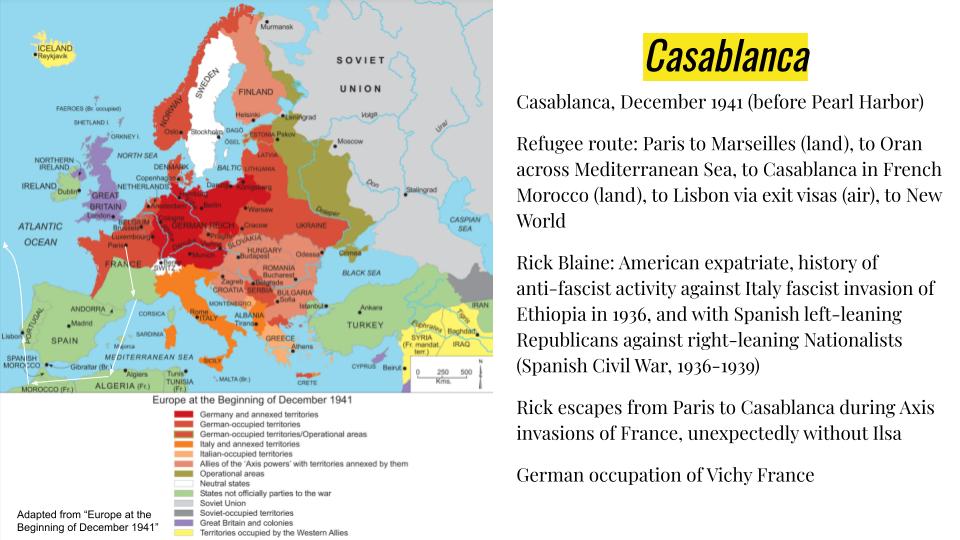
Casablanca (1942) was released in the wake of the attack on Pearl Harbor. The plot of the film is set in Casablanca, Morocco, in December 1941 before the U.S. entered World War II (WWII). Based on the play Everybody Comes to Rick’s by Murray Burnett and Joan Alison, Casablanca featured an accomplished production team and cast, who adapted upon the play’s anti-Nazi, pro-French themes. The film’s production, drama, and themes have grounded the lasting reception of the film and continued discussion on pertinent topics in the humanities. This infographic explores the factors, complexities, and dynamics contributing to the success of Casablanca as a classic.


What Does it Mean to be Free: Sartre’s Take On Human Freedom in the Face of the Nazi Regime

by Gina Koch, April 15, 2022

Jean-Paul Sartre is undeniably one of the most prominent philosophers of the twentieth century and the chief founder of existentialism. The works he published influenced various ideologies spanning philosophy, politics, literature, and cultural studies. Sartre, like most philosophers, had his moments of being subject to public disappointment and outrage. After living through World War II as a French prisoner of war, he sparked outrage when he published the essay, “The Republic of Silence,” which he started with the infamous line “Never were we freer than under the German Occupation” (Sartre, 1).

In  “The Republic of Silence,” Jean-Paul Sartre explores the concept of true freedom amid the Nazi German occupation of France. Extreme conditions often breed unique schools of thought for many thinkers, and Sartre was no different. Being a witness and victim of the brutal Nazi regime resulted in profound ideologies coming to light, especially regarding the concept of freedom as evidenced by his essay “The Republic of Silence.” Sartre explains that the essence of true freedom materialized during times of oppression. When people are condemned to extreme conditions of suffering, the sanctity of every thought and every right becomes apparent, and they are faced with the question of their freedom. There exists no force or authority that is capable of taking away one’s freedom because it is inherent and essential to the human condition. However, some forces can place physical limitations on one’s freedom, and it becomes a grave situation when these limitations go so far beyond as to attack one’s rights, beliefs, and principles. Under such an attack, people have the choice to exercise their freedom and resist such oppressive forces or partake in bad faith and give up on such beliefs and principles. This concept of freedom was different from other ideologies circulating at the time. For example, French philosopher Albert Camus, known for his contributions to the absurdist movement, maintained that human freedom is not inherent to humans but rather a state of mind achieved when people understand the absurdity and meaninglessness of life; thereby stopping themselves from constructing some greater meaning from it (Camus). Many differing ideologies regarding human freedom circulated during this war-torn era, but Sartre’s ideas managed to stand out among them. 

During the Nazi era in Germany, which lasted from 1933 to 1945,  particular groups of people such as the Jewish, gypsies, homosexuals, and any other groups not considered a part of the superior Aryan race were targeted as part of the ethnic cleansing scheme initiated by political leader Adolf Hitler. These groups faced oppression, suffering beyond imagination, and witnessed their inherent and basic rights being stripped away from them. They were stripped of their citizenship, denied interactions with those considered part of the Aryan race, and sent to concentration camps, often to be killed. Sartre, being a philosopher who means to seek meaning in everything that happens around him, found hope among the brutality that surrounded him. In his essay, he claims, “never were we freer than under the German Occupation” (Sartre, 1). It is quite a wonder that Sartre was able to find such freedom when the majority of people around him were arrested, sent to concentration camps, or killed. He is not talking about physical freedom, but inherent freedom; the freedom that governs the human condition and is an essential part of existence. He compares the manner people think in during peaceful times and during atrocious ones, similar to that of Nazi occupation. 

As Sartre says, “In this way, the very question of freedom was posed, and we were on the verge of the deepest knowledge human beings can have of themselves” (Sartre, 5). During times of oppression, people tend to question the limits of their freedom and their character questions that were neglected during peaceful times. Would they resist the torture and hold on to secrets and information about the resistance movement or would they give in to the pain and reveal secrets that can lead to numerous arrests and deaths? It is during moments like these that people question their freedom and existence because the choices they make can have profound effects, many times concerning life or death. Sartre also discussed “resistance was a true democracy” (Sartre, 6). There was solidarity in how they resisted the Nazi regime. During such difficult times, there is a sense of equality and responsibility among the people that is not palpable in society during peaceful times. Sartre claims he witnessed the strengthening of the Republic because everyone shared the same freedom regardless of their rank or position within the movement. The freedom they experienced while under the ironclad rule of the Nazi regime was one that was true, absolute, and equal. 

The freedom that Sartre discusses in his essay is distinct from the conventional idea of freedom that many may have. The freedom to do anything one wants is separate from the true and absolute freedom that Sartre refers to. True personal freedom is one’s ability to express their beliefs and principles regardless of the forces that govern them. It is the ability to make choices regardless of any rewards or material possessions one may obtain as a consequence of their choice. In an oppressive society, personal beliefs often start to take precedence over any material possessions and sometimes, over their own life. In other words, people are willing to die at the hands of their oppressors rather than give up on what they believe in. In his essay, Sartre explains that people often made the authentic choice in the presence of death, and it was through this act that they were able to exercise true freedom. Many of those who were tortured at the hands of the Nazis resisted revealing any information they had on the resistance movement because they stayed true to believing that their people should be freed from the oppressors. This choice may have cost them their lives but they did so as part of exercising their freedom. If they had instead chosen to spill information as a means to keep themselves alive, they would have continued living a limited life; one in which they sacrificed their freedom and lacked any meaning or purpose because they abandoned any beliefs they had. People are more than their situation so they should be able to transcend the situation and stay committed to their beliefs. 

The attitudes that Sartre shared in his essay forces us to think about the manner in which we live. Initially, society seems to be guilty of stripping freedom away from the people, and then forcing them to obey laws in order to keep their freedom. In fact, it may seem quite ironic how we are rewarded with freedom, which is something inherently ours, for giving up a certain level of our autonomy. However, this outlook on society in freedom is not accurate. Since freedom is something that is inherently ours and essential to our existence; it cannot be stripped away from us by external forces or authority. However, as members of society, we agree to accept some limitations placed on our freedom. For example, we agree to obey the laws of society as a means to maintain order in our lives and fulfill our potential as social creatures. However, we do not lose our freedom because everyone has the ability to break the law. The fact that we are still capable of committing terrible acts but choose not to proves that we still maintain our freedom. 

However, one would have to face the consequences of committing any terrible and unlawful acts. Therefore, it is important to distinguish between the consequences of an act and freedom. People have the freedom to commit any acts but they may not be successful or satisfied with the consequences, but this does not mean they do not have the freedom to commit an act. The German occupation placed limitations on people’s freedom that conflicted with their rights and beliefs. At this point, it becomes a clear case of oppression as opposed to society maintaining order. During peaceful times, it is not obvious if something is lacking in the manner they live their lives but during oppressive circumstances, it becomes very apparent. Once, it becomes apparent that their lives are not to be lived in the way that it is supposed to be, the urge to fight for their lives materializes and it results in a strength that ultimately empowers them to exercise their freedom. The absolute freedom that they experience under the regime is one that was born out of the shackles that they were bound to. 


Works Cited

Camus, Albert. “The Myth of Sisyphus.” The Myth of Sisyphus, and Other Essays. Translated by Justin O’Brien, Hamish Hamilton, 1955, pp. 3-119.  

Sartre, Jean-Paul. “The Republic of Silence.” Lettres françaises, 1944, pp. 1-7.

The Origins of Ancient Rome Reveal Incredibly Sexist Social Structures

by Namal Fiaz, March 29, 2022

The birth of the Roman Republic, which would soon transform into a vast empire with a monumental legacy, has brutal origins all beginning with a rape victim. It’s no secret the Romans were excellent storytellers; the proof is longevity. Roman myths, passed down for generations, outlived their society and continue to echo off the tongues of modern storytellers. 

The story of Lucretia is a mythological and historical tale that has survived since the early origins of Roman history, over two thousand years since its believed origins in 509 BCE. It was narrated and criticized in several different versions of works by prolific Roman writers such as Livy, Ovid, and Dionysius. Gaining popularity immediately after her death, Lucretia became a legendary symbol of beauty, virtue, and chastity. Subsequently, Roman society encouraged women, and especially young girls, to view her as a matron for model behavior. 

As the victim of the story, the glorification of Lucretia’s story after her death reveals deeper insight into the sexist roles women were expected to conform to in ancient Rome.

In Book 1 of Ab Urbe Condita, “From the Founding of the City,” Titus Livius, or Livy, a Roman historian whose works are largely viewed as reliable historical sources, recounts Lucretia’s story. Livy narrates the events leading up to the climax of her rape, as well as the aftermath and her impact on the founding of the republic. The story begins with Lucius Tarquinius Collatinus, Lucretia’s husband, and his companions drinking at the house of Sextus Tarquinius, son of the king Tarquinius Superbus, one night. The men drunkenly argue on the subject of wives, each man praising his own, and Collatinus decides that the mere sight of his wife at such late hours would put an end to the debate altogether. They mount their horses and head to Collatia, a Roman town governed by Collatinus, and into the quarters where Lucretia resides. Upon entering, Lucretia is seen weaving wool by herself by the lamplight with only the company of slave girls, unlike the other wives who had spent their night mingling and drinking with each other. This alone is meant to portray her legacy as a woman of the utmost chastity and virtue. Lucretia wins “the prize of this contest in womanly virtues”1 for her devotion to her husband and home. Sextus, intrigued by her beauty, is “seized by wicked desire”2 to conquer her modesty. 

A few days later, he returns to Collatia again, this time without Collatinus. His motives unsuspected, Sextus is welcomed to dinner in their home and is provided guest chambers for his seemingly innocuous visit. Late into the night, he enters Lucretia’s room while she is asleep. A knife in one hand, Sextus holds her down while clasping onto her breast with the other, and threatens her to comply with his wishes, otherwise he would lay the dead naked body of a male slave next to her corpse and frame her for adulterous acts. Sextus then rapes her. 

Afterwards, Lucretia, frightened and upset, sends a message to her father and Collatinus to return home with trusted companions so that she can recount all of this. All of the men are enraged by Sextus’ actions. They reassure her that “it is the mind that sins, not the body.”3 This part of the story is particularly interesting as it challenges the norms in Roman society by unexpectedly diverting blame onto the perpetrator rather than the victim who was raped. In the end though, Lucretia deeply fears that her virtue has been “ruined” by Sextus and does not wish to be an “impure” example to Roman wives. She admits that although her heart does not hold any guilt, and that she absolves herself of blame from the rape, she still cannot free herself from punishment. Lucretia reveals a knife she hid under her dress and thrusts it into her chest out of shame as Collatinus, her father, and their companion named Junius Brutus bear witness. Just before committing suicide, she urged the men to decide Sextus’ fate. It is evident she herself prefers to die before being seen as a role model to unchaste women. 

Lucretia’s rape was also the impetus of political revolution in Rome. Collatinus and Brutus led the overthrow of Sextus’s father and exiled the Tarquins from Rome. A new form of government was established in 509 BCE, with Collatinus and Brutus serving as the first pair of consuls of the Roman Republic.

Lucretia’s suicide was socially viewed as honorable by Romans, and she was subsequently immortalized as a heroine. Given that her story serves as thematic for proper behavior for women in Rome, it further reveals incredibly sexist ideals present in Roman society. Lucretia’s position as the embodiment of pudicitia, a term used to describe virtuous women, would only grow after she died. Sexual ethics were deeply conceptualized in ancient Rome; there were several intricate terms to describe one’s social as well as physical position regarding male and female sexuality. Pudicitia was a distinctly feminine descriptor of one’s character, predominantly in relation to morality and sexual fidelity. 

It is important to recognize that the male equivalent of this quality did exist in the form of virtus, meaning virtue, although not nearly to the same extent women were judged. Pudicitia was not praised as a positive ideal in men, rather, it was viewed as a neutral trait for males, and could sometimes be simply reduced to whether they acted in the dominant role in sexual relations with other men.4 Much of the explanation as to why a woman’s chastity held so much value in ancient Rome was due to the fact that it ensured they were kept “pure” for men until marriage. Lucretia’s virtue and sexual modesty was promoted as a feminine ideal through “deeply conservative and patriarchal impulse.”5  It is important to address the emphasis on virginity as men were certainly not scrutinized to the same standards. Roman girls were purposefully married young, the legal age twelve, to “ensure an undefiled body and mind.”6 This view alone amplifies the misogynistic logic used by the ancient Romans to control female sexuality and restrict freewill. 

As expected, Roman societal structures continued to subjugate women throughout the longevity of the republic and empire. The specific reasons for this perceived inferiority of women thrived on their generalization as “fragile and fickle, therefore in need of protection.”7 A plausible explanation for these rigid social structures is the historical dichotomy of men as “protectors” and women as “childbearers.” Additionally, it was a widespread belief that women were “emotional, irrational, and intellectually less capable than men”8 to the point where objections to such beliefs were controversial. In a speech written by Livy, capturing the thoughts of Cato says: “Our ancestors decided that women should not handle anything…they should always be in power of fathers, brothers, husbands. If once they get equality, they’ll be on top.”9 In contrast, Musonius, a Stoic philosopher, argued that women possessed reason and logic, were inclined towards good virtue just like men, and that “men should have as high a standard of sexual virtue as women.”10

Marriage was beyond a sufficient reason society deemed it unworthy for girls to continue their education, instead prioritizing domestic tasks and tending to the wishes of their husbands. It is also dire to address the fact that the majority of the available information about the daily lives of Roman women is provided through the lens of men, often incidental in orations or letters or poems.11 It is clear the ancient Romans did not prioritize women’s education nor urge them to contribute to literature or philosophy. The already lacking information about the daily lives of women is focused on upper class women, with scarce information about common women. In the study of classics, a field that has traditionally been dominated by men, studying the lives of ancient women was an academic priority until recent feminist perspectives concerning historical analysis emerged.

It is known that Roman women were established as subservient to men in all aspects of life; their names were technically not even their own. A Roman woman’s name was the feminine form of her father’s gentilicium during the early republic, which was passed down to all of the sisters, and also shared with aunts and cousins on her paternal side.12 Marriage was largely an social and economic proposition for both parties since the Romans rarely married for happiness and romantic love; the latter was usually reserved for extramarital affairs.

 Additionally, women had limited citizenship status, meaning they could not vote or run for public office, and in many cases their properties were under control of their father and eventually husband. Specific terms evolved for circumstances of marriage: cum manu, “with the hand,” and sine manu, “without the hand.” A woman who was married cum manu was no longer under her father’s authority, but under the legal control of her husband.13 This meant that she was under potestas, “power,” of her husband rather than her father. If she was married cum sine, which was common in the late republic, she remained under her father’s control. She needed his approval to make important financial transactions, and “might have her marriage ended by him even against her wish.”14 In a divorce, which women were allowed to bring forth under legally valid conditions, children were no longer left to her, but rather to her husband’s family. 

A woman’s influence was not acknowledged in the public sphere; they were restricted to domestic matters concerned with running the home. Such partially demonstrates why Lucretia was glorified above the other wives from the moment Collatinus and his companions found her tending to her weaving, historically one of the most domestic chores, instead of away socializing with other women. A “virtuous” Roman wife influenced by the precedent of Lucretia behaved modestly, felt great devotion to her husband and tended to his needs, and most importantly valued her chastity, and in this legendary case, above her own life.

The widespread idealization of Lucretia in ancient Rome provides insight into the way Romans viewed the social structures of gender, family life, law, and marriage. Often portrayed as a docile victim, it is clear Lucretia embodies the submissive traits women were expected to display in order to fit the status quo. Although in modern times her story is often regarded as a mere puzzle piece in the larger image of ancient Rome, it continues to raise questions regarding the position of women in a society where they were severely oppressed.


References

  1. “Titus Livius (Livy), the History of Rome, Book 1 Benjamin Oliver Foster, Ph.d., Ed.” Titus Livius (Livy), The History of Rome, Book 1, chapter 57. Accessed December 8, 2021. http://www.perseus.tufts.edu/hopper/text?doc=Perseus%3Atext%3A1999.02.0151%3Abook%3D1%3Achapter%3D57
  2. Livy, Chapter 57.
  3. Ibid, Chapter 58.
  4. Noreña, Carlos F. “Hadrian’s Chastity.” Phoenix 61, no. 3/4 (2007): 296–317.
  5. Noreña, 301.
  6. Clark, Gillian. “Roman Women.” Greece and Rome 28, no. 2 (October 1981): 193–212. https://doi.org/10.1017/s0017383500033313.
  7. Ibid, 207.
  8. Ibid, 208.
  9. Ibid, 207.
  10. Ibid, 208.
  11. Ibid, 194.
  12. Ibid, 202.
  13. Ibid, 203.
  14. Ibid, 204.

The Contradictory Holiday of Thanksgiving

by Nora Rivera-Larkin, December 6, 2021

While the basis for Thanksgiving is rooted in the concept of giving back and giving thanks to the many positives in our lives as well as a way to reflect on the year, this holiday also comes with some very contradictory underlying tones. The holiday of Thanksgiving serves as a way to gloss over the struggles of many people throughout the years. The pain of the Civil War and the history of slavery, the ignored role of women in the household, and its’ use of reinforcing patriotism and distracting many from the deep sociological issues in America, are some ways that the holiday has been used to promote an exalted idea of the United States and its history. 

The first Thanksgiving, as an official national holiday, is a prime example of how the holiday has been used to smooth over the troubles of a nation. In his “Proclamation of Thanksgiving,” President Lincoln said,

“Peace has been preserved with all nations, order has been maintained, the laws have been respected and obeyed, and harmony has prevailed everywhere except in the theatre of military conflict…”

(Lincoln).

This excerpt from Lincoln’s speech shows that the establishment of the holiday was based on the concept of solidifying this idea of unity into a national holiday on the backdrop of a war that tore apart the country. Though it has a positive message and meaning, it hides the intensity of the war and the issues still rampant within the country such as institutionalized racism, the masses of freed yet unsupported slaves, and the continued resistance of the South. In a review of the holiday, history scholar Elizabeth Pleck writes, “Thanksgiving did not unify a war-torn nation, but the holiday probably did help unify the Northern side during the Civil War” (Pleck). While this new national holiday may have been an opportunity for renewed strength and power in the North, it was a conceptual holiday that paid no dues to the ongoing suffering throughout the country and did not serve as the day of remembrance and unification it was supposedly for. 

As time went on, Thanksgiving became more widely celebrated and became a day for relaxation and a positive outlook on the hard work of the past year. But it had some very sexist underlying tones: “As women in the kitchen washed the dishes, and men listened to the game, one could recognize that women (willingly) gave up their leisure, and that men and children benefitted” (Pleck). Though this situation may not be as true in current times given the many changes in the “traditional” American household, the underlying tone may still hold true. A day for celebration and relaxation is often a double-edged sword; the holiday was built on the backs of someone – whether it be a political purpose or a sexist approach – and it continues to ignore its origins and the continued work of the less fortunate. It pays no real remembrance to the work of many and has often become an egotistical holiday geared towards the more fortunate and to the men of the country. 

The final target of this holiday is children. In schools, the idea of patriotism and a sort of “happy past” is widely promoted. Oftentimes, history lessons are smoothed over to protect the image of the country and to hide its ugly truths and origins. As a land of immigrants, people saw it imperative to get children, especially immigrant children, to believe in this idea of a “golden country.” Pleck continues to analyze the teaching of this holiday in schools, writing,

The schools recognized that they had to develop an emotional bond between the immigrant and the nation, a love of country… the home was where the deepest feelings of patriotism were conveyed. Thus, the home celebration of holidays needed to be encouraged to reinforce the patriotism”

(Pleck).

Again, the holiday is twisted into a political tactic, erasing its supposed true origins and elements to form a specific idea of patriotism and unity in a child’s mind and then their home. It becomes an ignorance of struggles, of past truths, and the reinforcement of this glossy, picture-perfect holiday used to conceal its true intentions. 

It cannot be forgotten that the true pillar of the Thanksgiving holiday has been political strategy, whether to reinforce the idea of unity even in the face of war, to make an example of the power structure and imbalance between genders in the household, or to become a way to spread an idea of patriotism in the country. Thanksgiving has many ugly truths and it is important that these be taught, without the edited versions that conceal the truths of this nation. It is only when these truths are taught, when we confront our history and understand that it has been painful and unfair to so many people in this country, that we can move forward and make proper change, and hopefully celebrate a future Thanksgiving that not only gives remembrance to our most recent past year but also to the ones far before it and those who have been hurt by this holiday’s history. 


Works Cited

Lincoln, Abraham. “Proclamation of Thanksgiving.” Abraham Lincoln Online, 2018, http://www.abrahamlincolnonline.org/lincoln/speeches/thanks.htm. 

Pleck, Elizabeth. “The Making of the Domestic Occasion: The History of Thanksgiving in the United States.” Journal of Social History, vol. 32, no. 4, 1999, pp. 773–89. JSTOR, http://www.jstor.org/stable/3789891.

The Power of Presentation and Representation throughout History

by Nora Rivera-Larkin, April 20, 2021

History is often subjective, with the primary voice being given to the winners. Accounts of historical events are often biased, and while there is much they can tell us about the people who delivered them, such as the driving force behind their actions and what rhetorical strategies and methods were crucial to their success and failure, objective accounts of history should also be brought to the foreground of discussion and show other perspectives on history, giving voice to people of marginalized communities. Some writers utilize the power of media and genre to enhance their message and to give it the larger platform it needs, like Fredrick Douglass’ speech “What to the Slave is the Fourth of July?” and the Munsee petition to former President Zachary Taylor. More recent works, such as the 1619 Project, look back on historical events, giving voice to those who were previously silenced. Written and oral transcriptions of historical events serve the purpose of convincing the reader of an argument, and giving an objective look at the past of this country.

Fredrick Douglass’ speech “What to the Slave is the Fourth of July?” demonstrates the power of public forum and the emotional weight of spoken word. Douglass connects the experiences of the revolutionaries that led to the Fourth of July holiday the people celebrate now, to the struggles of the enslaved and oppressed black people. He says, “Feeling themselves harshly and unjustly treated by the home government, your fathers, like men of honesty, and men of spirit, earnestly sought redress,” (Douglass). Douglass intertwines pathos and logos within his speech, playing on the pride of the nation, the citizens who still believe so much in the revolution and their young country, and slowly unveils the similarities between their experiences and those of the oppressed. The very presence of his speech, his articulation, and his ability to stand in front of a crowd, humble but firm, only adds to the message he is trying to convey and only further supports the idea of equality by representing his intelligence.

In addition to the oppression of black people in America, the manipulation of information throughout history is also crucial to the Native Americans exploitation by the American government. This was demonstrated with the Munsee petition, which reminded the president, Zachary Taylor, and the government of the United States of America of the history between the founders of America and the Native American tribes. They wrote, “The Commissioner’s name was Capt. Bullen, who acted on the part of the government of the United States, in making the said important Covenant of peace. He told our people to commit to Memory in their feeble way of entering into Record, such important national matters,” (Williams). The writers of the petition call out the commissioner and the government of the United States, illustrating how they played on a Munsee tradition of Wampum Records which eventually held no value or pertinence to the government. It was a ploy used to manufacture a friendship that would then be abused by the United States government. This is an example of how information can be manipulated and twisted by one side to get their way. The government, encouraging a Wampum Record while knowing it would have no meaning to them in the future served as empty promises in the wake of potential growth and benefit that the government officials wanted at the time.

Though many accounts of history only provide the pieces of information that the winners wanted to emphasize, more recent works provide a more accurate and objective view of the history of this country. The 1619 Project allowed voices often suppressed to be heard, and for history to finally be shown through the lens of those it had oppressed. It identified the hypocrisy in this nation’s birth, saying, “The United States is a nation founded on both an ideal and a lie. Our Declaration of Independence, signed on July 4, 1776, proclaims that ‘all men are created equal’ and ‘endowed by their Creator with certain unalienable rights.’ But the white men who drafted those words did not believe them to be true for the hundreds of thousands of black people in their midst,” (Hannah-Jones). A nation built on the backs of those it enslaved and denied rights to for hundreds of years often ignores the voices of those who try to speak up about the truth of America’s founding. Projects and collections such as these challenge the pure idea of the American memory and call it into question. They are the ones who are providing a truly objective view of American history by allowing all sides of history to be properly voiced and considered.

Writing and transcription are very powerful forces in shaping history and shaping perspective. Both written accounts and oral accounts can serve as a complication to the objective view of events, but they can also hold power in analyzing history and in providing cohesive messages of change to societies. The purpose of all of these works is to convince the reader of the side presented, to justify their actions and their side of history, whether it be for colonization or change in society, but cultivating multiple perspectives of historical events is the only way to maintain true objectivity.


Works Cited

Douglass, Frederick. “What to the Slave Is the Fourth of July?”.” Teaching American History, teachingamericanhistory.org/library/document/what-to-the-slave-is-the-fourth-of-july

“Gideon Williams Letter to Zachary Taylor – Transcription.” Scalar: Login, dsp.domains.trincoll.edu/HL/hidden-literacies/gideon-williams-letter-to-zachary-taylor—transcription-uncorrected?path=andrew-newman.

“The 1619 Project.” The New York Times, The New York Times, 14 Aug. 2019, http://www.nytimes.com/interactive/2019/08/14/magazine/1619-america-slavery.html?mtrref=blackboard.stonybrook.edu.