Mapplethorpe’s Riveting “Rosie”: Exposing America’s Naked Truths and Prejudices

by Sophia Garbarino, February 9, 2021

The following article is a revised version of the original piece and does not include all photos. The full original article with all accompanying photographs can be viewed by downloading the PDF below (recommended, but viewer discretion advised).


Robert Mapplethorpe, Self Portrait, gelatin silver print, 1980, © Robert Mapplethorpe Foundation.

American photographer Robert Mapplethorpe shocked the international art community in 1988 with The Perfect Moment exhibition at the Contemporary Arts Center (CAC) in Cincinnati, Ohio. Against politicians’ desires, the CAC decided to display Mapplethorpe’s work even though the Corcoran Gallery of Art in Washington, D.C. cancelled the same exhibit only a few months earlier (Tannenbaum). The majority of Mapplethorpe’s photos were labeled obscene and pornographic, leading to criminal charges pressed against the CAC and its director at the time, Dennis Barrie. One of the most shocking was Rosie (1976), a photograph featuring a friend’s three year-old daughter sitting with her legs open, revealing her nude body beneath her dress. The trial took over a year, ending in acquittal and the public display of Mapplethorpe’s work at the CAC in 1990, just over one year after his death in 1989 (Mezibov).

Nude photography was one of Mapplethorpe’s specialties. Several of his portfolios featured the S&M and LGBTQ* communities in New York City, particularly in nude portraits (“Biography”). Many believe his intense focus on the nude body was an expression of his homosexuality. Rosie however, was one of only two photographs of nude children—the other, Jesse McBride (1976), featured a fully nude five year-old boy sitting on a chair. Both photos were taken with the children’s mothers’ permission but still received heavy backlash and criticism for being “pornographic” (Mezibov).

Ultimately, Mapplethorpe’s Rosie (1976) was not meant to be pedophilic, but rather a response to increasing radical American conservatism during the 1970s and 1980s. Its showcasing in The Perfect Moment exhibition (1988) challenged the limits of censorship and artistic freedom, reflecting the growing social phenomenon of hypersexualization that continues to define American media today.
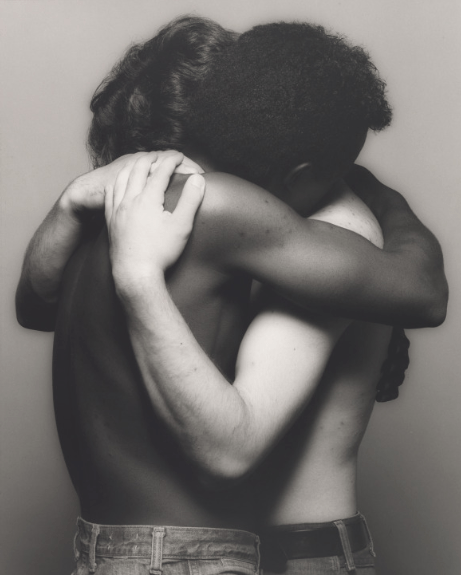
Robert Mapplethorpe, Embrace, gelatin silver print, 1982, © Robert Mapplethorpe Foundation.

Senator Jesse Helms and Homosexuality

Mapplethorpe lived in the heart of LGBTQ* activism in New New York in the 1970s. It was during this decade that the gay community began seeing representation in mainstream media, including movies that featured gay characters and the establishment of Gay Pride week. In 1973, the American Psychiatric Association stopped recognizing homosexuality as a mental illness, and the corporate world started prohibiting sexual orientation discrimination (Rosen). The LGBTQ* community saw tremendous strides in equality and justice advocacy.
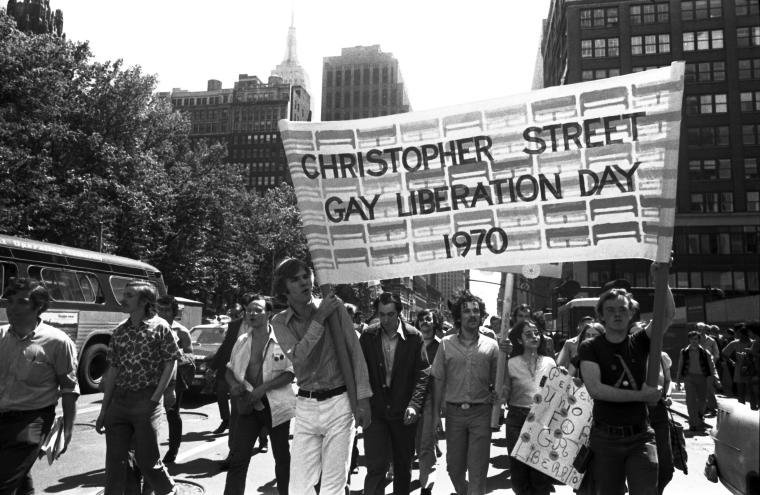
Diana Davies, Men holding Christopher Street Liberation Day banner, 1970, © New York Public Library Digital Collections.

It was during this time that Mapplethorpe became an icon for LGBTQ* folks. According to his friend and writer Ingrid Sischy, Mapplethorpe’s works purposefully focused on homosexuality in order to draw attention. His unapologetically direct photographs helped turn homosexuality from a shameful secret into a proud identity (Sischy).

Senator Jesse Helms, n.d., © United States Senate Historical Office. 

However, the AIDS epidemic soon heightened homophobia in the 1980s. Mapplethorpe heavily focused on black male nudes, a clear expression of his homosexuality, making him a prime target for censorship. Republican Senator Jesse Helms was especially offended by Rosie and hyperfocused on Mapplethorpe’s homosexuality, AIDS-related death, and interracial photographic subjects (Adler, Meyer). In 1989, Helms convinced the deciding congressional committee to pass a bill prohibiting the National Endowment of the Arts (NEA) from funding the Institute of Contemporary Art (ICA), which organized the original Perfect Moment exhibit, for five years (Adler, Tannenbaum). He did so by lying about the photographs he saw firsthand at The Perfect Moment and distributing copies of four of them to the other committee members (Meyer).

Robert Mapplethorpe, Derrick Cross, gelatin silver print, 1982, © Robert Mapplethorpe Foundation.

At the time, Senator Helms’ arguments reflected those of a growing conservative movement. His outrage about Rosie was less about the photograph itself and more about the artist. Furthermore, his push for censorship was less about Rosie’s exposed body and more about silencing the LGBTQ* community, including proudly gay folks such as Mapplethorpe. In his attempts to “cordon off the visual and symbolic force of homosexuality, to keep it as far as possible from [himself] and the morally upstanding citizens he claim[ed] to represent,” Helms ironically brought even more attention to it (Meyer 134).

Some supported censoring Mapplethorpe’s work by claiming he was a pedophile and child abuser, but neither Jesse nor Rosie recall him as such. As adults, both reflected on their portraits proudly (Adler). As censorship lawyer Edward de Grazia wrote regarding the Mapplethorpe case, “art and child pornography are mutually exclusive… no challenged picture of children having artistic value can constitutionally be branded ‘child pornography’ or ‘obscene’” (de Grazia 50). Though it was ultimately deemed non-pornographic after the Mapplethorpe trial, Rosie was only the beginning of a political push to seize funding from the arts, particularly the radical works such as Mapplethorpe’s, following several rising liberal and conservative movements in the previous decades.

Robert Mapplethorpe, Brian Ridley and Lyle Heeter, gelatin silver print, 1979, © Robert Mapplethorpe Foundation.

Historical Context: Radical Conservatism and the Sexual Revolution

During the 1970s, the LGBTQ* community became more vocal, allowing gay men such as Mapplethorpe to be more openly accepted in the art world. In response, movements such as the New Right and the Christian Right emerged, led largely by American evangelicals claiming that homosexuality was morally sinful (“The New Right”). Mapplethorpe’s very existence contradicted traditional conservative values, and he could never align with socially-accepted heteronormative culture.

In fact, the Rosie controversy emerged during a new wave of conservative outrage that began a few years earlier in 1987, when Andres Serrano’s Piss Christ was awarded $15,000 by the partially NEA-funded Southeastern Center for Contemporary Art (Meyer). Along with many other Republican Christians, Senator Helms was deeply offended and embraced the opportunity to denounce another artist who defied traditional conservative values when The Perfect Moment debuted in 1988. At that point, Helms’ focus shifted from Serrano’s critique of religion to Mapplethorpe’s expressions of homosexuality, repeatedly calling his photographs “sick” (Meyer 137). In doing so, Helms used the art as a larger metaphor for homosexuality and AIDS, which he believed were plaguing and contaminating Christian-American society.

Andres Serrano, Piss Christ, Cibachrome print, 1987.

As a gay man, Mapplethorpe was not sexually attracted to females at all, so it would have been much easier for Helms to use Jesse McBride rather than Rosie in his rhetoric. It was the ongoing sexual revolution, which also contributed to the rise of far-right conservatism, that put Rosie in the spotlight instead. Rosie, then, can be interpreted as Mapplethorpe’s way of challenging traditional ideologies and aligning with the sexual liberation movement. Where he saw an innocent child, many conservatives such as Senator Helms saw the bare sexuality of a young girl. Movements such as the New Right could not view her as anything other than sexual with her genitalia exposed. Therefore, it was not Mapplethorpe who sexualized the child but the audience who saw her, revealing a culture deeply rooted in traditional domestic roles and gender spheres.

The 1960s and 1970s saw a rapid increase in women’s and sexual liberation. Nonheterosexual sex was brought to national attention as well, especially after the Stonewall Riots in 1969 (Kohn). Much of Mapplethorpe’s work reflected this new spotlight. Rosie, though, was unlike his trademark photographs of an interracial S&M community, yet it still gained significantly more attention. Despite the portrait subject being a White child, Rosie was one of the four photographs that Senator Helms distributed to his fellow Congressmen and Senators. The others were Mark Stevens (Mr. 10½) (1976), Man in Polyester Suit (1980), and Jesse McBride (Meyer). There were several other photos of naked men in The Perfect Moment, many considered far more pornographic than Rosie and Jesse McBride could ever be, but Rosie was not chosen by mistake. She reflected a different, but not unrelated, threat to Christian-American tradition: women’s liberation.

Robert Mapplethorpe, Ken Moody and Robert Sherman, platinum-palladium print, 1984, © Robert Mapplethorpe Foundation.

After the birth control pill hit the market in 1960, sexuality and sexual expression were no longer taboo subjects. Rates of premarital sex increased significantly while books such as Alex Comfort’s The Joy of Sex normalized conversation about sex (Kohn). For many, Rosie represented a new generation of sexually-liberated women. For conservatives like Senator Helms, this was an intolerable break from traditional gender roles, where men and women had defined, separate roles in society. The New Right movement believed the sexual revolution was destroying the American family structure, leading little girls like Rosie from domesticity to radicalism (“The New Right”). Rosie, then, was the epitome of everything wrong with women’s liberation for Helms. In distributing her photograph, he attempted to defy the new wave of feminism.

Robert Mapplethorpe, Self Portrait, gelatin silver print, 1980, © Robert Mapplethorpe Foundation.

Censorship and Artistic Freedom

However, despite its many controversies, the Mapplethorpe censorship case was most defiant of artistic freedom. Following the case, American art critic Robert Storr wrote that “there are no ‘laws of decency’; certainly none that have any juridical standing with respect to art” (Storr 13). He further argued that censorship itself is the manifestation of widespread mistrust of the public’s ability to draw their own conclusions. In a nation founded on freedom of speech and expression, art essayists like Hilton Kramer, who deeply criticized Mapplethorpe’s work, and politicians like Helms ironically believed that common people should not and could not discern what was acceptable, particularly regarding art (Storr). Helms and Kramer used censorship to impose their own beliefs onto the general public, serving as a microcosm of strong conservative attempts to minimize the voices of non-traditional values.

Robert Mapplethorpe exhibition, 2018, Gladstone Gallery, 515 West 424th Street, New York, NY 10011

 When such defiances of conservatism emerged, they were immortalized in the form of art through Mapplethorpe and other “radical” artists like Serrano. In the heat of America’s changing society, Rosie became a monumental representation of true freedom: freedom of artistic expression, freedom of sexual expression, and the freedom of perspective. Politicians, however, disagreed over what freedoms should receive public funding. Helms and his fellow White Christian American conservatives believed that the NEA should not fund art that offended them based on “their assault on social constructions of sexuality, race, and spirituality” (Atkins 33). Once again, the majority group was attempting to impose their beliefs on the rest of society, a perfect example of censorship at its core.
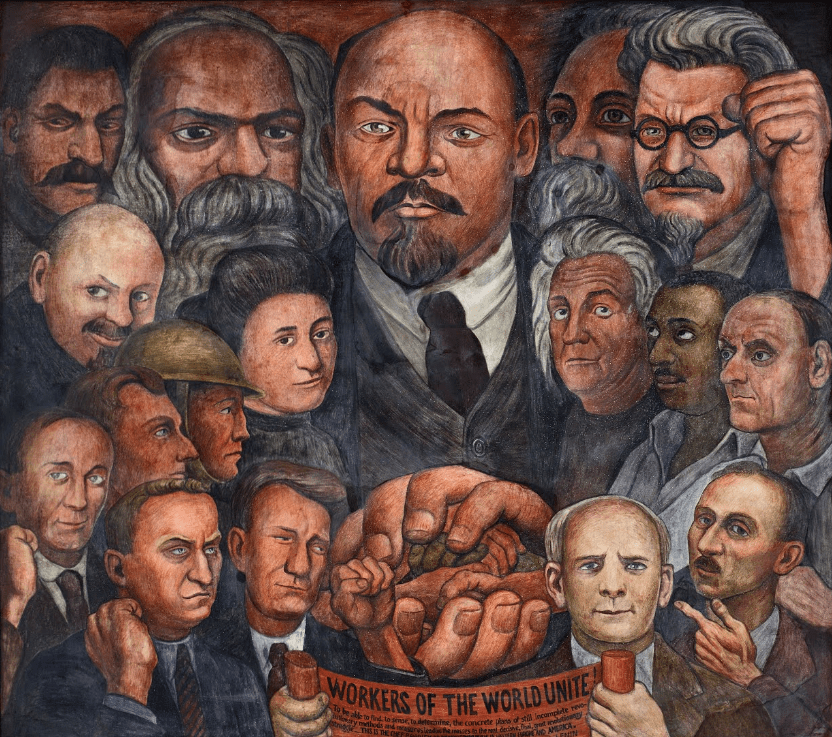
Diego Rivera, Proletarian Unity from Portraits of America, mural panel, 1933, © Nagoya City Art Museum.

Mapplethorpe’s case was significant but not the first. Works by LGBTQ* folks, people of color, and those with “dangerous” political views have been consistently marginalized. For example, Diego Rivera’s Portrait of America mural at Rockefeller Center was destroyed in 1933 because its center featured Vladimir “Lenin” Ulyanov, former leader of the communist Soviet Union (Atkins). In 1934, Paul Cadmus’ The Fleet’s In was removed from the Corcoran Gallery of Art—the same gallery that cancelled The Perfect Moment in 1988—because the Franklin D. Roosevelt administration requested it (Atkins). This was only a small part of FDR’s anti-gay legacy: during his time as Assistant Secretary of the Navy, FDR helped run a sting operation in Newport, Rhode Island in 1919, resulting in the arrest of over 20 Navy sailors for homosexual activity (Loughery). In 1981, after strong advocacy from Hilton Kramer and other conservative critics, the NEA stopped funding individual art critics because many of them were leftist (Atkins). Clearly, the Mapplethorpe case followed decades of conservative attacks on art.
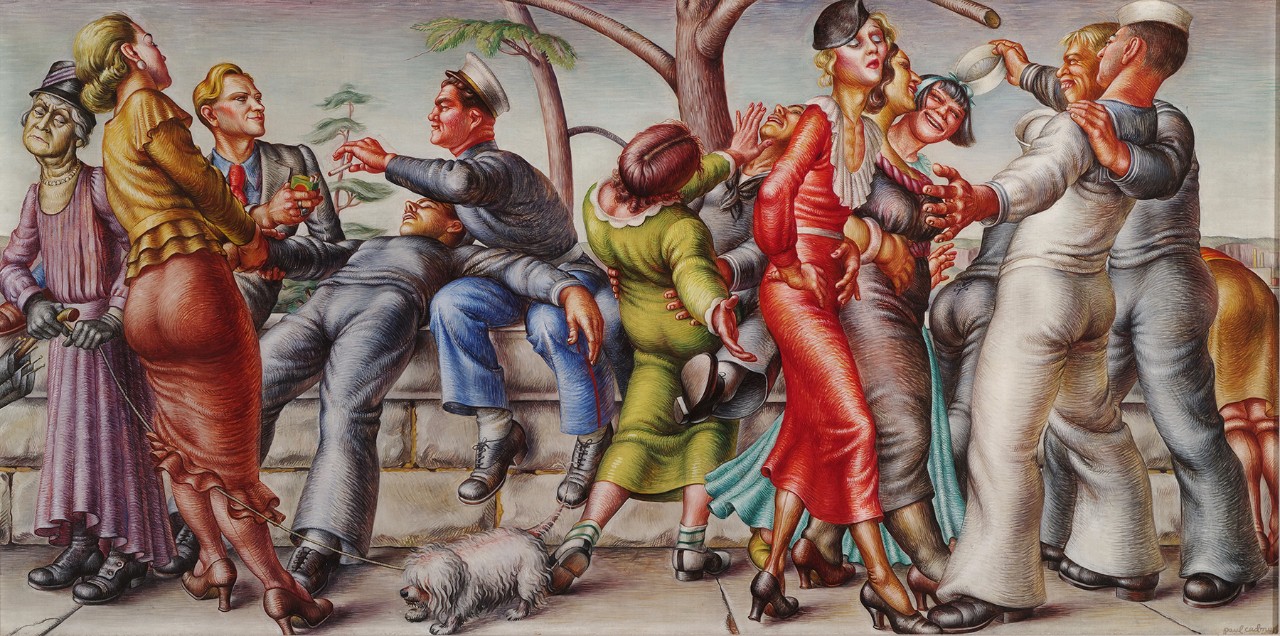
Paul Cadmus, The Fleet’s In!, tempera on canvas, 1934, © United States Navy.

Hypersexualization

Some believe the most pressing issues surrounding Rosie were Rosie’s age and exposed body. There were certainly multiple other artists photographing naked women at the time, like Don Herron and his Tub Shots series, who received little criticism for the nudity. In fact, nudity itself has never been an issue in art; some of the most famous and public classical works portray naked Romans, Greek gods, and biblical figures, like Michelangelo’s David and Sistine Chapel ceiling. In fact, nude boys were not an issue either, as seen in works like Thomas Eakins’s Boy nude at edge of river (c. 1882) and John Singer Sargent’s A Nude Boy on a Beach (1925).

John Singer Sargent, A Nude Boy on a Beach, oil paint on wood, 1925, © Tate.

The fact that Rosie was a girl was not the most significant factor either. During the 1970s, when the Rosie photograph was taken, the United States saw a rapid increase in explicit advertisements, particularly those with women only partially dressed or in full nude. One 1993 study revealed that the number of purely decorative female roles in ads increased from 54 percent to 73 percent from 1959 to 1989 (Busby and Leichty). A 1997 study found that over a 40-year period, 1.5 percent of popular magazine ads portrayed children in a sexual way, and of those ads, 85 percent depicted sexualized girls, with the number increasing over time (O’Donohue et. al). Even in the 1970s and 1980s, the sexualization of young girls was certainly nothing new. Advertising industries had been doing this for decades before the Rosie controversy started in 1988. In fact, they still do.

“Love’s Baby Soft. Because innocence is sexier than you think,” magazine advertisement, 1974–1975.

The hypersexualization of both women and children in the media is quite common now. As National Women’s Hall of Fame activist Dr. Jean Kilbourne reveals in So Sexy So Soon, corporations use sex and sexiness to advertise to children at increasingly younger ages—and they are alarmingly successful. Dangerously unhealthy standards of beauty define sexiness as the most important aspect of a woman’s identity and value. The sexual liberation movement of the 1960s and 1970s has turned into a hypersexualized culture, where children as young as Rosie are exposed to sex in songs, TV shows, advertisements, and social media (Kilbourne and Levin). Like the conservatives’ reaction to Rosie in 1988, young girls are now seen in a sexual way before they are seen as simply children.

Original Cuties film poster, 2020, © Netflix, Inc.

Therefore, like the basis of Helms’ original arguments, the outrage and controversy surrounding Rosie was less about the photograph itself and more about the artist and what the artist represented. Mapplethorpe’s identity and lifestyle contradicted many traditional conservative values: he was homosexual, engaged in S&M, photographed interracial couples, and eventually died of AIDS. Rosie herself said she did not view her portrait as pornographic and could not understand why others thought it was. In fact, in a 1996 interview with The Independent, Rosie recalled her mother making her put on a dress just before the photo was taken, and immediately after, she took the dress off. Ironically, she noted that “if it had been a small [nude] boy, maybe this furore would be justified; Robert [Mapplethorpe] wasn’t interested in girls anyway” (Rickey). Jesse McBride, which is exactly that, received even less backlash than Rosie.

Helms, then, used Rosie against Mapplethorpe not because he thought it was pornographic, but because of all Mapplethorpe’s works, Rosie garnered the most conservative support for censorship. He could easily use the classic damsel in distress situation by painting Rosie as a helpless little White girl in need of protection from a dangerous gay man, with emphasis on Mapplethorpe’s homosexuality. It wasn’t Rosie’s age, nor her exposed body, that angered Helms: it was Mapplethorpe.

Robert Mapplethorpe, Self Portrait, platinum-palladium print, 1988, © Robert Mapplethorpe Foundation.

Final Notes

The Rosie controversy was just as relevant in 1988 as it is now. It continues to pose crucial questions, challenging the boundaries of art and the limits of censorship while highlighting the marginalization of LGBTQ* art, societal resistance to change, and hypersexualization of women and children. Ultimately, Rosie was not the creator of such outrage and conservative criticism, but the vessel exploited by powerful politicians to further their own agendas against Mapplethorpe and other LGBTQ* folks. The Mapplethorpe trial surrounding Rosie was the culmination of decades of liberal movements—including women’s liberation, the sexual revolution, and increasing attention to LGBTQ* voices—and the conservative responses to them. Despite the continuous controversy, critics consider Mapplethorpe, rightfully so, as one of the most influential American artists in the twentieth century. Rosie was last on public display in 2017 at the Guggenheim Museum in New York City.


Works Cited

Adler, Amy. “The Shifting Law of Sexual Speech: Rethinking Robert Mapplethorpe.” University of Chicago Legal Forum, vol. 2020, no. 1, 2020, chicagounbound.uchicago.edu/uclf/vol2020/iss1/2.

Atkins, Robert. “A Censorship Timeline.” Art Journal, vol. 50, no. 3, 1991, pp. 33–37. JSTOR, doi.org/10.2307/777212. Accessed 25 Jan. 2021.

“Biography.” Robert Mapplethorpe Foundation, www.mapplethorpe.org/biography/. Accessed 26 Jan. 2021.

Busby, Linda, and Greg Leichty. “Feminism and Advertising in Traditional and Nontraditional Women’s Magazines 1950s-1980s.” Journalism Quarterly, vol. 70, no. 2, 1993, pp. 247–264. SAGE Journals, doi.org/10.1177/107769909307000202. Accessed 27 Jan. 2021.

Cadmus, Paul. The Fleet’s In!. 1934. United States Navy, Washington, D.C. Naval History and Heritage Command, www.history.navy.mil/our-collections/art/travelling-exhibits/paul-cadmus.html. Accessed 28 Jan. 2021.

Capps, Kriston. “Jesse Helms: The Intimidation of Art and the Art of Intimidation.” Huffington Post, 15 July 2008, www.huffpost.com/entry/jesse-helms-the-intimidat_b_112874. Accessed 26 Jan. 2021.

“Cuties.” Wikipedia, 2020, en.wikipedia.org/wiki/Cuties. Accessed 28 Jan. 2021.

Davies, Diana. “Men holding Christopher Street Liberation Day banner.” The New York Public Library Digital Collections, 1970, digitalcollections.nypl.org/items/91433901-5e24-aece-e040-e00a18066e82. Accessed 28 Jan. 2021.

de Grazia, Deward. “The Big Chill: Censorship and the Law.” Aperture, 5 May 1990, pp. 50–51. JSTOR, www.jstor.org/stable/24472936. Accessed 25 Jan. 2021.

Eakins, Thomas. Boy nude at edge of river. c. 1882. Pennsylvania Academy of the Fine Arts, Philadelphia. PAFA, www.pafa.org/museum/collection/item/boy-nude-edge-river. Accessed 28 Jan. 2021.

Herron, Don. “Paula Sequeira.” Swann Galleries, 1978, catalogue.swanngalleries.com/Lots/auction-lot/DON-HERRON-(1941-2012)–Suite-of-11-photographs-from-Tub-Sho?saleno=2514&lotNo=184&refNo=756720. Accessed 28 Jan. 2021.

“Jesse Helms.” Biographical Directory of the United States Congress, bioguide.congress.gov/search/bio/H000463. Accessed 28 Jan. 2021.

Kilbourne, Jean, and Diane Levin. So Sexy So Soon: The New Sexualized Childhood, and What Parents Can Do to Protect Their Kids. Ballantine, 2008.

Kohn, Sally. “The sex freak-out of the 1970s.” CNN, 21 July 2015, www.cnn.com/2015/07/21/opinions/kohn-seventies-sexual-revolution/index.html. Accessed 27 Jan. 2021.

Mapplethorpe, Robert. Ajitto. 1981. Solomon R. Guggenheim Museum, New York City. Guggenheim, www.guggenheim.org/artwork/2701. Accessed 28 Jan. 2021.

Mapplethorpe, Robert. Brian Ridley and Lyle Heeter. 1979. Los Angeles County Museum of Art, Los Angeles. LACMA Collections, collections.lacma.org/node/2155762. Accessed 28 Jan. 2021.

Mapplethorpe, Robert. Dan. S. 1980. J. Paul Getty Museum, Los Angeles. Getty, www.getty.edu/art/collection/objects/255901/robert-mapplethorpe-dan-s-american-negative-1980-print-2011/. Accessed 28 Jan. 2021.

Mapplethorpe, Robert. Derrick Cross. 1982. Robert Mapplethorpe Foundation, www.mapplethorpe.org/portfolios/male-nudes/. Accessed 28 Jan. 2021.

Mapplethorpe, Robert. Embrace. 1982. J. Paul Getty Museum, Los Angeles. Getty, www.getty.edu/art/collection/objects/256224/robert-mapplethorpe-embrace-american-negative-1982-print-1996/. Accessed 28 Jan. 2021.

Mapplethorpe, Robert. Honey. 1976. Tate and National Galleries of Scotland. Tate, www.tate.org.uk/art/artworks/robert-honey-ar00157. Accessed 28 Jan. 2021.

Mapplethorpe, Robert. Honey and Rosie. 1976. Los Angeles County Museum of Art, Los Angeles. LACMA Collections, collections.lacma.org/node/2233535. Accessed 28 Jan. 2021.

Mapplethorpe, Robert. Jesse McBride. 1976. Los Angeles County Museum of Art, Los Angeles. LACMA Collections, collections.lacma.org/node/2233522. Accessed 28 Jan. 2021.

Mapplethorpe, Robert. Ken Moody and Robert Sherman. 1984. J. Paul Getty Museum, Los Angeles. Getty, www.guggenheim.org/artwork/2740. Accessed 28 Jan. 2021.

Mapplethorpe, Robert. Man in Polyester Suit. 1980. J. Paul Getty Museum, Los Angeles. Getty, www.getty.edu/art/collection/objects/254454/robert-mapplethorpe-man-in-polyester-suit-american-negative-1980-print-1981/. Accessed 28 Jan. 2021.

Mapplethorpe, Robert. Mark Stevens (Mr. 10½). 1976. J. Paul Getty Museum, Los Angeles. Getty, www.getty.edu/art/collection/objects/254447/robert-mapplethorpe-mark-stevens-mr-10-12-american-1976/. Accessed 28 Jan. 2021.

Mapplethorpe, Robert. Patti Smith. 1976. Metropolitan Museum of Art, New York City. Met Museum, www.metmuseum.org/art/collection/search/266975. Accessed 28 Jan. 2021.

Mapplethorpe, Robert. Phillip. 1979. Modern Museum of Art, New York City. MoMA, www.moma.org/collection/works/199945. Accessed 28 Jan. 2021.

Mapplethorpe, Robert. Phillip Prioleau. 1979. J. Paul Getty Museum, Los Angeles. Getty, www.getty.edu/art/collection/objects/255738/robert-mapplethorpe-phillip-prioleau-american-1979/. Accessed 28 Jan. 2021.

Mapplethorpe, Robert. Rosie. 1976. Los Angeles County Museum of Art, Los Angeles. LACMA Collections, collections.lacma.org/node/2233440. Accessed 28 Jan. 2021.

Mapplethorpe, Robert. Self Portrait. 1980. J. Paul Getty Museum, Los Angeles. Getty, www.getty.edu/art/collection/objects/255800/robert-mapplethorpe-self-portrait-american-negative-1980-print-1999/. Accessed 28 Jan. 2021.

Mapplethorpe, Robert. Self Portrait. 1980. Tate and National Galleries of Scotland. Tate, www.tate.org.uk/art/artworks/robert-self-portrait-al00388. Accessed 28 Jan. 2021.

Mapplethorpe, Robert. Self Portrait. 1988. J. Paul Getty Museum, Los Angeles. Getty, www.guggenheim.org/artwork/5354. Accessed 28 Jan. 2021.

Mapplethorpe, Robert. Tennant Twins. 1975. J. Paul Getty Museum, Los Angeles. Getty, www.getty.edu/art/collection/objects/255477/robert-mapplethorpe-tennant-twins-american-1975/. Accessed 28 Jan. 2021.

Mapplethorpe, Robert. Thomas. 1987. J. Paul Getty Museum, Los Angeles. Getty, www.guggenheim.org/artwork/5353. Accessed 28 Jan. 2021.

Meyer, Richard. “The Jesse Helms Theory of Art.” October, vol. 104, 2003, pp. 131–148. JSTOR, www.jstor.org/stable/3397585. Accessed 25 Jan. 2021.

Mezibov, Marc. “The Mapplethorpe Obscenity Trial.” Litigation, vol. 18, no. 4, 1992, pp. 12–15, 71. JSTOR, www.jstor.org/stable/29759554. Accessed 25 Jan. 2021.

“The New Right.” ushistory.org, www.ushistory.org/us/58e.asp. Accessed 26 Jan. 2021.

O’Donohue, William, et al. “Children as Sexual Objects: Historial and Gender Trends in Magazines.” Sexual Abuse, vol. 9, no. 4, 1997, pp. 291–301. SAGE Journals, doi.org/10.1177%2F107906329700900403. Accessed 27 Jan. 2021.

Rickey, Melanie. “Revealed (again): Mapplethorpe’s model.” The Independent, 14 Sept. 1996, www.independent.co.uk/news/revealed-again-mapplethorpe-s-model-1363318.html. Accessed 27 Jan. 2021.

Rivera, Diego. Proletarian Unity from Portrait of America. 1933. Nagoya City Art Museum, Nagoya. Google Arts & Culture, artsandculture.google.com/asset/proletarian-unity-diego-rivera/1QGr_VcJ142Tpw?hl=en. Accessed 28 Jan. 2021.

“Robert Mapplethorpe.” Gladstone Gallery, 2018, www.gladstonegallery.com/exhibition/296/robert-mapplethorpe/installation-views. Accessed 28 Jan. 2021.

Rosen, Rebecca. “A Glimpse Into 1970s Gay Activism.” The Atlantic, 26 Feb. 2014, www.theatlantic.com/politics/archive/2014/02/a-glimpse-into-1970s-gay-activism/284077/.

Sargent, John Singer. A Nude Boy on a Beach. 1925. Tate. Tate, www.tate.org.uk/art/artworks/sargent-a-nude-boy-on-a-beach-t03927. Accessed 28 Jan. 2021.

Serrano, Andres. “Immersion (Piss Christ).” TIME 100 Photos, 1987, 100photos.time.com/photos/andres-serrano-piss-christ. Accessed 28 Jan. 2021.

Sharp, Gwen. “‘Because Innocence is Sexier than You Think’: Vintage Ads.” The Society Pages, 13 Nov. 2008, thesocietypages.org/socimages/2008/11/13/because-innocence-is-sexier-than-you-think-vintage-ads/. Accessed 28 Jan. 2021.

Sischy, Ingrid. “White and Black.” The New Yorker, 6 Nov. 1989, www.newyorker.com/magazine/1989/11/13/white-and-black. Accessed 26 Jan. 2021.

Storr, Robert. “Art, Censorship, and the First Amendment: This Is Not a Test.” Art Journal, vol. 50, no. 3, 1991, pp. 12–28. JSTOR, doi.org/10.2307/777210. Accessed 25 Jan. 2021.

Tannenbaum, Judith. “Robert Mapplethorpe: The Philadelphia Story.” Art Journal, vol. 50, no. 4, 1991, pp. 71–76. JSTOR, doi:10.2307/777326. Accessed 26 Jan. 2021.

The Micronesian Suicide Epidemic

by Brandon Chavez, January 25, 2021

Brandon Chavez is a Class of 2024 undergraduate majoring in History. He enjoys learning about social and political issues in other countries & places around the world. He also enjoys learning about the challenges faced by indigenous populations.

***FALL 2020 CONTEST SUBMISSION***

”Suicide rates since 1960 in Micronesia (the U.S. Trust Territory of the Pacific Islands) have undergone an epidemic-like increase. This phenomenon is focussed narrowly within the 15-24-year male age-group”

(Rubinstein, 1983).

Family plays a quite significant role in Micronesian society. An individual’s self-esteem is very dependent on the acceptance and support of the family, more so than any other contributing factor. A firm place and role in the family is a source of self-esteem for an individual. The significance of familial relations and approvals are shown with one of Hezel’s statistics in his data: “Over 70 percent of all the suicides since 1960 were precipitated by conflicts within the consanguineal family” (Hezel, 55).

This phenomenon of high suicide rates among the male youth in Micronesia was first noticed by Reverend Francis Hezel, a Jesuit who was the director of Xavier High School in the Chuuk islands for nearly 18 years. Reverend Hezel wrote a magazine article about this phenomenon in 1977. Dr. Rubinstein, a researcher at Honolulu’s East-West Center, and Reverend Hazel later decided to research the issue further in the following years where they collected many facts about the situation but unfortunately did not come up with any solutions at the time. A later publication by Hezel in 1989 described the magnitude of the situation in Micronesia in comparison with the suicide rates of the United States: “The general suicide rate for Truk is 40 per 100,000. The rate for Trukese males between 15 and 25 is a startling 250 per 100,000. This is 20 times the youth rate in the United States” (Hezel, 1989).

Hezel observed that these suicides can be linked to small disputes between a young man and an older family member, like an older sibling or parent. Two examples were cited by Hezel to show his observation of the trend: one 13 year old boy hung himself after being scolded by his mother and a 16 year old boy also hung himself after his father refused to give him $1.

Another trend Hezel recognized was that the suicides would be clustered in groups; the death of one young man would often lead to suicides of others in the area. 

When thinking about possible causes for these trends, Hezel initially thought that the process of modernization and its pressures clashing with traditional island societies was responsible for this phenomenon. Hezel and Rubinstein looked further into the issue and found that poor family relations were a common pattern with their research. 

Hezel also described another insight into the issue that he gathered from his research: 

“Rather than an impulsive act, we found the suicides were often the result of a longterm intolerable situation”

(Hezel, 1983).

Reverend Hezel’s insight reveals that these suicides in Micronesia are not impulsive, but that there is a cultural aspect to the situation, regarding a traditional island defense mechanism taken to an extreme. The word “amwunumwun” is used by the Chuukese to describe the behavior of young men using withdrawal to express shame or anger. Refusing to eat or being silent are examples of actions that these young men engage in when showing this behavior. 

Reverend Hezel and Dr. Rubinstein believed that the strategy of amwunumwun became violent in the 1960s and 1970s where suicide might be considered the most extreme form of this behavior of bringing harm to oneself to save a relationship. A Chuukese suicide victim thought that being dead would repair more to a damaged relationship than if they were alive.In a later publication Reverend Hezel shed new insight on the suicide epidemic in the Chuuk islands (Hezel, 1989).

Figure 1

Note. Hezel found that anger was the leading cause of suicide in several islands in Micronesia (Chuuk, Pohnpei, Kosrae and Yap), the Marshall Islands and Palau (Hezel, 1989, p. 49).

Hezel also sought to find out the significance of the types of interpersonal and familial relationships that lead to suicide in Micronesia. Below is the table of his recorded data:

Figure 2

(Hezel, 1989, p. 51)

The table revealed that a relational disruption or conflict between a young man and his parents was often the most common cause of relational disruption that led to suicide. Hezel notes that in suicide cases that were led by disruptions in nonfamily relationships, the victim might break off familial ties because of the shame that might be bringing to their family and fear of what their family members’ reactions woud be. The victim was ashamed of actions that could offend their family and feared a consequential disruption in familial relations.

In 2007,  Dr. Mao-Sheng Ran, a professor at the University of Hong Kong, reviewed pre-existing data on the characteristics of suicide in Micronesia. 

Dr. Ran’s research found another phenomena that highlights the effect of mental health on suicide in Micronesia the effect of mental health on suicide in Micronesia compared with another country such as the United States.

Figure 3

(Ran, 2007, p. 83).

The bar graph above reveals an interesting and peculiar observation about the correlation between mental illness and suicide victims in Micronesia. Only 10% of suicide victims in Micronesia had psychiatric disorders, while 90% of suicide victims in the United States had mental illness. Dr. Ran states that: “Mental illness did not appear to be an important factor in Micronesian suicides. Most of the victims have had no serious delinquency problems, psychological abnormality, or psychosis” (Ran, 83).

Dr. Ran noted that intergenerational conflict was the most common cause that led to suicide and most suicides occured because of a conflict, misunderstanding or argument between a young victim and their parents or older relative. 

The definition of anger in Hezel’s research is further explored in Dr. Ran’s review. Hezel’s publication in 1989 cited three distinct patterns of suicides which included anger suicides, shame suicides and psychotic suicides. It was previously mentioned in Hezel’s publication that anger suicides were the most prominent in Micronesian suicide cases, but this definition of anger adds a new understanding to the situation. Ran established that:”The definition of ‘anger’ was similar to the way Americans describe depression”(Ran, 2007, pg. 84). This definition of anger shows a cultural difference in how anger is defined in Micronesian society and American society. 

The review also included several aspects and social changes that may be responsible for the high suicide rate in Micronesia. The first change is the expansion of a cash economy in Micronesia and the decreasing reliance on subsistence production. The production may be responsible for weakening the significance of clan and lineage activities. The decline in clan and lineage activities narrows social support for teenagers, increases reliance and dependence on parents, and increases  parental-adolescent conflicts.The second change is the acceptance of suicide which can be attributed to this increase in suicide rates. As suicide becomes common among the youth, it became more acceptable and even expected.

According to Hezel, western solutions such as suicide prevention hotlines and counseling would not fully solve the suicide epidemic witnessed in Micronesia as the issue is not only psychological but also cultural. Dr. Ran offered several suggestions for future research to combat the issue. Ran suggests that there should be more surveillance on suicidal behavior in Micronesia, independent research on preventive and risk factors, and a longitudinal study on social and economic shifts affecting the male youth. Since there is not many mental health professionals available, Ran suggests that more individuals should be trained to counter the issue of suicide. 

The Micronesian suicide epidemic is quite unique as the root of the issue is concerned more with the inter-generational conflict and socio-cultural elements found within Micronesian society rather than mental illness. Solutions to the issue and research on the topic cannot be treated in a western approach, as the act of suicide has shown to be woven into the youth culture of Micronesian society. Future studies, research, and clinical approaches must consider the socio-cultural elements of Micronesian society & family to make progress in combating the Micronesian suicide epidemic.


References

Hezel, F. (1989). Suicide and the Micronesian family. The Contemporary Pacific, 1(1/2), 43–74. Retrieved November 30, 2020, from http://www.jstor.org/stable/23701892 

Micronesia’s male suicide rate defies solution. (1983, March 06). The New York Times. Retrieved November 30, 2020, from https://www.nytimes.com/1983/03/06/us/micronesia-s-male-suicide-rate-defies-solution. html 

Ran, Mao-Sheng. (2007). Suicide in Micronesia: A systematic review. Primary Psychiatry, 14(11), 80–87. Retrieved November 30, 2020, from https://www.researchgate.net/publication/262882325_Suicide_in_Micronesia_A_Systematic_Review

Rubinstein, D. H. (1983). Epidemic suicide among Micronesian adolescents. Social Science & Medicine, 17(10), 657–665. doi:10.1016/0277-9536(83)90372-6

AI – A Casual Overview

by Jeffrey Huang, January 21, 2021

Jeffrey is pursuing a B.A. in Psychology at Stony Brook. He enjoys technology and is always keeping up with the latest hardware releases.

***FALL 2020 CONTEST SUBMISSION***

Technology. Such a simple concept of scientific application can have many implications for our lives, history, and the world. When people talk about the dangers of technology, popular media has us thinking about robots, and by extension, Artificial Intelligence (AI). Media like The Matrix franchise, Person of Interest, or 2001: A Space Odyssey (either novel or film) highlight the potential that AI has in terms of changing our world through apocalyptic means, a dystopic society, etc. Would you believe me if I told you we were already, in some respects, in such a society today? For example, think of any time where you might have been discussing something in the open with a friend, but then see advertisements the next time you browse the web? Such was most likely the work of AI, or more specifically, Machine Learning (ML) Algorithms. The overhead of employing many human listeners would usually be too much, so such work would be mostly delegated to automation[1]. This essay is a culmination of what I’ve learned from Professor Brennan’s PSY 369, Psychology in the Age of Intelligent Machines, and what I know as a computer enthusiast.

The AI singularity seems like a technological milestone that humanity may never reach. However, despite less than ideal implementations of such technology in areas like human language translation[2], we have progressed significantly over the course of computing history. In terms of literal definitions, automated systems can pass the Turing Test, as it was written in the 1950s. Nobody uses the Turing Test in the way it was originally written; it is more of a thematic test of achieving near-human systems. I would recommend VSauce’s video here for reference (Stevens, 2017). Some key examples of AI efforts include major companies you’ve probably heard of. Tesla is one among many automobile manufacturers developing autonomous driving (“Autopilot AI”, 2020). Google, being the technological juggernaut it is, has general AI research and development along with custom computer chips (“Google AI”, 2020). Even Boston Dynamics is using AI, with some autonomous functionalities built into the Spot lineup of robots (“Spot®”, 2020).

Most prominently, AI is in the social media we use every day, through feed recommendations and those all-important corporate advertisements that provide these services to you. Most of these efforts are not usually made with malicious intent, but their implications may be anything but benevolent. Despite me writing this essay, the majority of users will not really notice AI as it slowly creeps into our lives. It’s like the rising sun; minute by minute, you don’t notice the incoming light. But, over time, if you were to compare your first minute to your last minute; assuming the sun is up, you notice this marked change. It’s a similar concept here. Slowly, technology and AI integrates itself into our lives until we don’t see its marked change before. For reference, ask older individuals what life was like before the internet, or the proliferation of accessible personal computing. We’ve advanced from expensive IBM compatibles to Chromebooks.

The issue with AI is not so much the underlying technology, nor the idea behind it. Like many concepts, it is a good idea on paper. In practice, nobody adheres to what might make it great. In the interest of expediency and cost-effectiveness, companies push forth half-baked implementations where we see more negative consequences. AI/ML algorithms are simply algorithms. They attempt to predict, with less precision than the real world, an approximation of what should be. It’s like walking through your house blindfolded. You probably won’t fall or seriously injure yourself, but seeing with your eyes is much better than relying on memory reconstructions. It’s similar with AI. However, instead of stumbling blindly in a controlled, familiar environment, such systems are thrown into the real world. Instead of being blindfolded in your house, you’re blindfolded and randomly placed on a football field. Imagine the disorientation – you would have no idea of where you were relative to the rest of the layout of said field.

AI’s implementations in the current justice system and in job selection are akin to these blind analogies. While you might think that this is due to evil programmers, this is not usually intentional. AI algorithms are mysterious in that regard. Given current frameworks and paradigms, how it generates results is unknown. Oftentimes, this is to shocking effect with its eerily accurate predictions, sometimes from scant data – privacy violations notwithstanding. Despite this, it’s sometimes claimed as a great innovation. Finally one can get “objective” judgements and predictions.

The truth is, though, there’s no such a thing as an objective algorithm. AI is only as good as the data that it’s fed, and in some cases, the wrong data leads to a perpetuation of broken systems. For instance, recidivism algorithms[3] are biased towards disadvantaged populations like people of color.

recidivism – a tendency to relapse into a previous condition or mode of behavior, especially to relapse into criminal behavior

Merriam-Webster

In some cases, more privileged, Caucasian individuals are at an advantage given confounding lifestyle correlations tied to outcomes. For instance, an African-American who is considered high in recidivism risk will receive more scrutiny while on parole versus a Caucasian who is not. It’s ironic at times, as the end outcome can be that the African-American will obey the law and the Caucasian ends up back in prison. Despite these inconsistencies, such algorithms are pushed onto judges who don’t know any better, and innocent individuals can be caught in the crossfire (Angwin et al., 2016).

With that in mind, is there reason to panic, shout and protest? Yes and no. While it isn’t always great as I enumerated above, there are some benefits to these technologies, when used properly. An easy example of this duality is in nuclear technologies. It can be used to terrible effect, or used to generate power. AI has shown immense potential, as shown in various technology demos, or real-world implementations. For video games, AI can enable higher perceived visual fidelity with more realistic lighting or resolution upscaling, and such implementations are slowly being added to newer games and are present in next-generation consoles (“RTX. It’s On. Ultimate Ray Tracing and AI,” 2020; Battaglia, 2020). Outside of gaming, you have frame-interpolation for animations, where an algorithm attempts to make it smoother. Traditional animations like Pixar films may suffer visually from attempting this, as seen in this thread on Twitter:

For stop-motion, though, this changes the game completely. It’s much easier to just have an animation filmed at 15 fps than it is to use AI to enable a smoother, 30 fps final product (Boosting Stop-Motion to 60 fps using AI, 2020). And of course, there is the infinite comedic potential, especially with song generation or translations (The Tonight Show Starring Jimmy Fallon, 2020). Outside of that, this has the capability to change the way we work literally. Imagine a richer world where AI assists in creative work, or the formulation of novel chemicals that could change lives (Conti, 2016; Hessler & Baringhaus, 2018). That’s also in the works, as well as the dystopic solutions above.

The key point of this essay is not so much to get you fired up one way or the other about AI, but to just be aware of these systems and changes in our society. Congress has tried, unsuccessfully, to consider it, and it’s our job as the greater public to be informed and act accordingly. Greater awareness can be detrimental, as seen with Brandolini’s Law[4]. However, given how unconscious these processes currently operate, it’s best to bring them to light.

Footnotes

[1] Additionally, you probably consented to such listening when agreeing to the arcane and long Terms of Service or End User License Agreement for things like Google services.

[2] As improved as translation services are like DeepL, it can still sound odd to native speakers, as I’ve learned in Chinese with my own family.

[3] Algorithms designed to predict re-offending inmates after being released on parole

[4] It takes more information and effort to correct misinformation, especially on the internet.


References

Angwin, J., Larson, J., Mattu, S., & Kirchner, L. (2016). Machine Bias. ProPublica. Retrieved 31 December 2020, from https://www.propublica.org/article/machine-bias-risk-assessments-in-criminal-sentencing

Autopilot AI. Tesla.com. (2020). Retrieved 31 December 2020, from https://www.tesla.com/autopilotAI

Battaglia, A. (2020). PlayStation 5: what to expect from next-gen console ray tracing. Eurogamer.net. Retrieved 31 December 2020, from https://www.eurogamer.net/articles/digitalfoundry-2020-playstation-5-ray-tracing-software-analysis

Boosting Stop-Motion to 60 fps using AI. (2020). [Video]. Retrieved 31 December 2020, from https://www.youtube.com/watch?v=sFN9dzw0qH8

Crimson Mayhem. 2020, October 6. “You want to know why converting animation that were specifically made in 24 frames per second to 60 FPS…”. Twitter. https://twitter.com/Crimson_Mayhem_/status/1313562730977255426

Google AI. Google. (2020). Retrieved 31 December 2020, from https://ai.google/.

Merriam-Webster. (n.d.). Recidivism. Merriam-Webster. Retrieved January 11, 2021, from https://www.merriam-webster.com/dictionary/recidivism

Spot®. BostonDynamics.com. (2020). Retrieved 31 December 2020, from https://www.bostondynamics.com/spot

Stevens, Michael. (2017). Artificial Intelligence – Mind Field (Ep 4) [Video]. Retrieved 31 December 2020, from https://www.youtube.com/watch?v=qZXpgf8N6hs

The Tonight Show Starring Jimmy Fallon. (2020). Google Translate Songs with Halsey [Video]. Retrieved 31 December 2020, from https://www.youtube.com/watch?v=BRZ4zci_YUU

Should We Embrace Race in the Workplace and School?

by Ean Tam, January 16, 2021

***FALL 2020 CONTEST SUBMISSION***

As a student of the New York City public education system, I have always been in a diverse environment. For instance, my elementary and middle schools had an annual Multicultural Day Fair. The younger students performed traditional dances from different cultures, while the older students set up tents around the campus and presented research they had done on specific countries or an influential person. I enjoyed the Multicultural Day Fair, but I never thought of it as anything particularly special. It was just an event that I had always participated in since kindergarten. A few years into high school is when I realized that not all schools in America are as diverse as mine and how diversity can be a privilege. What diversity has taught me in terms of social interactions with people of other backgrounds is not a lesson that every person in America has the opportunity of receiving. However, in today’s world, where companies and firms can draw in employees from all across America and the world, employees may find themselves in workplaces where a majority of their coworkers are from different ethnic and cultural backgrounds. Schools are another part of society in which people may experience culture shocks or accidentally stumble into a cultural clash. Employers and school administrations may try to mediate these differences by encouraging either of the two strategies: color blindness or multiculturalism. The colorblind strategy advocates for people to be oblivious of race, whereas the multicultural strategy embraces race. Having been accustomed to the multicultural mindset all my life, I want to explore how the colorblind strategy compares. How successful is the colorblind strategy not only in leading people to ignore race, but also in establishing a cooperative and supportive environment? 

At the 2016 Republican National Convention, Ivanka Trump introduced her father, Donald Trump, and claimed, “He recognizes real knowledge and skill when he finds it. He is colorblind and gender neutral.” Evidently, she has linked color blindness as a means of seeing a person’s true worth—what he or she can bring to the table is more important than his or her race. This very same idea is highlighted in Martin Luther King Jr.’s famous “I Have a Dream” speech. The notion that our personal attributes solely define who we are is very attractive. So, it is not hard to see why a colorblind strategy would be implemented in a company or school. But how successful is the colorblind implementation when it comes to people looking beyond a person’s race? Research suggests grim potential for the colorblind strategy. In a study conducted at Dartmouth College, researchers Dr. Jennifer A. Richeson and Dr. Richard J. Nussbaum found that participants who had been told the colorblind strategy was most ideal in a diverse setting were more likely to show signs of racial bias versus the participants who had been told the multicultural strategy was better (419-421). The research  participants were presented with names and were asked to categorize them as “White” or “Black” names, and they were presented with pleasant and unpleasant stimuli and were asked to categorize them as “Good” or “Bad.” Richeson and Nussbaum observed students of the colorblind group took longer to categorize negative stimuli as either “Black” or “Bad,” but were faster to categorize positive stimuli as either “White” or “Good.” They interpreted this discrepancy as a sign of the students’ racial bias. This categorizing system may seem like unconvincing evidence of bias. However, this system, called the Implicit Association Test (IAT), is well known and utilized by researchers to find the true attitudes people do not want to admit (“Implicit Association Test”). Richeson and Nussbaum’s research suggests that even the very idea of the colorblind strategy being successful was enough to create a considerable amount of racial bias within the students. The participants in this study were participating on their own free will without any personal repercussions (Richeson and Nussbaum 419-421). So this makes me wonder, what would be the effects on workers who have to keep a colorblind mindset since their paycheck depends on it? 

Dr. Michael I. Norton et al. of Harvard Business School demonstrate how color blindness affects work productivity and interactions between black and white coworkers. Norton et al. concluded that white workers were more productive with other white workers and communicated more in order to complete the task at hand (950). This ease of communication was facilitated because the white worker was more willing to use specific terms such as “black” and “African-American” when doing a categorizing activity. However, when the white workers were put in the same situation but with a black coworker, white coworkers no longer had the confidence to use those specific terms regarding race. Norton et al. explain that interactions between the black and white coworkers went further downhill as the white coworkers’ “… attempts to appear color-blind—by avoiding race—are accompanied by additional costs: less friendly nonverbal behaviors” (950). I found the results of this article interesting because it presents the colorblind strategy unintentionally becoming a form of extra-baggage in someone’s head. Instead of focusing and being able to communicate freely, a person who is attempting to be colorblind is carefully watching every one of his or her words. Now, I do not interpret (and I am sure the researchers do not imply it either) that being able to “communicate freely” means being able to mention race as comfortably as one likes. Not at all. “Communicate freely” is just everyday conversation that we should all be able to engage in. The colorblind strategy makes the everyday conversation subject to paranoia and increased self-restraint. Much like how a germaphobe is too afraid to venture outside because germs may or may not be on the next door handle, coworkers may be skeptical of those from other backgrounds because an accidental racial offense may or may not be lingering in the next conversation. As a result, coworker interactions are limited, brief, and uncordial. 

It is important to note that the workers described in the above study were not committing any kind of discrimination by limiting their interactions with black coworkers. They just did not want to be put out of their comfort zone, and that in itself should be convincing enough that the colorblind strategy is flawed. However, there is more research contributing to a narrative that the colorblind strategy separates people more than it brings them together. While the research mentioned so far has been focused on coworker-to-coworker interactions and not so much coworker-to-employer interactions, the research concerning education policy is just about equally focused on teacher-to-student and student-to-student interactions. This should give some insight into how the colorblind strategy affects authority and how such effects trickle down. 

Ideally, a successful educational system is one that makes every student feel welcome and comfortable to learn the material. In 2017, the United States Department of Education published a report stating, “Achieving a diverse student population in a given school building is a major accomplishment, but additional efforts are important to avoid the replication of inequities and disparities in achievement and access within a school that has a diverse student population” (18). This report takes the stance that a diverse student body will not automatically find its own way of including every student on the same path to success. Surprisingly, the twenty page report makes no specific reference to multicultural or colorblind strategies (it does not even use any form of the word “multicultural”). Although the US Department of Education report does not stress a particular strategy, it does advise school districts to consult legal experts if the school districts wish to recognize students’ race and cultural background (5). The report also emphasizes the importance of funding if a school wants to increase diversity because proper funding is necessary to enroll students from outside of their own districts (5). The US Department of Education report has made it seem that recognizing race, cultural backgrounds, and increasing diversity is quite the hassle: legal consulting, examining state and local laws, and allocating the proper funds. It may be possible that the colorblind strategy is an easier strategy to apply in schools than the multicultural strategy. A colorblind strategy ignores race, thus relieving any obligation a school administration may feel to increase the diversity of the student body. Not only does the colorblind strategy have an idealistic “I recognize people for their worth” mentality, but it can also be more practical and convenient. As mentioned earlier, this US Department of Education report was published in 2017, but the colorblind strategy and diversity in schools have been issues long before then. What is the historical basis for the colorblind strategy? 

Dr. Subini Ancy Annamma and co-researchers of the Stanford Graduate School of Education argue the persistence of the colorblind mindset in education is a result of the misinterpretation of a dissenting opinion from the famous 1896 Plessy v. Ferguson case (147). The lone dissent in the case by Justice John Marshall Harlan stated, “Our Constitution is color-blind, and neither knows nor tolerates classes among citizens. In respect of civil rights, all citizens are equal before the law” (559). Annamma et al. see these two lines of Harlan’s dissent to be the root of colorblind policies not only in schools, but also in society in general. Annamma says it is important to understand that just because Harlan says all the laws of the land are colorblind does not equate to Harlan believing race is irrelevant in all matters (Annamma et al. 147). However, it would appear that Harlan’s dissent has indeed been taken as an advocacy for the colorblind strategy for an all-purpose use. In the years following Plessy v. Ferguson, “[a]ccording to the liberal discourse that has developed in the post-Jim Crow era, a good citizen is colorblind” (Choi 56). So, color blindness has become a methodology of progressives to combat the idea of “separate but equal.” While well-intentioned as a means to combat discrimination, the colorblind strategy in contemporary times has actually been shown to encourage discrimination and discourage inclusiveness in schools. 

In a 2016 article published in the Journal of Diversity in Higher Education, Yale University researchers Aragón, Dovidio, and Graham defined inclusiveness as a means “to increase retention and enhance the achievements of people of color and women in STEM education, research, academic, and public sector careers” (201). Aragón et al. focused on the attendance of teachers to the National Academies Summer Institutes on Undergraduate Science Education, which  aims to promote inclusive teaching methods in schools. According to the post-attendance data, teachers who endorsed the colorblind strategy were less likely to implement inclusive teaching methods and activities and were more easily convinced that an inclusive education was a bad idea. The teachers who endorsed the multicultural strategy had the exact opposite results—they supported inclusive teaching and were not easily convinced that an inclusive education was a bad idea (210). Based on the results of Aragón et al., I interpret the colorblind strategy as a mindset that minimizes the needs of different groups. Schools may inadvertently leave some students behind because recognizing the students’ differences would disrupt the schools’ commitment to the colorblind strategy. 

While I am alarmed that teachers of the colorblind mindset would so easily dismiss inclusive programs, I am not surprised that teachers of the multicultural mindset were open to more inclusive teaching practices. Relating back to my own personal experience, I see now the efforts my elementary and middle school teachers made in order for every student to feel included. For example, whenever a cultural holiday would be approaching, our teachers would ask students of that culture to explain the importance of the holidays and traditions involved. It was not awkward or a forced one-off moment in class. The teachers would try to incorporate the holiday into the day’s lesson. In hindsight, I see how important such activities were to making us feel that we all had an equal opportunity to contribute to the class. We were not just students listening to the teacher—we had something to offer. Applying the evidence provided by Aragón et al., I can presume that if my school had embraced the colorblind strategy, no such activities would have taken place. We would have lost out on a chance to build a personal connection to our teacher and class. 

Inclusiveness may not be a priority for teachers of the colorblind mindset, but the reduction of discrimination in schools is a common goal for both the colorblind and multicultural strategies. In spite of that, the colorblind strategy has been found to decrease students’ ability to recognize discrimination when they see it. In a study of elementary grade students, Dr. Evan Apfelbaum et al. of Northwestern University investigated how the colorblind and multicultural mindsets affected the students’ responses to various scenarios (1587). In one scenario, a white classmate physically harmed a black classmate and then justified his actions by stating the black classmate would play rough too since he is black. Only 50% of the colorblind group of students said the black student had been discriminated against. In the multicultural “value-diversity mind-set” group, 77% of those students reported discrimination (1589-1590). Based on this data, I cannot trust any pro-colorblind school administration that touts a decreased rate of discrimination or bullying on the basis of race. I have no way of knowing whether the colorblind strategy actually decreased acts of discrimination or merely decreased the rate of reporting of such acts. 

On the other hand, if a school following the multicultural strategy reported a decrease in discrimination, there is data suggesting the multicultural mindset was actually responsible. In an article published in the Canadian Journal of Behavioural Science, Dr. Frances E. Aboud and Dr. Anne Beth Doyle assessed the attitudes and interactions of high- and low-prejudiced students. After discussing race with low-prejudiced students, the high-prejudiced students “became significantly less prejudiced in their evaluation” of others, especially if the low-prejudice students expanded on the similarities among people of different racial backgrounds (161). Aboud and Doyle’s advice: allow students to talk about race and start the conversation early on. If left unattended, students with prejudices and racial biases can grow up and allow these negative ideas to manifest and grow stronger. An open dialogue of race is essential to ridding students of any prejudices they may have. A colorblind school would frown upon discussions of race, and the students are deprived of an opportunity to learn how their prejudices were misguided. This not only affects a student’s behavior (whether or not he or she will discriminate), but also how he or she will interpret other’s behavior (deciding whether or not another student’s discrimination is wrong). 

Of course, it is not to be implied that colorblind students are prejudiced and that is why they do not report discrimination. Dr. Janet W. Schofield of the University of Pittsburg offers insight into the minds of the students who are aware of discrimination but decide not to report it. Schofield studied middle schools that insisted their student body were colorblind. Her data is especially valuable because Schofield did not impose the conditions on the students. The behavior she observed was the result of a long term institution of the colorblind strategy (268). To put in perspective of how long the colorblind strategy had been imposed on these students, one student was bewildered when Schofield told him Martin Luther King Jr. was African-American (280). In one school, Schofield noticed students had a harder time reporting any kind of problems—not necessarily problems of discrimination, just basic classroom complaints—because the students did not want to use race as a description. Schofield acknowledges that students in this particular middle school “[w]ere well aware that making references to race displeased many of their teachers and might also offend peers” (273). As a result, students, fearful of retaliation for identifying others by race, were hesitant to come forward when real problems arose. The students were clearly aware of their teachers’ colorblind expectations and—given the teacher-student relationship—conformed without question. The colorblind mindset does not solve the issue of discrimination in schools; rather, it merely shoves it under the rug and forces students to turn a blind eye. 

We can now see the parallelism between the workplace and the school setting. Schofield showed us that in colorblind situations, students will be mindful of their every word when reporting to teachers because they fear their teachers’ discipline. Recall Norton’s et al. study in which white coworkers became less friendly and communicative in order to appear colorblind; they too were filtering their words of any suggestions of race. Although differing in age and circumstance, students and workers manifest similar behavior when in colorblind situations. Both inhibit their everyday behavior in order to spare themselves an unpleasant reprimand from the authorities who implemented the colorblind policy. Given this parallelism, we can now return to previous studies and make a few assumptions. Apfelbaum et al. found students of the colorblind mindset to be oblivious of clear cases of discrimination; thus, workers will also be incognizant of racial injustices in the workplace. Aragón et al. exhibited colorblind-endorsing teachers to be opposed to inclusive teaching strategies; thus, colorblind-endorsing employers will also show distaste for programs to coalesce diverse workplaces. 

My personal experience convinced me that the multicultural strategy is effective in creating a cooperative and supportive environment. Examining the evidence, it is difficult to say the same for the colorblind strategy. Schools and businesses may find the colorblind strategy attractive due to its convenience and historical context, but they should consider the actual ramifications of imposing it. Is the colorblind strategy successful in making people oblivious of another’s race? No. The colorblind strategy encourages internal racial bias in coworkers. Given the similarities between worker and student behavior in colorblind situations, it is reasonable to believe that students would just as likely develop internal racial biases in school. Is the colorblind strategy successful in establishing a cooperative and supportive environment? Being that the colorblind strategy deters everyday conversation and work productivity, synergy may be hard to find. How does the multicultural strategy fare, provided the research and not just my personal experience? From the same studies, multiculturalism does what the colorblind strategy cannot. Inclusiveness is prioritized, and discrimination is recognized and—most importantly—reported. Multiculturalism does not mean students or coworkers have to address ethnicity in every conversation, but at least multiculturalism allows for that conversation to happen. Multiculturalism can disprove prejudices and improve our understanding of those who are culturally and racially different from ourselves. Acknowledging the research, the colorblind strategy would be an ill-advised imposition in both schools and workplaces.


Works Cited

Aboud, Frances E., and Anne B. Doyle. “Does Talk of Race Foster Prejudice or Tolerance in Children?” Canadian Journal of Behavioural Science, vol. 28, no. 3, 1996, pp. 161-170. EBSCOhost, doi.org/10.1037/0008-400X.28.3.161

Annamma, Subini A., Darrell D. Jackson, and Deb Morrison. “Conceptualizing Color-Evasiveness: Using Dis/ Ability Critical Race Theory to Expand a Color-Blind Racial Ideology in Education and Society.” Race Ethnicity and Education, vol. 20, no. 2, 2017, pp. 147-162. Taylor & Francis Journals, doi.org/10.1080/13613324.2016. 1248837

Apfelbaum, Evan P., Kristin Pauker, Samuel R. Sommers and Nalini Ambady. “In Blind Pursuit of Racial Equality?” Psychological Science, vol. 21, no. 11, 2010, pp. 1587-1592. JSTOR, www.jstor.org/stable/41062417

Aragón, Oriana R., John F. Dovidio, and Mark J. Graham. “Colorblind and Multicultural Ideologies Are Associated With Faculty Adoption of Inclusive Teaching Practices.” Journal of Diversity in Higher Education, vol. 10, no. 3, 2016, pp. 201-215. PsycARTICLES, doi:10.1037/dhe0000026

Choi, Jung-ah. “Unlearning Colorblind Ideologies in Education Class.” Educational Foundations, vol. 22, no. 3-4, 2008, pp. 53-71. EBSCOhost, search.ebscohost.com/login.aspx?direct=true&db=eric&AN=EJ857639&site=ehost-live&scope=site

“Implicit Association Test.” Hopkins Medicine, www.hopkinsmedicine.org/odcc /implicit_association_test.html.

Norton, Michael I., Samuel R. Summers, Evan P. Apfelbaum, Natassia Pura, and Dan Ariely. “Color Blindness and Interracial Interaction: Playing the Political Correctness Game.” Psychological Science, vol. 17, no. 11, 2006, pp. 949-953. EBSCOhost, search.ebscohost.com/login.aspx?direct=true&db=mnh&AN=17176425&site=ehost-live &scope=site

Plessy v. Ferguson. 163 U.S. 537 (1896). Supreme Court of the United States, supreme.justia.com/cases/federal/us/163/537/

Richeson, Jennifer A., and Richard J. Nussbaum. “The Impact of Multiculturalism Versus Color-Blindness on Racial Bias.” Journal of Experimental Social Psychology, vol. 40, no. 3, 2004, pp. 417-423. Science Direct, doi.org/10.1016/j.jesp.2003.09.002

Schofield, Janet W. “The Colorblind Perspective in School: Causes and Consequences.” Multicultural Education: Issues and Perspectives. Eds. James A. Banks and Cherry A. McGee Banks. 5th ed., John Wiley & Sons, Inc., 2005, pp. 265-281. 

Trump, Ivanka. Republican National Convention, 21 July 2016, Quicken Loans Arena, Cleveland, OH. Introductory Speech. Time, time.com/4417579/republican-convention -ivanka-trump-transcript/

United States, Department of Education, Office of Elementary and Secondary Education. “Improving Outcomes for All Students: Strategies and Considerations to Increase Student Diversity.” Diversity & Opportunity, 19 January 2017, ed.gov/diversity-opportunity.

Rated E for Education, Graded F for Failure

by Zarya Shaikh, January 12, 2021

***FALL 2020 CONTEST WINNER***

In 2014, New York City Mayor Bill de Blasio launched Pre-K for All to encourage “free, full-day, high-quality pre-K.”1 The program increased enrollment in Pre-K among different communities, especially within low-income families. Its success led to the creation of 3-K for All1 and yielded similar outcomes: “[o]f the 52,741 children enrolled in pre-K, 37 percent were Hispanic, 30 percent [B]lack” with no ethnic majority.2 One would expect that a student body with multiple ethnicities represented would have access to a teaching curriculum tailored to different backgrounds. The Pre-K for All handbook’s page 21 includes a list of “ emotionally responsive books about being safe” which says otherwise.1 Of the three books presented, all are written by white authors. This booklist is not an anomaly; authors of color are missing from the handbook and the curriculum itself. An analysis of the Pre-K For All curriculum reveals that “there are 0 Black authors, 0 Native authors, 0 Middle Eastern authors, 1 Latinx author, 1 Asian author, and 40 white authors” of the 42 total texts available.3 The number of white authors to authors of colors writing for younger ages is grossly disproportionate. It exemplifies the concept of a dominant culture – a “relatively small social group that has a disproportionate amount of power” – represented by the 17% of white students enrolled in the program.4 Some may argue that this is not an issue since there are Black characters in some texts. It is important to consider that “20 of the 22 books that center Black characters are written by white authors”3 who have not genuinely experienced life from the standpoint they’re writing from. The author may thoroughly research what would be their character’s background beyond the book and consult individuals who identify with the character’s community. Regardless, they may still inadvertently overlook or dismiss important details about the culture or traditions associated with their character’s identity.

The Introduction to Women, Gender, Sexuality Studies textbook defines institutions as forms of stratification among individuals by “gender, class, race, ability, and sexuality”.5 The Pre-K for All curriculum is, unfortunately, another example of an institution prioritizing white students over students of color. As coordinator Natasha Capers of the Coalition for Educational Justice phrases it – how can students of color “create a world view” from the books they read “[i]f they never see themselves in it”?4 Teaching students of color with textbooks and educational sources that do not reflect the perspective and struggles associated with their ethnic background is unfair and demeaning. Returning to the idea of the curriculum as one aspect of an institution, the common thread is neglecting authors of color and perspectives of BIPOC by BIPOC in favor of instilling at a young age that the normal “thought and behavior” is to exclude, misrepresent, and misunderstand BIPOC.5 Although the Supreme Court ruled that segregation in public schools was unconstitutional in 1954, racial discrimination continues well into the 21st century since we are still “teach[ing] these expectations . . . to younger generations” with alarming confidence in the school system to change course.5 BIPOC students should have the opportunity to see themselves represented in the education system as their white classmates do. That liberty should extend beyond elementary school as well. 

Education as a service to the LGBT community fails to deliver similarly in the reading curriculum. In the Ready NY CCLS and EL Education middle school curriculums, “there are no main characters that identify as LGBTQ+.”3 It would be beneficial to increase the representation of BIPOC and LGBTQ+ communities as written by individuals who identify with either or both within school curriculums. 


References

[1] NYC Department of Education. (n.d.). 3-K for All & Pre-K for All Handbook for District Schools and Pre-K Centers. New York, New York: NYC Department of Education. 

[2] Potter, H. (2016, September 20). Diversity in New York City’s Universal Pre-K Classrooms. Retrieved October 02, 2020, from https://tcf.org/content/report/diversity-new-york-citys-universal-pre-k-classrooms/?session=1

[3] Education Justice Research and Organizing Collaborative. (n.d.). Diverse City, White Curriculum: The Exclusion of People of Color from English Language Arts in NYC Schools. New York, New York: NYC Coalition for Educational Justice. Retrieved October 02, 2020, from https://www.nyccej.org/wp-content/uploads/2019/12/Diverse-City-White-Curriculum-3.pdf 

[4] Elsen-Rooney, M. (2019, December 09). More than 80% of books in NYC schools’ curriculum for pre-K to eighth grade written by white authors: Report. Retrieved October 03, 2020, from https://www.nydailynews.com/new-york/education/ny-school-curriculum-diversity-20191204-b mpmgjusevgtxnofdalchpq6ti-story.html 

[5] Kang, M., Lessard, D., Heston, L., Nordmarken and Kang, S., & M. (2017). Introduction to Women, Gender, Sexuality Studies. Amherst, Massachusetts: University of Massachusetts Amherst Libraries. 

[6] Sergent, J., & Bravo, V. (2019, June 14). 7 maps show the mess LGBT laws are in the USA. Retrieved October 01, 2020, from https://www.usatoday.com/story/news/2019/06/14/lgbt-laws-hate-crimes-religious-exemptions-a doption-differ/1432848001/

Alexandria Ocasio-Cortez and E.B. White: Controlling the Narrative with the Confidence of Their Readers

by Ean Tam, January 3, 2021

***FALL 2020 CONTEST WINNER***

At first glance, it may seem odd to compare Alexandria Ocasio-Cortez and E.B. White. Other than spending their childhoods in Westchester County, New York, what else do they have in common? Ocasio-Cortez is a current United States congresswoman, representing New York’s 14th district. For many, she is a symbol of change: she defeated her well-established primary opponent despite being outspent 18-1; she is the youngest woman to serve in the US Congress; she sponsors bills considered to be radical, such as the Green New Deal and Medicare for all; and she even has an asteroid named after her (Hajela; Mosher). On the other hand, White can be seen as a standard bearer, an idealistic image of an Ivy League-educated white male who came to age before any of the two world wars. Even during the Great Depression, White lived comfortably as a writer for the New Yorker (Heitman). As a co-author of the prolific style guide, The Elements of Style, White has set the bar for writers for decades. His books, Stuart Little and Charlotte’s Web, have influenced countless children as they learn to develop their own styles of writing. Dr. Laura Lisbeth of Stony Brook University characterizes White’s influence as “a tradition in Anglo-American literacy,” for The Elements of Style “certainly turned the English language into a personal expression of his idiosyncratic preferences” (Lisbeth).

Comfortability would not be an accurate descriptor of Ocasio-Cortez’s life. Despite rising from poverty and winning her own voice in the United States Congress, her troubles as a young, idealistic woman of color were far from over. On July 23, 2020, Ocasio-Cortez gave an impassioned speech on the floor of the House of Representatives. She reprimanded her colleague, Representative Ted Yoho, for his offensive remarks that he delivered to her personally on the steps of the Capitol Building. Ocasio-Cortez rebuked not only Yoho’s remarks, but also Yoho’s compliance with a culture that has served to the detriment of women throughout American history. In 1941, almost 80 years earlier, White made his mark in literary history and published his essay “Once More to the Lake” in Harper’s Magazine. In the essay, he details his vacation to a lake in Maine with his son. White weaves in and out between the past and present, merging them together and revealing how some things never change.

As different as Ocasio-Cortez and White are, a common theme between these two works is the past and how it affects our present and future. Because the barrier between past and present is fluid for White, he uses the past as a way of telling the story of the present. Nostalgia would not be enough to describe White’s attachment to his childhood: he actively lives in both worlds. Ocasio-Cortez uses the past not as a point of nostalgia, but as a point of reference from which society should use to change the future. Unlike White, Ocasio-Cortez does not wish to live in the past. She would rather live up to her reputation and change the future for the next generations of women. Both White and Ocasio-Cortez share a common theme, but differ in how they examine the implications. Using rhetorical devices such repetition, parallelism, anadiplosis, and antimetabole, Ocasio-Cortez and White engage their readers with cohesive and rhythmic sentences that display the authors’ control over their narratives. By having this control, both writers can focus their readers to the details and emotions they wish to convey. In return, the readers have confidence in how each author interprets their relationships with the past.

Prominent rhetorical devices used by Ocasio-Cortez and White are parallelism and repetition. In the opening of Ocasio-Cortez’s speech, she describes exactly what Yoho had said to her. She says, “[H]e called me disgusting, he called me crazy, he called me out of my mind, and he called me dangerous” (00:14-01:43). The repetition of the opening, “he called me,” creates an intensity that is palpable to the reader. Even to those in the audience who are already aware of the incident involving Yoho, there is an anticipation built up because of Ocasio-Cortez’s wording. To those who are not aware of Yoho’s remarks, this repetition would be even more enthralling: ‘He did what? He called her what?’ This kind of excitement provides emphasis to Yoho’s comments. There is particular stress on “crazy” and “dangerous.” The parallelism allows the reader to find cohesion (Kolln and Gray 129, 152-153). The remarks Ocasio-Cortez relays to her audience are not broken up by different structures or introductions. She consistently states, “he called me.” This, in effect, keeps the reader focused and attentive to the string of offensive remarks, instilling outrage and disappointment.

A second instance of repetition and parallelism in Ocasio-Cortez’s remarks comes soon after the first. She denies that Yoho’s comments hurt her personally. She says, “Because all of us have had to deal with this in some form, some way, some shape, at some point in our lives” (01:43-03:11). As she repeats “some,” she implies that Yoho’s remarks are not an isolated event; rather, his remarks come in a long line of incidents that Ocasio-Cortez acknowledges she shares with “every woman in this country.” Thus, her use of “all of us” and “in our lives” allows her to build a relationship with the women in the audience. When considered together, the two quotes accomplish three things: instill anger in the audience towards Yoho and disgust towards his remarks, imply Yoho’s remarks are not isolated and are an unfortunate consistency throughout Ocasio-Cortez’s life, and build a shared experience with Ocasio-Cortez’s target audience, which is actually split. She is simultaneously addressing men and women to different effects: men are meant to feel guilty and responsible, while women are meant to feel sympathy.

In his essay, White observes his fellow campers and writes, “This was the American family at play, escaping the city heat, wondering whether the newcomers at the camp at the head of the cove were ‘common’ or ‘nice,’ wondering whether it was true that people who drove up for Sunday dinner at the farmhouse were turned away because there wasn’t enough chicken” (3). Here, White exhibits parallelism in structure. His use of gerunds provide a sense of eloquence and activity. Given White wants to reminiscence in past experiences and merge them with the present, eloquence and activity are welcomed sentiments for the reader. White does not provide the kind of repetition that Ocasio-Cortez has. However, White’s objective of describing the experiences at the lake is made stronger without repetition. Although repetition does not imply the experiences themselves were repetitive, it may lead the reader to believe they were. Ocasio-Cortez uses repetition to make it apparent to her audience that Yoho’s remarks have been a repeated occurance in her life. Thus, repetition may not serve White so well in this manner. After all, why would someone feel nostalgic about a camping experience that feels repetitive? Repetitive would be counter to White’s portrayal of activity and eloquence. Even though White and his son engage in almost routine activities—fishing, swimming, boating—White’s recollection of his childhood negates any sense of the story being repetitive. He says, “You remember one thing, and that suddenly reminds you of another thing” (1). He adds, “I kept remembering everything…. It was like the revival of an old melodrama that I had seen with childish awe.” (4-5). By continuously remembering the first time he ever experienced these activities, White allows himself to reconnect to the “childish awe” those first experiences instilled in him. He is not so much repeating activities, but instead repeating positive emotions. As for the reader, they can see a parallelism in his wording as well as the parallels between White’s past and present but without any perception of repetitiveness.

Both Ocasio-Cortez and White portray themselves as being in control of the narrative. Both of them make their statements from personal sentiments, but from different sources. White derives his purpose from the personal bonds he has forged with his son and his own childhood: years could not separate White from his affections for his childhood memories, sentiments he hopes to pass on to his son. Ocasio-Cortez makes it evident she derives her purpose and conviction from personal wounds: “he called me.” Both Ocasio-Cortez and White build shared experiences. Ocasio-Cortez shares her experiences with the women in her audience. White shares the experiences with himself (past and present), his father, his son, and the other campers. 

The two works differ in how the reader assesses Ocasio-Cortez and White. The reader is meant to feel sympathy and reverence towards Ocasio-Cortez — sympathy for her years of being the recipient of offensive remarks, and reverence for her bravery and solidarity with her fellow women, a stance that many would argue is long-overdue. The reader feels more inclined to involve themselves with Ocasio-Cortez’s narrative, whereas the reader may feel more inclined to ‘sit back and watch’ the narrative being portrayed by White. White’s narrative is unique to himself not only because it is, of course, his personal story, but also because his story evades the circumstances of his time. As White and his son have a nostalgia-filled summer escape to the lakes of Maine, the world is in its second world war, and many sons are dying far away in unfamiliar places. White is afforded the privilege to take his reader for a ride as he navigates his way through past and present experiences that are out of the readers’ control. Ocasio-Cortez, representing herself as a casualty of another person’s privilege, wants to apply the past to the future. The future is never certain and she is addressing all generations of Americans, men and women as well. Ocasio-Cortez forces the reader to think with her about the implications of the past. She has a universal message, whereas White’s message is most definitely not shared amongst the readers of his time. 

In the use of parallelism, an author may feel inclined to also build up to a climax. The term climax used here should not be confused with the climax in a sequence of a story, but it does bear resemblance. Just as a story can develop to a critical moment for its plot, a sentence or set of sentences can end itself with a climax of ideas (Kolln and Gray 49-51). For example, observe how Ocasio-Cortez uses parallelism in this sentence: “I could not allow my nieces, I could not allow the little girls that I go home to, I could not allow victims of verbal abuse and worse to see that, to see that excuse and to see our Congress accept it as legitimate and accept it as an apology and to accept silence as a form of acceptance. I could not allow that to stand which is why I am rising today to raise this point of personal privilege” (04:35-05:49). The parallel structure and repetition introduce a series of clauses with “I could not….” The repeated use of the opening is an example of anaphora (Kolln and Gray 130). The parallelism builds up until Ocasio-Cortez reaches the climax: She could not allow that to stand, and she goes on further explaining her purpose before the House. The climax is the definitive statement. This is where all the repetition and parallelism has led to. This is the most important statement. This is “why [she is] rising today.”

White also creates a climax in his sentence: “We caught two bass, hauling them in briskly as though they were mackerel, pulling them over the side of the boat in a businesslike manner without any landing net, and stunning them with a blow on the back of the head” (2). White uses climax to narrate a specific instant with his son. This is another use of parallelism (continuous use of gerunds) that culminates with the climax of killing the fish. The reader is drawn into this action sequence that is resolved by a climatic finish. It is climactic both rhetorically and in terms of the sequence of events. Both Ocasio-Cortez and White create a climactic point to show their readers that they have reached a control over the ideas, and they are steering the readers toward an end goal. Ocasio-Cortez’s climactic end goal is to show purpose for speaking. White’s climactic end goal is to finish an action sequence. 

Another way Ocasio-Cortez and White take an authority of their narrative is by using short sentences. In order to dispel Yoho’s use of his daughter and wife as part of his apology for his behavior, Ocasio-Cortez issues this statement, “I am someone’s daughter too” (05:49-07:12). She then goes on to claim she will not anguish herself waiting for Yoho to properly apologize: “I will not do that to myself” (07:12-08:18). Short sentences gravitate more attention than longer sentences (Kolln and Gray 29-30). Here are clear instances of Ocasio-Cortez using that fact to her advantage. There is no surprise that both sentences begin with “I.” Ocasio-Cortez wants her reader to feel the impact of these short, yet meaningful sentences. What made her write such short sentences in the midst of her longer remarks? Obviously, it comes from personal conviction: “I am…,” “I will….” Similarly, White uses short sentences. When he describes the nature of the lake, he says, “There had been no years” (3). White wishes to be firm and declarative to his readers in his recollection of events. He asserts with confidence that nothing has changed. The emphasis in the sentence falls on “no.” This strengthens the readers’ trust in White’s narrative. Another short sentence by White is a deliberate fragment. Within his remembrance of the lake, he adds, “Peace and goodness and jollity” (4). White only wants to encapsulate the serenity of the experience. This serenity must not be shared with any other ideas because it is personally significant to White. Thus, a short sentence suffices. 

Both Ocasio-Cortez and White use short sentences to command authority from their audiences. Ocasio-Cortez obtains authority through justified defiance and strong will. White obtains authority through his confidence in detail and assessment. Of course, the authors do not blatantly say, “I am defiant,” or “I am confident in my recollection.” Good narrators will show, not tell. Through short sentences, Ocasio-Cortez and White show these sides of themselves without explicitly telling the audience. 

Throughout their respective pieces, Ocasio-Cortez and White enhance their writing with a play on words. The first device is anadiplosis. This is used when one clause ends and another begins with the same word or phrase (“Anadiplosis”). There are two instances where Ocasio-Cortez uses it in her speech. When she begins a fiery condemnation of men using derogatory terms towards women, she says, “It happens when individuals who hold the highest office in this land admit, admit to hurting women and using this language against all of us” (09:06). In the course of her speech, Ocasio-Cortez insinuates that Yoho has not only wronged her, but also wronged women across the country; he adheres to a terrible culture that has treated and continues to treat women so poorly. Insinuation is one thing, but now Ocasio-Cortez puts special emphasis on “admit” by ending the first clause and beginning the second with the same action. In Ocasio-Cortez’s mind, the act of Yoho admitting he has used derogatory terms towards women is not best served by saying it once. She needs to say it twice and add how Yoho’s admission is an affliction towards “all of us” women. In the second clause, “admit” is not the only word that has emphasis. “Us” also has stress on it, creating an even greater sense of solidarity with her female audience. 

Contrast her first use of anadiplosis with her second use of it: “Treating people with dignity and respect makes a decent man, and when a decent man messes up as we all are bound to do, he tries his best and does apologize” (08:18-09:06). “Decent man” is clearly in the limelight of Ocasio-Cortez’s sentence. This is another instance of showing, not telling. Ocasio-Cortez has branded Yoho as the opposite of a decent man because he admits to his actions but refuses to take the proper responsibility for them. Yoho is evasive and not forthcoming. Characterizing him as such without explicitly saying so can be created by Ocasio-Cortez’s use of anadiplosis. The emphasis and stress allow the reader to infer the intention behind her words. 

White uses anadiplosis in a manner similar to Ocasio-Cortez’s second use of it. Towards the end of his essay, as White begins to make his final assessments of the camping experience, he states, “This was the big scene, still the big scene” (5). It is a conclusive statement, in which White reaffirms that the present lake and camping experience resembles the experiences from his childhood. There is emphasis on “still” and, of course, “big scene.” The reader can feel the confidence White instills in his statement. There is no uncertainty. An alternative way White could have written this sentence is, “This was the big scene, [and it] still [is] the big scene.” We can see here how White uses ellipsis to leave out phrases that are understood (Kolln and Gray 132-133). This omission allows the sentence to be more precise and controlled by White. 

Ocasio-Cortez’s use of anadiplosis is to uphold Yoho to his actions, turn her audience against him, and place herself on the moral high ground. White does not use anadiplosis to reflect badly on anyone else. Rather, he uses anadiplosis to reflect on his own ability to recall detail and connect to the past. Nonetheless, their uses of anadiplosis aid in their ability to command the narrative and direct the readers towards sentiments the two authors want them to feel. This is an indispensable tool, not only for politicians like Ocasio-Cortez, but also for storytellers like White. 

An additional rhetorical device involving repeating phrases is antimetabole. This time, however, the repeated phrases are in reverse. For example, Ocasio-Cortez explains the wife and daughter excuse is a fallacy: “And so what I believe is that having a daughter does not make a man decent. Having a wife does not make a decent man” (08:18-09:06). Ocasio-Cortez reverses “decent man” and creates two different meanings. Her proposition can be more definitively stated as, “Having a daughter does not transform a man into decency. Having a wife does not show the decency of a man.” The use of antimetabole is a witty way for Ocasio-Cortez to explain herself. The purpose of her speech is to condemn the idea that having a daughter or wife excuses inappropriate language towards women. The antimetabole accomplishes this and has the added benefit of being catchy and quote-worthy. Politicians are always searching for the one-liner or debate hook to jab at their opponents. It is evident to the audience that Ocasio-Cortez has found hers.

White also uses antimetabole but more subtly. White says, “I began to sustain the illusion that [my son] was I, and therefore, by simple transposition, that I was my father” (2). White has reversed “was I” from one clause to the other. The purpose of White’s essay is to illustrate how the imagery and sentiments of the lake remain constant, but the roles are transferable: he becomes his father, and his son becomes him. White’s use of antimetabole is an eloquent way of stating this occurrence. Recall how White’s repetition and parallel use of gerunds added an eloquence to his wording. The antimetabole reaffirms that eloquence and engages the reader with the abstract idea of transposition. 

Ocasio-Cortez’s use of antimetabole puts her in a position to judge. Her moral high-ground gives her that responsibility. Her self-identification as a fellow victim gives her the right to confront the culprit. As stated earlier, White exhibits eloquence in his imagery and eloquence in how he describes such imagery. This duality adds to the fairy tale-aspect of his story. Fairy tales, or children stories, usually involve a lot of flowery language to charm the reader with the ‘magic’ of the scene. White authored many children’s books, but he may have excused this essay from that flowery diction. His use of antimetabole helps get similar ideas across to his audience. Without antimetabole, Ocasio-Cortez’s idea would be more lengthy and less characteristic of a political speech, and White’s ideas would lose the essence of eloquence and charm he had been establishing throughout the essay. 

The last major rhetorical tool that Ocasio-Cortez and White share is the use, or lack of use, of conjunctions when creating a series. Polysyndeton is the excess use of coordinating conjunctions, while Asyndeton is the absence of coordinating conjunctions (Kolln and Gray 128-129). Ocasio-Cortez uses asyndeton as she depicts Yoho’s actions as having greater repercussions than he may have assumed. She says, “In using that language in front of the press, he gave permission to use that language against his wife, his daughters, women in his community, and I am here to stand up to say that is not acceptable” (07:12-0:8:18). The list is composed of wife, daughter, and women in the community. Ocasio-Cortez does not put “and” before “women in his community.” Ocasio-Cortez implicates Yoho’s actions as an offense to a never-ending list of women in America. The asyndeton does not give any emphasis to each listed object (wife, daughter, women in community), but it implies the list of victims can go on and on. ‘Victims’ is a strong word, but given the circumstances, it would not be a far cry to assume Ocasio-Cortez wishes to portray women as victims of never-ending misogyny from men. This misogyny coincides with the use of the asyndeton: never-ending misogyny equates to a never-ending list of victims. 

White uses polysyndeton in his essay. In the beginning, he describes why he prefers to go to the lake than the ocean. He claims, “I have since become a salt-water man, but sometimes in summer there are days when the restlessness of the tides and the fearful cold of the sea water and the incessant wind which blows across the afternoon and into the evening make me wish for the placidity of the woods” (1). Here, White uses an excess of “and.” The polysyndeton allows White to list three aspects of the ocean (restless tides, cold water, and wind) without sacrificing emphasis on any one of the three. The excess “and” adds rhythm to the sentence, as the reader bounces from one idea to another. The sentence is lengthy, but White can focus the readers’ attention to the details he feels important to him. White begins his essay by describing a trip to the lake in Maine when he was a young boy, but now he has “since become a salt-water man.” White is his own man now with his own preferences and judgements. He can go where he pleases. So what would compel him back to the lake? What would override his preferences that he has accumulated in the years since boyhood? Evidently, it is the restless tides, cold water, and incessant wind of the ocean. All three can be so brutally harsh that they convince White to turn his back on his own present-day preferences and return to the sanctity provided to him when he was a young boy: a sanctity from his past. 

Ocasio-Cortez and White—separated by decades, circumstance, and purpose—show that rhetorical devices are not limited by genre or style. Kurt Vonnegut said, “Find a subject you care about and which you in your heart feel others should care about. It is this genuine caring, and not your games with language, which will be the most compelling and seductive element in your style” (qtd. in “Quotable Quotes”). Ocasio-Cortez and White, when writing their respective pieces, did not think to themselves, ‘I will use parallelism and anadiplosis to convey my ideas.’ It was the passion that led them through their drafts: Ocasio-Cortez’s passion for change and White’s passion to enjoy the memories of his childhood.

In a chapter of Writing Spaces: Readings on Writing, Craig Hulst writes, “The rhetorical situation of a piece of writing is everything surrounding it—who the audience is, the purpose for writing it, the genre of the writing, etc.” (88-89). The difference in rhetorical situation between Ocasio-Cortez and White is obvious, but the rhetorical devices they used empowered both authors to control the events around them and command the narrative. The reader trusts White’s recollection of his camping experience, and the reader understands how White jumps between past and present and realizes the end of his childhood and the beginning of his son’s. The reader can feel the frustrations in Ocasio-Cortez’s speech. The reader grows disappointed with Yoho’s poor excuse and the culture he perpetuates. The reader can focus on the implications of the issue Ocasio-Cortez addresses, and she engages them to think about how to prevent the future from being a repeat of the past. Some readers may believe White’s essay is an example of his privilege or that Ocasio-Cortez’s judgement is incorrect, but there is no dispute that the correct rhetorical tools gifted the two authors with the means to make their case in the first place.


Works Cited

“Anadiplosis.” Literary Devices, go.shr.lc/2Zia6Ul. Accessed 6 Aug. 2020. 

“Antimetabole.” Literary Devices, go.shr.lc/30RgT6D. Accessed 6 Aug. 2020. 

Hajela, Deepti. “Political Novice Ocasio-Cortez Scores for Progressives in NY.” AP News, The Associated Press, 27 June 2018, apnews.com/45eb9af59317402699b23c4826a8192c. Accessed 7 Aug. 2020. 

Heitman, Danny. “The White Pages.” Humanities, 24 Jan. 2014, www.neh.gov/humanities/2014/januaryfebruary/feature/the-white-pages. Accessed 8 Aug. 2020. 

Hulst, Craig. “Grammar, Rhetoric, and Style.” Writing Spaces: Readings on Writing, edited by Driscoll, Dana, Mary Stewart, and Matthew Vetter, vol. 3, Parlor Press, 2020, pp. 86-99. 

Kolln, Martha, and Loretta Gray. Rhetorical Grammar. 8th ed., Pearson, 2017. 

Lisbeth, Laura. Interviewed by Carolyn Cosentino, Sophia Hoss, Kathy La, and Patricia Paulynn Mallari. The Elements of Style, 26 July 2020, you.stonybrook.edu/elements/laura-lisabeth-interview/

Mosher, Dave. “Alexandria Ocasio-Cortez, the 28-Year-Old Who Defeated a Powerful House Democrat, Has an Asteroid Named After Her — Here’s Why.” Business Insider, 28 June 2018, www.businessinsider.com/alexandria-ocasio-cortez-asteroid-2018-6?utm_source=copy-link&utm_medium=referral&utm_content=topbar. Accessed 8 Aug. 2020. 

Ocasio-Cortez, Alexandria. United States House of Representatives floor, 23 July 2020, United States Capitol, South Wing, Capitol Hill, Washington D.C. Point of personal privilege. 

“Quotable Quotes.” Goodreads, www.goodreads.com/quotes/3247685-find-a-subject-you-care-about-and-which-you-in. Accessed 6 Aug. 2020.

White, E.B. “Once More to the Lake.” Harper’s Magazine, 1941.

Dying Without Dignity: An Intersectional Analysis of Lhamo’s Death and Domestic Violence in China

by Sophia Garbarino, December 22, 2020

“More than 900 women have died at the hands of their husbands or partners since China’s law against domestic violence was enacted in 2016”

(CHEN, 2020).

Lhamo, a Tibetan woman and popular social media star living in southwestern China, was one of them. Two weeks after her ex-husband set her on fire, Ms. Lhamo died in the hospital, leaving her two sons and a rekindled wave of women’s rights protests behind. Her story, according to The New York Times reporter Elsie Chen (2020), reflects the Chinese government and law enforcement’s inability, and perhaps lack of desire, to protect its women. However, there are several underlying factors influencing feminist politics in China that went unaddressed in Chen’s report, along with the few other news reports covering the same story. Ms. Lhamo’s tragic death is also a product of brutal, complex relationships between ethnicity, sexuality, and socioeconomic status, revealing minimal progress towards equality and justice despite written law.

Ms. Lhamo’s family was well aware of her husband’s abuse, as she frequently fled her home with bruises and injuries over the course of their marriage. When she divorced him for the first time, he threatened to kill their children, forcing Ms. Lhamo to remarry him.

The local police further ignored her abuse complaints after this, allegedly telling her that because it was a “personal family matter… there was nothing they could do”

(Chen, 2020).

While it may seem like a feminist issue on the surface, the authorities’ ignorance actually reflects a much larger, deeper ethnic prejudice. As a Tibetan, Ms. Lhamo was a minority, and according to Human Rights Watch, her case “illustrate[s] the Chinese government’s long-running mistreatment of Tibetans,” stemming from tense relations after the failed Tibetan revolt against Chinese occupation in 1959 (2020). Since 2006, the government has forcibly relocated and created “near complete restriction on the freedom of movement” of over 2 million Tibetans (Minority Rights Group International, 2017). Even before any domestic abuse occurred, Ms. Lhamo was already a victim of injustice because of her national origin. However, Chen’s report does not mention this, reflecting a broader lack of attention to ethnic individualities within the global feminist context.

As Syracuse University professor of Women’s and Gender Studies Chandra Talpade Mohanty writes in Feminism Without Borders: Decolonizing Theory, Practicing Solidarity (2003), “systems of racial, class, and gender domination do not have identical effects on women in Third World contexts” (p. 55). As such, a Tibetan woman such as Ms. Lhamo would not receive the same treatment as a Han Chinese woman would because of her ethnicity (the Han ethnic group is the largest in China). Furthermore, she had lower socioeconomic status, producing additional challenges. For poor minority women like Ms. Lhamo, human rights have “always been mediated by a coercive, racist state” (Mohanty, 2003, p. 54). According to Chen’s report,

“in the countryside, where Ms. Lhamo was from, victims often lack social support networks and are less educated about their rights”

(2020).

Even after “she sought help from All-China Women’s Federation, the government agency in charge of protecting women’s rights,” Ms. Lhamo was denied justice “when an official dismissed her injuries, saying other women were worse off” (Chen, 2020). This prompted her to file for divorce a second time, after which the police did bare minimal investigation and let her husband escape any consequences yet again.

Ms. Lhamo’s experiences and tragic death went unaddressed by the Chinese government, with the Communist body going as far as censoring social media hashtags like #LhamoAct (Chen, 2020). As Mohanty writes in Feminism Without Borders, “Chinese women ‘disappear’ in popular and academic discourses on China, only to reappear in ‘case studies’ or in the ‘culture garden’” (2003, p. 76). Ms. Lhamo is a clear example of this. Chinese feminist issues have gone largely unaddressed in Western media and academia, only resurfacing when case studies such as Ms. Lhamo’s occur. Western feminisms often fail to incorporate the “diverse struggles and histories” of women from other countries, more commonly lumping them together to further their own agendas (Mohanty, 2003, p. 46). Like Mohanty, professor Amrita Basu of Amherst College recognizes the necessity of diversity inclusion, arguing that when feminist discourses fail to identify and consider cultural influences on women’s experiences, particularly regarding gender violence, women’s “identities as Bosnian, African American, or poor women may be muted” (2000, p. 76). These are only a few examples of the several aspects that comprise one’s identity.

To make any progress towards true gender equality in China, the diverse population and cultures must be considered. This includes diversity in sexuality, which Chen also does not address in her report. Like the United States, China’s political and social structures are based on heterosexism and homophobia. As feminist scholar Audre Lorde writes, heterosexism is the “belief in the inherent superiority of one form of loving over all others and thereby the right to dominance” (1985, p. 3). Currently, China’s Domestic Violence Law “does not protect gay couples,” and though it does protect cohabitating couples, Chinese government official Guo Linmao noted at a press conference that

“for homosexuals in our country, we have not yet discovered this form of violence… it can be said that people who cohabit does not include homosexuals”

(Reuters Staff, 2015).

Essentially, he meant gay couples do not encounter domestic violence, which is untrue.

Chen’s report echoes this false assertion, though perhaps not intentionally, quoting Chinese women’s rights lawyer Wan Miaoyan, “But why does it take a tragedy and a victim to sacrifice herself in such a bloody way before we make progress on law enforcement?” (Chen, 2020). This statement assumes all domestic violence victims are women. However, according to the United States National Intimate Partner and Sexual Violence Survey (2010), members of the LGBTQ+ community “have an equal or higher prevalence of experiencing IPV [intimate partner violence], SV [sexual violence], and stalking as compared to self-identified heterosexuals” (CDC, p. 1). China is certainly not exempt from this pattern. In fact, a 2009 survey conducted by the Chinese organization Common Language found that of the 900 participating lesbian and bisexual women, “42.2 percent reported intimate partner violence with same sex partners” (UNDP, 2014, p. 28). In every aspect of injustice, LGBTQ+ folks continue to fight for recognition and support, especially when the government refuses to protect them. As a member of the heterosexual hegemony, this is one battle that Ms. Lhamo did not have to fight, which some may consider a privilege despite her tragic situation.

Since the COVID-19 pandemic started, instances of domestic and intimate partner violence have significantly increased due to lockdown and quarantine policies. According to another domestic violence report from The New York Times (2020), Chinese “activists, citing interviews with abused women, estimate the numbers are far higher, especially after millions were placed under lockdown during the pandemic” (Wee). As Basu writes, “Women’s movement activists have employed the term violence against women in describing diverse practices cross nationally… in order to assert the global dimensions of a single problem” (2000, p. 78). Unfortunately, partner violence is not a single problem. It is stuck in a web of complex, intersectional relationships between sex, race, ethnicity, socioeconomic class, sexual orientation, and more. However, despite the multitude of experiential and cultural differences, women like Ms. Lhamo still share many similarities and often unite on these common grounds. China’s women are not alone, and like every country around the world, China has a long road ahead to achieving gender justice.


References

Basu, A. (2000). Globalization of the local/localization of the global mapping transnational women’s movements. Meridians, 1(1), p. 68–84. https://doi.org/10.1215/15366936-1.1.68

CDC. (2010). NISVS: An overview of 2010 findings on victimization by sexual orientation. https://www.cdc.gov/violenceprevention/pdf/cdc_nisvs_victimization_final-a.pdf

Chen, E. (2020, November 15). Her abuse was a ‘family matter,’ until it went live. The New York Times. https://www.nytimes.com/2020/11/15/world/asia/china-women-domestic-abuse.html

China: Tibetan woman dies in custody. (2020, October 29). Human Rights Watch. https://www.hrw.org/news/2020/10/29/china-tibetan-woman-dies-custody#

Lorde, A. (1985). I am your sister: Black women organizing across sexualities. Kitchen Table: Women of Color Press.

Mohanty, C.T. (2003). Feminism without borders: Decolonizing theory, practicing solidarity. Duke University Press.

Reuters Staff. (2015, December 27). China passes first domestic violence law, gay couples excluded. Reuters. https://www.reuters.com/article/us-china-lawmaking-family/china-passes-first-domestic-violence-law-gay-couples-excluded-idINKBN0UA08A20151227

Tibetans. (2017, November). Minority Rights Group International. Retrieved December 8, 2020, from https://minorityrights.org/minorities/tibetans/

Two spirit. (2020). Indian Health Service. Retrieved December 7, 2020, from https://www.ihs.gov/lgbt/health/twospirit/

UNDP. (2014). Being LGBT in Asia: China country report. https://www.asia-pacific.undp.org/content/dam/rbap/docs/Research%20&%20Publications/hiv_aids/rbap-hhd-2014-blia-china-country-report.pdf

Wee, S. (2020, September 16). Her husband abused her. But getting a divorce was an ordeal. The New York Times. https://www.nytimes.com/2020/09/16/world/asia/china-domestic-abuse.html

Yang, H. (2020, April 1). China’s domestic violence law turns four. The Asia Foundation. https://asiafoundation.org/2020/04/01/chinas-domestic-violence-law-turns-four/

Debating the Electoral System of the United States

by Cassandra Skolnick and Sanjana Sankaran, December 16, 2020

To conduct this collaboration, the authors participated in a coin flip. Cassandra lost the coin flip and has been entrusted to debate in favor of the Electoral College. Sanjana, the winner of the coin flip, has been entrusted to debate in favor of Ranked Choice Voting. Both authors have agreed to suppress all personal opinion and bias for the purpose of this debate. To make things more interesting, this debate was conducted through text message.

DEBATE QUESTION

Which electoral system is better for the United States: the existing Electoral College or Ranked Choice Voting (RCV)?

Cassandra (Nov. 23, 2020 – 11:36 AM)

Opening Statement: I am disinclined to acknowledge this debate question as it is presented. The question is categorically wrong, deriving from the assumption that the Electoral College and ranked choice voting are mutually exclusive. Maine used ranked choice voting in the 2020 election, and the votes were then allocated to an elector in the Electoral College. So, your argument is still in favor of the Electoral College and there is no debate to be had.

Sanjana (Nov. 24, 2020 – 5:30 PM)

Opening Statement: I believe that ranked choice voting is better for the United states. The Electoral College and RCV are not mutually exclusive, and that is shown in various countries, including New Zealand, Australia, Canada, and Great Britain, who use RCV for various elections, both major and local, without the use of an elector. RCV is the epitome of majority rules, the system we have now is plurality rules, where a majority of people who vote do not get the candidate of their choosing.  Benjamin Reilly, an electoral system design expert at the University of Western Australia, said at best, RCV serves as a “prophylactic against extremism,” something America sorely needs (Kambhampaty).

Cassandra (Nov. 24, 2020 – 9:01 PM)

Your opening argument calls for the implementation of a Ranked Choice Voting system because it is “…the epitome of majority rules” (Skolnick and Sankaran). An analysis conducted on Ranked Choice Voting in the journal Electoral Studies “…analyzed some 600,000 votes cast using RCV in four local elections in California and Washington” (Waxman). The conclusion from the analysis was that none of the elections resulted in the winner receiving a majority of the votes.

Cassandra (Nov. 24, 2020 – 9:30 PM)

Ranked Choice Voting is an attractive concept, and I am willing to concede that it may be entertaining to rank candidates based on who you like best and who you like least; but let me propose a question to you. You are a passionate American who wants to perform their civic duty and vote in an upcoming presidential election. The ballot is in front of you and you have a selection of five candidates. You think hard and rank your top three choices.

Cassandra (Nov. 24, 2020 – 9:34 PM)

When the polls close, your three candidates are eliminated and one of the remaining two is declared the winner. Did you have a say in who won the election? Did the majority of Americans have a say in who won the election? Instead of voting for one candidate or against another, you now have to ask Americans to think strategically to make sure that the worst-case scenario fails to emerge.

Sanjana (Nov. 24, 2020 – 9:40 PM)

You say Americans have to prevent the worst case scenario, however many democrats believed Biden was the worst or last case scenario. There were many progressive candidates who had huge followings such as Warren and Sanders. Those democrats would argue that RCV would have given those people a fighting chance. Referencing your point about the elections in California, the paper that Waxman cites discusses the pros and cons of RCV, and says the candidate did not receive over 50% of the vote because of “voting exhaustion” (Waxman).

Sanjana (Nov. 24, 2020 – 10:00 PM)

While I can agree this is a problem with the RCV system, it has not been a problem for Australia for the past century. In a majority of these cases candidates always get over 50 % of the votes after a certain amount of rounds, and might I add that voting exhaustion is only a problem when voting is made to be extremely difficult. Mail in ballots being sent back, lack of same day registration, voter intimidation and suppression all contribute to voter exhaustion, and not solely because of RCV.

Sanjana (Nov. 24, 2020 – 10:04 PM)

In fact, according to many election result archives from the “Fair Vote,” places with RCV have increased voter turnout because candidates feel less guilty for voting for minority parties; additionally, because it is done in rounds, there is higher voter participation than the plurality system. Between 2006 and 2010 there was a 43% increase in voter turnout for the mayoral elections in Oakland, California (Richie and Hill).

Sanjana (Nov. 24, 2020 – 10:22 PM)

According to Rob Richie, the Conservative and Labor party used RCV for electing a mayor in London and “The Conservatives elected a winner on the first count, while the Labor nominee earned 59% of the final round vote after securing 37% of first choices – with more than 99.9% valid ballots out of the nearly 90,000 ballots cast” (Richie).

Sanjana (Nov. 24, 2020 – 10:30 PM)

One of the main reasons why the current system is dangerous to democracy is because it enforces the concept of negative partisanship whereby people would rather vote against someone than for someone. We saw this in the 2016 election where many people were unhappy with both options so they abstained, or they were extremely unhappy with the democratic option so they voted against Clinton rather than for Trump. This in turn creates more division and a politicization of issues that should be bipartisan such as the COVID-19 pandemic (“We’re Doing Elections Wrong”).

Cassandra (Nov. 27, 2020 – 12:40 PM)

This is the problem with proponents for RCV. There is a general understanding of RCV, but not the many parts that make the system up. For one, are you arguing for Instant Runoff Voting (IRV) or a Single Transferable Vote Proportional Representation (STV)? You brought up Australia but are you aware that Australia employs both of these RCV voting systems? I’m going to assume you have been thinking of Instant Runoff Voting (IRV) since you keep speaking about the presidential election, so we will start there…

Cassandra (Nov. 27, 2020 – 12:43 PM)

The problem in the United States with IRV is that the advantage it proposes is illusory at best (Minguo). Proponents believe that IRV is the solution needed to prevent supporters of minor parties from stealing votes from a major party and therefore benefiting the other major party in an election: the spoiler effect. That sounds fantastic, as long as the minor party has no chance of actually winning the election. Well, Sanjana, I propose this situation to you; what happens when a minor party gains traction and becomes a threatening major third party? Well, then supporters pose the same risk they pose in a plurality system. Let’s explore this…

Cassandra (Nov. 27, 2020 – 12:50 PM)

Suppose that strong third party comes along. For the sake of argument, we will call this party the American Party. The party identifies as a politically centrist party, leaning left on issues involving social oppressions and environmental concerns. On November 3rd, your preference is the American candidate, and the Democratic candidate is naturally your second choice. After several rounds of counting, the American candidate is eliminated and your votes transfer to your second choice, the Democratic candidate. The Democrat ultimately wins the election. Great, you may be disappointed that the American candidate lost, but at least the Democratic candidate who shares a lot of your beliefs won.

Cassandra (Nov. 27, 2020 – 12:54 PM)

Now, let’s throw a monkey wrench into your early celebration of the IRV system. What if the Democratic candidate is eliminated before the American candidate? Unless all of the votes transfer to the American candidate, which is unlikely, the Republican candidate would win the election. You just helped the Republican win the election by not ranking the Democrat first. Which puts you in a familiar situation that you are experiencing in the current plurality system if you vote your true preference (Minguo).

Cassandra (Nov. 27, 2020 – 12:57 PM)

I understand your frustration with the Electoral College, but you are overlooking a fundamental flaw of IRV. The example that I described above fails to recognize one of your preferences in the election. By voting American and then Democrat, you increased the chances that the Democrat will be eliminated before the American. Once this happens, your preference for the Democrat over the Republican is essentially discarded or ignored. The only way that you can make sure that your vote is not wasted is to vote for one of the two major party candidates as your first choice (Minguo). Wait a minute, isn’t that what we’re doing already?

Cassandra (Nov. 27, 2020 – 1:05 PM)

You keep speaking passionately about democratic majority rule and bringing up countries like Australia and New Zealand. To quote you directly, “RCV is the epitome of majority rules” (Skolnick and Sankaran). I want to counter by throwing out Athens and France, where democratic majority rule ultimately led to tyranny of the majority, “…the majority of the electorate pursues exclusively its own objectives at the expense of those of the minority factions” (Wikipedia, “Tyranny of the majority”). This is one of the pitfalls of democracy that our founding fathers feared when they established this country and why they created the Electoral College. It ultimately destroyed Ancient Athens. Now, you want to establish a voting system that could result in this precise dilemma.

Cassandra (Nov. 27, 2020 – 1:08 PM)

Let’s take a moment to deliberate the case of Ancient Athens. During the 4th century BC, Athens suffered catastrophic democratic collapse amid “…crippling economic downturn, while politicians committed financial misdemeanors, sent its army to fight unpopular wars and struggled to cope with a surge in immigration” (Cambridge). What caused these horrific conditions? Two words… “mob rules” (Cambridge). Democratic majority cleared the way for demagogues and tyrants to seize power, ultimately destroying the city-state from the inside.

Sanjana (Nov. 27, 2020 – 2:09 PM)

The Electoral College may have been a solution back then when several Americans did not have access to education. However, with the advancement of technology, and increased education of American’s, the American government should recognize that we are capable of making informed decisions. Now I want to be extremely clear when discussing RCV I am specifically interested in applying that to primaries, and local elections rather than general elections. In the general election I believe that we should only go by popular vote.

Sanjana (Nov. 27, 2020 – 2:12 PM)

Within governmental systems RCV will be more beneficial, especially in a two party system because there are several candidates within each party you fall under various different umbrellas. You have the Tea party, Green party, Progressives, Moderates, and Libertarians. Because of the vast amount of choices that exist RCV would allow candidates to freely rank their candidates without the instance of a spoiler candidate or vote splitting. RCV will actively prevent extremists from either side of the spectrum from reaching the general election.

Sanjana (Nov. 27, 2020 – 2:15 PM)

On one side you have conservatives whose extremists are white nationalists or supremacists, and on the other side one may see extreme socialism or communism. RCV also results in less negative campaigning because if they want to be someone’s second choice or third choice they still have to appeal to a broader base and withhold divisive language that only leads to more polarization (Neal).

Sanjana (Nov. 27, 2020 – 2:39 PM)

Now looking purely at the objections of this system, I will argue that these worries are unfounded. The first concern is that it will go against the concept of “one person, one vote”. Because of this, several lawmakers have tried to litigate this system as being unlawful and unconstitutional. However, several of these litigations have not succeeded because there is nothing in the constitution that proves RCV is considered to be unconstitutional. The second concern is that it may be too confusing for voters, and they will have to know all of the candidates policies, and how the whole voting process works. To this concern I say, “well, obviously.” In any voting system, every voter should be educated in the candidates’ policies in order to make a proper decision and then decide whether or not they want to support the candidate.

Sanjana (Nov. 27, 2020 – 3:00 PM)

In order to make an informed decision, voters need to be exposed to candidates from an unbiased perspective. As voters become more educated in the candidates’ policies, extremism will go down. Much of the reason that Trump rose to power was because of rampant misinformation spread by social media and sites such as Fox News. Lastly, many critics also argue that with a less negative campaign, a politician’s past will not be held accountable.

Sanjana (Nov. 27, 2020 – 3:07 PM)

To this, I argue that just because a campaign is less negative towards their opponent does not mean their past won’t be held accountable. It simply means that incendiary language and vitriol will be less prevalent. In the case of Senators Bernie Sanders and Elizabeth Warren, many Sanders supporters attacked Warren and her supporters online with truly hateful comments. I am not saying that RCV will completely eliminate the concept of the online bully, but it will tame the fires and create a sense of unity amongst the party (Neal).

Cassandra (Nov. 27, 2020 – 6:10 PM)

While you have changed your stance significantly, I still find myself perplexed by your desire to support “tyranny of the majority.” Whether you are debating as an avid proponent of RCV or Popular Vote, you are still stacking the deck unfavorably against the minority. Do urban city Americans understand the needs of rural American farmers? No. That is an absurd and reckless thought. Then why should we rely on these same urban Americans to choose leaders to represent rural Americans?

Cassandra (Nov. 27, 2020 – 6:12 PM)

You know the answer to that question… we shouldn’t! You then go on to argue, “…An election should not have to depend on the Electoral College outcome of two states, but rather the country as a whole” (Skolnick and Sankaran). I agree! You just argued in favor of the Electoral College, because it prevents two states from deciding the outcome of an entire election for the country. Your argument is against implementing a system based on the popular vote!

Cassandra (Nov. 27, 2020 – 6:14 PM)

Arguing against only one of many reasons why the Electoral College was established is equally as reckless. As you stated, in a negative connotation, one of the reasons was that our founding fathers were concerned that not all voters were informed enough to choose a leader (Seigel). The Electoral College was also established to balance interests of majority and minority groups across state lines. Why was this important? Our nation had “…fought its way out from under a tyrannical king and overreaching colonial governors. They didn’t want another despot on their hands” (History). Why do you think it requires two-thirds of Congress and three-fourths of states to ratify a constitutional amendment to append or abolish the Electoral College?

Cassandra (Nov. 27, 2020 – 6:15 PM)

If you believe the Electoral College doesn’t represent the will of the people it represents, then pass a Constitutional Amendment to tie electors to their state’s popular vote. In other words, eliminate faithless electors. What concerns me is your reason for debating in favor of RCV or Popular Vote is not because you believe them to be better electoral systems, but because you believe the systems will favor one political ideology over another.

Cassandra (Nov. 27, 2020 – 6:16 PM)

Whether we believe in particular political ideologies or not, barring actions that violate our natural rights, Americans have the right to celebrate political ideologies that are representative of who they are and how they believe. No electoral system should be established that eliminates political ideologies in favor of a single majority, because that is when democracy burns and tyranny reigns supreme.

Cassandra (Nov. 27, 2020 – 6:26 PM)

Closing Statement: As we stated at the beginning of this collaborative debate, we must remove our personal opinions and biases in order to effectively argue in favor of the electoral system we were assigned. There is a lot of fear, anger, and uncertainty dominating our nation presently. To blame an electoral system that has worked for over three hundred years because your ideologies have been oppressed is not the way to right the ship. I remain disinclined to agree with my friend’s argument in favor of Ranked Choice Voting and general elections decided by Popular Vote. This debate transcends to the heart and soul of a government that our founding fathers wanted to make immune from tyrannical oppression and domination that we fought desperately to escape. Overwhelmingly, the argument has been that Ranked Choice Voting and the Popular Vote would allow for the majority of Americans voices to be recognized. I contend that they already are. The Electoral College is far from perfect, but it gives each state the ability to cast votes in favor of a candidate that represents the will of their constituents.

Sanjana (Nov. 27, 2020 – 6:38 PM)

Closing Statement: I just would like to say that even though I find the Electoral College the source of many problems in the political sphere of America, abolishing it is only one part of the solution. Ranked choice voting and enabling the popular vote to decide the president-elect will allow for the will of the people to actually be heard. Ranked choice voting has been proven to also expand the two party system and allow for third party or minority party candidates to be heard as well, it is not necessarily in favor of one party over the other. RCV does have the ability to eliminate political extremism. RCV in practice has prevented spoiler candidates so voters will actually feel excited to vote for the candidate of their choosing. RCV in practice will reduce the polarization and political divide in this country.

CONCLUSION

The debate for the Electoral College vs. Ranked Choice Voting and the Popular Vote is one that is dominating headlines. The authors of this collaborative piece were given a limited number of exchanges in order to debate the opposing systems. We now ask you—as an unbiased reader—to decide who debated their assigned voting system better. Comment below with your thoughts, but please remember to be respectful.


Works Cited

“Historical Presidential Election Map Timeline.” 270toWin.Com, www.270towin.com/historical-presidential-elections/timeline/.

Kambhampaty, Anna Purna. “What Is Ranked-Choice Voting? Here’s How It Works.” Time, Time, 6 Nov. 2019, 5:45 PM, http://time.com/5718941/ranked-choice-voting/.

Neal, Jeff. “Ranked-Choice Voting, Explained.” Harvard Law Today, 26 Oct. 2020, http://today.law.harvard.edu/ranked-choice-voting-explained/

“The Problem with Instant Runoff Voting.” Minguo.info, http://minguo.info/election_methods/irv.

Richie, Rob. “New Zealand Holds National Election with Ranked Choice Voting.” FairVote, FairVote, 15 Dec. 2015, www.fairvote.org/new_zealand_holds_national_election_with_ranked_choice_voting

Richie, Rob, and Steven Hill. “FairVote.org: The Real Story on Ranked Choice Voting in Oakland’s Mayoral Election, 2010.” FairVote, 11 Nov. 2010, http://archive3.fairvote.org/press/oakland-rcv-response/.

Roos, Dave. “Why Was the Electoral College Created?” History.com, A&E Television Networks, 15 July 2019, http://www.history.com/news/electoral-college-founding-fathers-constitutional-convention.

Seigel, Jillian. “The Electoral College and Popular Vote Explained.” RepresentUs, RepresentUs, http://act.represent.us/sign/electoral-college/.

Skolnick, Cassandra, and Sanjana Sankaran. “Debating the Electoral System of the United States.” SBU Brooklogue: Stony Brook University Undergraduate Journal for Humanities and Social Sciences, 16 Dec. 2020, https://sbubrooklogue.com/2020/12/16/debating-the-electoral-system-of-the-united-states/

“Tyranny of the Majority.” Wikipedia, Wikimedia Foundation, 22 Nov. 2020, http://en.wikipedia.org/wiki/Tyranny_of_the_majority.

Waxman, Simon. “Ranked-Choice Voting Is Not the Solution.” Democracy Journal, Democracy Journal, 3 Nov. 2016, 3:03 PM, http://democracyjournal.org/arguments/ranked-choice-voting-is-not-the-solution/.

“We’re Doing Elections Wrong | Patriot Act with Hasan Minhaj | Netflix.” YouTube, uploaded by Netflix Is A Joke, 22 June 2020, www.youtube.com/watch?v=MykMQfmLIro.

Check Your Bias: Why Women’s Studies Should Amend Its Relationship With Biology

by Marcela Muricy, November 30, 2020

Over the years, a gap has grown. As it has expanded, the women’s studies field has largely distanced itself from making connections to the field that may cause it to flourish most: biology. Either due to lack of knowledge or necessity, many articles that could have included aspects of biology to support their claim chose not to. In addition, the women’s studies field has made several claims that science is biased, and has used that to discredit certain concrete pieces of information they could be using to their own benefit. Incorporating biology into their work would further fortify their claims, increase their credibility and respectability, as well as widen their target audience towards the scientific realm. The two need not clash, but rather integrate. As it stands, the disconnect from biology may be causing the misanalyzing of certain concepts and hindering the women’s studies field to grow, despite how much more they could accomplish by amending the relationship between the two fields.

An argument that has gained plentiful traction among those in the women’s studies field is that biologists allow bias to affect their perception of research and their own field. Here’s an example: Emily Martin’s “The Egg and the Sperm” critiques how scientific explanations are affected by gender roles, especially when it comes to reproductive systems. She analyzes the story of fertilization the way it is regularly told, questioning the choice of words. Eggs are said to “passively flow down the fallopian tubes,” while the sperm “go on a perilous journey” and travel actively towards the egg.1 Martin claims this personification of the germ cells gives them traits associated with women and men that coat our understanding of the reproductive system1—for instance, how the sperm travel “actively” and the eggs “await rescue.” Without the knowledge of the biological processes themselves, many wouldn’t hesitate to feel bothered by these facts, unable to reason this evidence otherwise. However, the common language in biology is to use “active” to signify energy (ATP) usage and passive to mean the lack thereof. Sperm is designed for travel, its most abundant organelle being mitochondria, so that it can reach the egg (which moves without energy) in the fallopian tubes. Excluding this, either because she chose to do so or simply wasn’t aware of the rhetoric, is harmful because it causes a devaluing and miscrediting of not only her claim, but of the biology field. This is a piece of information that biology majors learn in their freshman year of university, so anyone above that level of learning has the ability to see this flaw and the disconnect between the field of women’s studies and biology.

“The Egg and The Sperm,” published in 1996, has dominated the argument of scientific bias in the study of reproduction, but it seems many are unwilling to critique Martin and adjust her argument. Her purpose with this piece was to critique the impact that bias can have on science, which is an undeniably valid argument. Subjectivity is a myth, as all humans are impacted by their implicit bias and bound to apply that to their research. Yet, this should not be the primary example to support her claim because of its fundamental flaw, making Martin’s lack of knowledge in biology quite clear and weakening what may have otherwise been a very strong piece. In critiquing the bias in science, Martin then made her own bias evident, ultimately deflecting biologists away from the women’s studies field and furthering the divide.

This causes many people—women’s studies writers, biologists, as well as the general population—to view the two as incompatible, contradictory, and mutually exclusive. However, regularly using both lenses to analyze society can be illuminating and beneficial going forward. For instance, take a popular claim made by many feminist writers: sex (in addition to gender) is a socially constructed spectrum dependent on factors beyond just the sex chromosomes people carry. A claim such as this is baseless without the science to support it, so including concrete examples such as Androgen Insensitivity Syndrome can help solidify its validity. An individual with this condition, born with XY chromosomes, is phenotypically female because of the lack of androgen receptors. Androgens refer to hormones such as testosterone and DHT, essential for the expression of male traits. This individual, instead, exhibits female traits, but with no internal reproductive system.3 This serves as an incredible example that sex definitions are not so clear-cut because someone may not necessarily be ‘male’ even with XY chromosomes. This also helps explain the issues that may arise with hormone testing in sports, such as what took place with Maria José Martínez-Patiño, a Spanish Olympic hurdler with androgen insensitivity who failed the gender test. These topics can be incredibly complex to understand without a biological background, so creating this bridge between women’s studies and biology can facilitate the discourse surrounding these controversies and intricacies.

Rather than straying away from biology, then, there comes an immense benefit from embracing it and using it to solidify specific concepts and ideas. It can help strengthen feminists’ arguments while also expanding the target audience to those with a higher affinity for biology than sociology. They may also seek to critique biologists, yet they must do so with concrete research to build the discussion rather than hinder it. Once the conversation allows for biology and women’s studies to become amalgamated, the intersection between the two fields will serve to fundamentally shift the way many perceive the world towards a more accurate and educated perspective. This progress can only be achieved with the women’s studies field developing an intimate relationship with biology, using scientific evidence to refute arguments, but most importantly: checking their own bias.


References

1. Martin, E. (spring, 1991). The Egg and The Sperm: How Science Has Constructed a Romance Based on Stereotypical Male-Female Roles. University of Chicago Press. Signs, Vol. 16(No. 3), 485-501. Retrieved from http://www.jstor.org/stable/3174586

2. Notes & Videos- [1.2.1]Compare the mechanisms of active vs. passive transport. (n.d.). University of Pittsburgh. Retrieved November 22, 2020, from https://canvas.pitt.edu/courses/63946/pages/notes-and-videos-1-dot-2-1-compare-the-mechanisms-of-active-vs-passive-transport

3. Singh, S., & Ilyayeva, S. (2020, June 24). Androgen Insensitivity Syndrome. Retrieved November 22, 2020, from https://www.ncbi.nlm.nih.gov/books/NBK542206/.

4. Martinez-Patino, M. J. (2005). Personal Account: A woman tried and tested. Sports and Medicine,366(December), 538-538. doi:10.1016/S0140-6736(05)67841-5